The Middle Ages (roughly 500–1500 CE) was a time when most people’s lives were shaped by their work, social class, and place in the feudal system. From farmers laboring on manor estates to craftsmen producing essential goods, medieval society depended on a wide range of occupations to survive and function.
Unlike the modern world, medieval communities were often self-sufficient. Villages produced much of their own food and tools, towns supported specialized trades, and castles required workers to maintain defenses, households, and military readiness. Every occupation, whether humble or prestigious, contributed to the wider structure of medieval life.
This guide explores the main types of medieval jobs and occupations, from rural workers and skilled craftsmen to castle servants, military specialists, entertainers, and unusual court roles.
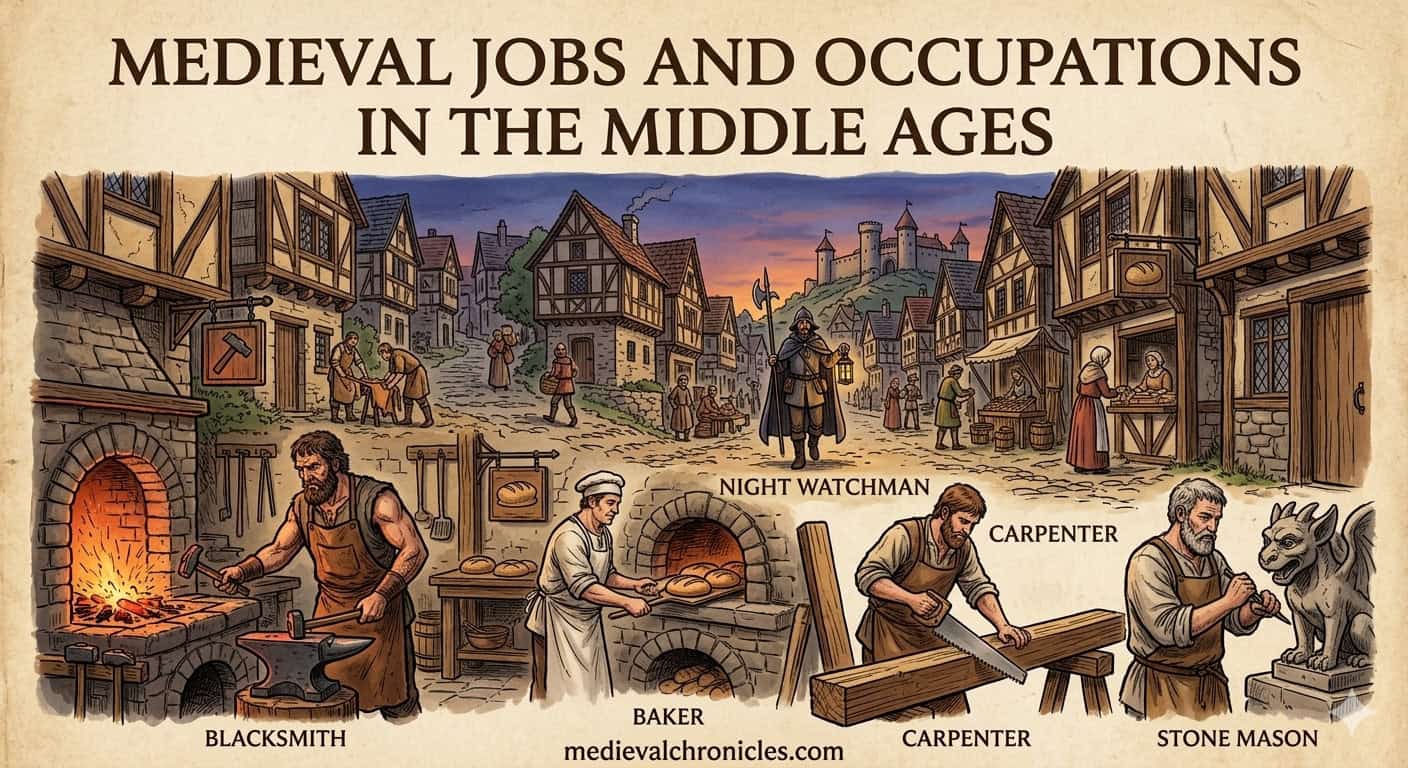
Medieval jobs and occupations shaped everyday life in the Middle Ages (500–1500 CE). Most people worked the land, but medieval society also relied on skilled craftsmen, merchants, soldiers, healers, and sailors. Every profession—from farmers and bakers to knights and scribes—played a role in supporting communities, maintaining castles, and sustaining the medieval economy.
Explore Medieval Job Categories
- Unusual Medieval Jobs – strange and fascinating occupations of the Middle Ages
- Agricultural Work – farmers, beekeepers, and food producers
- Craftsmen & Guild Trades – carpenters, coopers, shoemakers, and artisans
- Town & Market Jobs – bakers, butchers, merchants, and messengers
- Castle & Military Occupations – knights, guards, servants, and castle workers
- Medical & Scholarly Professions – apothecaries, barber surgeons, and scribes
- Maritime Jobs – sailors and ship crews
- Specialized Medieval Occupations – miners, cooks, and other unique professions
Life and Work in the Middle Ages
In medieval Europe, occupations were closely tied to the feudal system, social class, and local communities. Villages depended on agricultural labor, towns supported specialized trades, and castles required workers to maintain defense, administration, and noble households.
This guide explores the wide range of medieval professions that sustained daily life—from essential rural work to skilled urban trades and unusual court positions.
Use the categories to explore how different workers contributed to the economy, society, and culture of the Middle Ages.
Unusual and Interesting Medieval Jobs
Not every medieval occupation was ordinary. Some jobs were strange, uncomfortable, or highly specialized, especially within royal courts, castles, and large households. These unusual roles reveal how complex medieval society really was.
Some of the most surprising professions included roles connected to court life, sanitation, punishment, and specialized service.
Examples of Unusual Medieval Jobs
- Groom of the Stool – a surprisingly influential royal servant responsible for attending to the monarch’s private needs.
- Bizarre Medieval Jobs That Actually Existed – a look at some of the strangest occupations recorded in the Middle Ages.
- The Top 10 Worst Jobs of the Middle Ages – dangerous and unpleasant roles that few people envied.
- Cushy Jobs in Medieval Times – surprisingly comfortable positions within royal courts and noble households.
- The Medieval Executioner – feared yet necessary enforcers of justice in medieval society.

Agricultural Jobs in the Middle Ages
Agriculture formed the foundation of medieval society, with the majority of people living and working in rural communities. Most peasants farmed land owned by a lord or managed small plots within a manorial system, producing food that sustained villages, towns, monasteries, and castles.
Farmers cultivated crops such as wheat, barley, and oats while also caring for livestock including sheep, cattle, and pigs. Agricultural work followed the seasonal rhythm of planting, harvesting, and storing food, making it one of the most demanding but essential occupations of the medieval world.
Alongside farmers were other rural workers who helped process food and maintain agricultural life, ensuring that medieval communities remained largely self-sufficient.
Examples of Agricultural and Rural Jobs
- Medieval Farmers – the backbone of feudal society responsible for producing food.
- Medieval Beekeepers – caretakers of hives who supplied honey and beeswax.
- Medieval Bakers – essential workers producing bread for towns and villages.
- Medieval Butchers – specialists responsible for preparing and selling meat.
- Medieval Village Jobs – an overview of rural occupations in medieval communities.
Craftsmen and Guild Trades
As medieval towns and larger villages expanded, skilled craftsmen became essential to everyday life. These artisans produced tools, clothing, building materials, containers, and countless other goods needed by both rural communities and growing towns.
Many craftsmen belonged to guilds, professional organizations that regulated training, quality standards, and trade practices. Young workers typically began as apprentices, learning their craft under a master before progressing to journeymen and eventually becoming master craftsmen themselves.
Through their skill and labor, craftsmen transformed raw materials such as wood, leather, stone, and metal into practical objects that supported homes, trade, and infrastructure across medieval society.
Examples of Craftsmen and Guild Trades
- Medieval Carpenters – skilled builders responsible for houses, tools, and wooden structures.
- Life of a Medieval Carpenter – insights into the daily work of this essential trade.
- Medieval Shoemakers – artisans crafting footwear for every level of society.
- Medieval Coopers – makers of barrels and storage containers used for food and drink.
- Medieval Wheelwrights – craftsmen who built wagon and cart wheels.
- Medieval Stone Carvers – artists and builders responsible for cathedral and castle decoration.
- Medieval Candle Makers – suppliers of light in an age before electricity.
- Medieval Bowyers – craftsmen who produced bows used in warfare and hunting.
Jobs in Medieval Towns and Cities
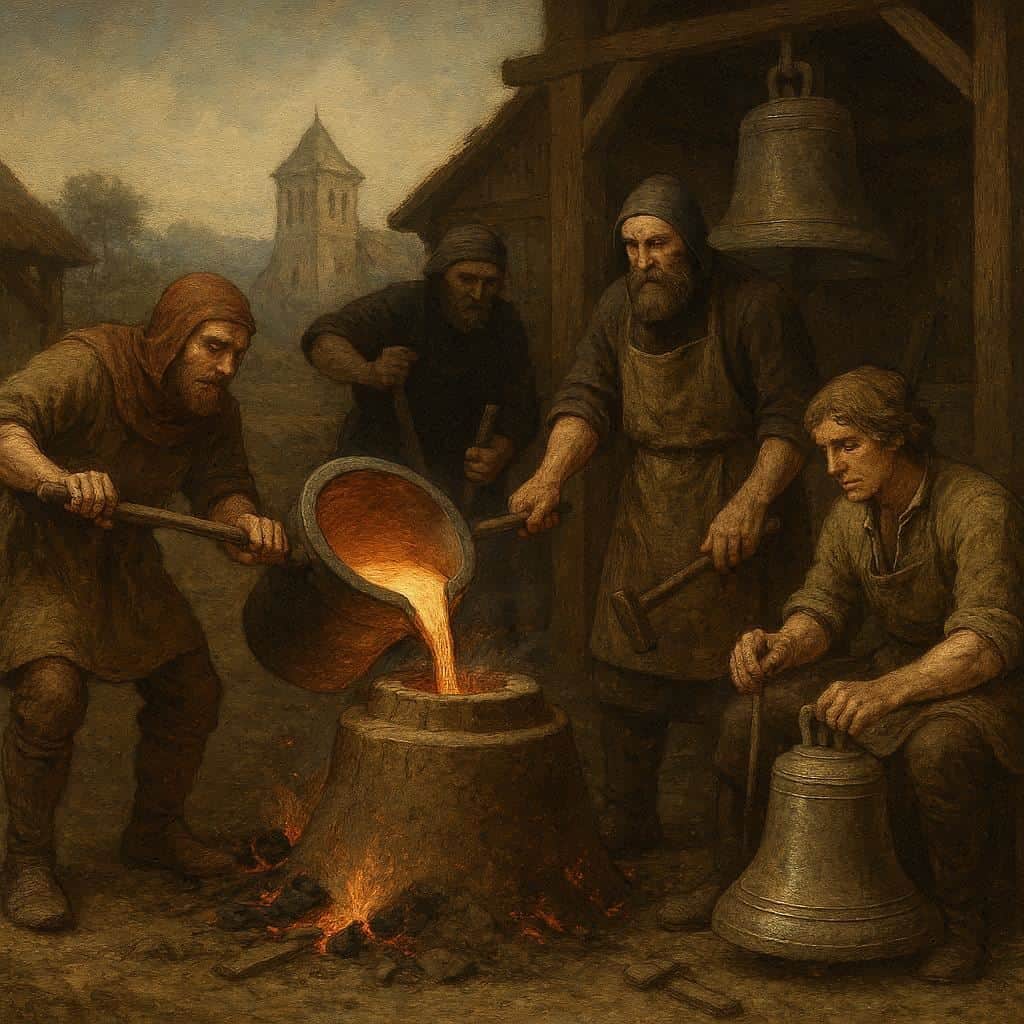
Medieval towns and cities were centers of trade, commerce, and specialized labor. Unlike rural villages, where most people worked in agriculture, urban communities supported a wide range of professions connected to markets, services, manufacturing, and administration.
Workers such as bakers, butchers, merchants, and messengers helped sustain daily life in towns, while larger cities supported even more specialized occupations tied to long-distance trade and growing economies. These professions played an important role in transforming medieval towns into busy centers of economic activity.
As urban populations expanded, occupations became increasingly specialized, and many professions operated under guild systems that regulated training, quality standards, and trade practices.
Examples of Medieval Town Jobs

Why Town Jobs Were Different from Village Work
- Greater specialization – urban workers often focused on specific crafts or services rather than general labor.
- Stronger guild presence – many professions were organized into guilds that regulated training, standards, and trade practices.
- Closer ties to trade and markets – town occupations were closely linked to local marketplaces and regional trade routes.
- More service-based occupations – urban communities required bakers, butchers, merchants, messengers, and other service providers.
Castle and Military Occupations
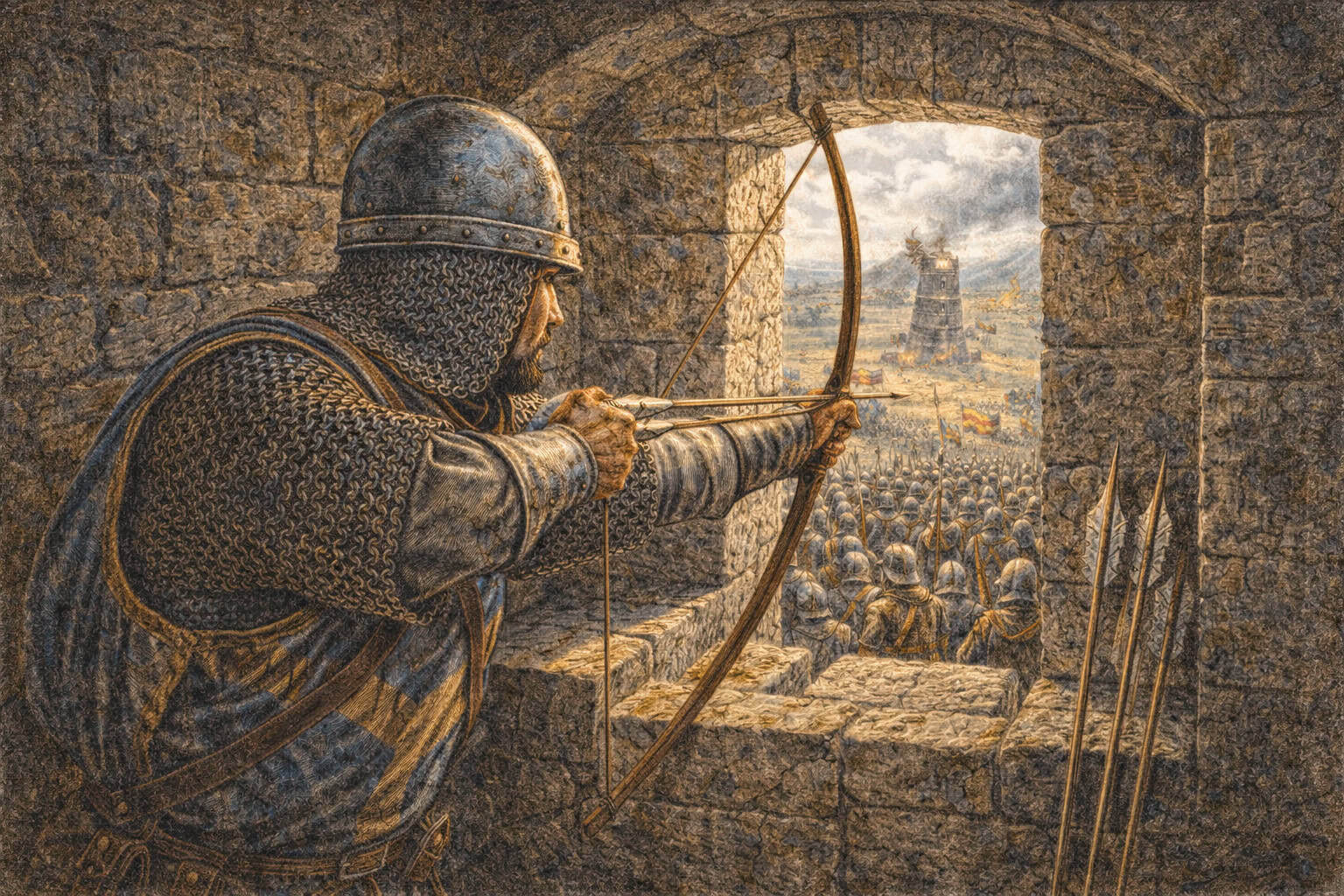
Castles were not only homes for kings and nobles—they were also military, political, and administrative centers. Maintaining a castle required a wide variety of workers, from soldiers and guards to household servants and specialists connected to warfare.
Knights were the most famous military figures of the Middle Ages, but many other occupations supported medieval conflict and castle life. Guards watched walls and gates, engineers and sappers played roles in siege warfare, and servants kept noble households running.
Castle life required organization, discipline, and labor. Even beyond times of war, fortresses depended on workers who managed security, domestic service, and the practical needs of noble residence.
Who Worked in a Medieval Castle?
Armored warriors who defended castles and served their lords in battle.
Soldiers who patrolled walls, gates, and towers to protect the fortress.
Workers who managed kitchens, cleaning, and daily household duties.
Specialists who built defenses and conducted siege operations.
Officials responsible for enforcing justice and carrying out punishments.
Medical and Scholarly Professions
Not all medieval occupations involved farming, building, or warfare. Some roles focused on medicine, learning, and record-keeping, helping preserve knowledge and care for the sick.
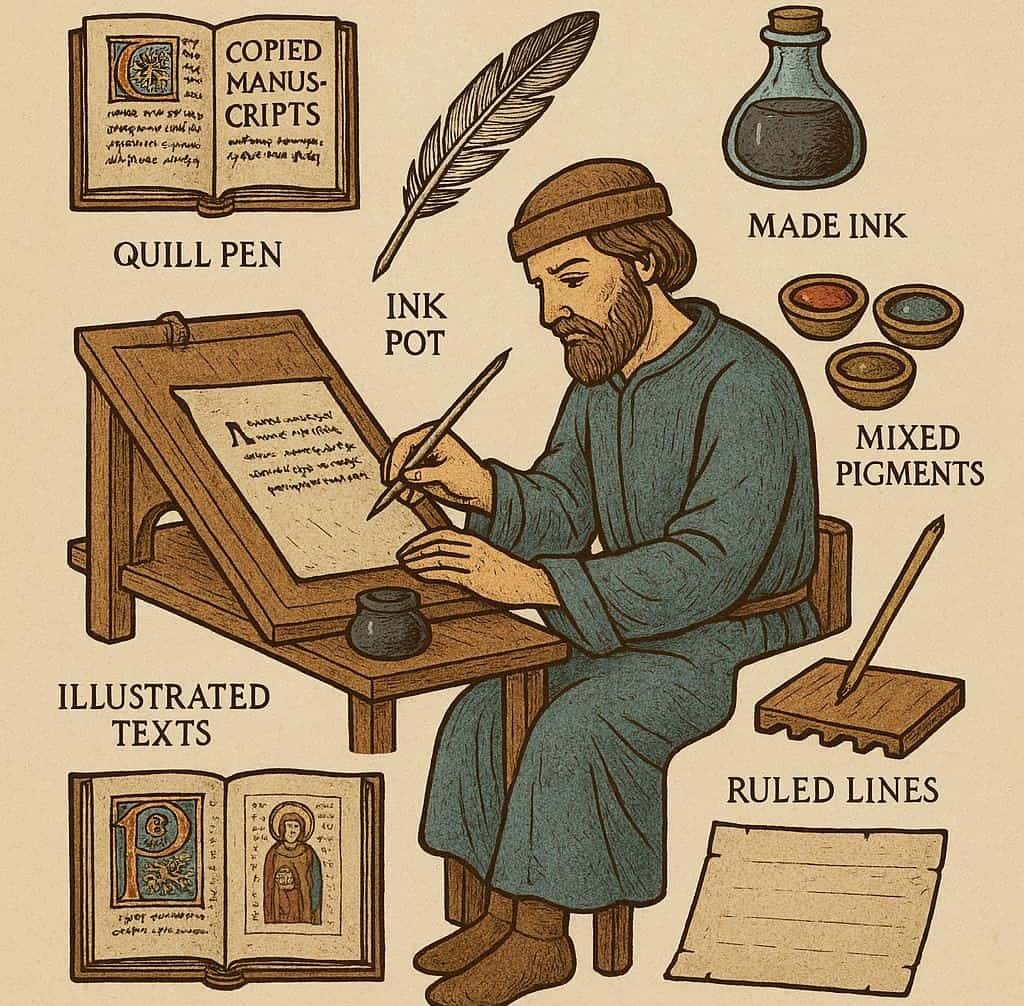
Apothecaries prepared remedies using herbs, minerals, and other substances. Barber surgeons carried out basic medical procedures and personal grooming, while scribes copied manuscripts and recorded important documents. These professions were especially important in monasteries, towns, and noble households.
Though medieval medicine and scholarship were limited by the knowledge of the time, these occupations played a crucial role in preserving learning and supporting medieval communities.
Knowledge and Healing in the Middle Ages
Scholars who copied manuscripts, recorded events, and preserved religious and historical texts.
Early pharmacists who prepared herbal medicines, remedies, and treatments for illness.
Professionals who combined hair cutting with medical procedures such as bloodletting and minor surgery.
Interesting insights into how apothecaries prepared medicines and treated illnesses in medieval communities.
Maritime and Seafaring Occupations
Seafaring was vital to medieval trade and communication. Ships carried goods, merchants, travelers, and news between ports, helping connect different parts of Europe and beyond.
Life aboard a medieval vessel could be dangerous and physically demanding. Sailors and crew members worked in harsh conditions, navigating uncertain weather and long-distance routes. Their labor made maritime trade possible and helped expand the economic reach of medieval kingdoms and cities.
Although maritime jobs were less common than agricultural work, they were essential to the wider medieval economy.
Maritime and Seafaring Jobs in the Middle Ages
Crew members who navigated ships, handled sails, and transported goods and passengers across medieval trade routes.
Various specialized roles aboard vessels, including navigators, deckhands, and crew responsible for maintaining ships during long voyages.
Traders who transported goods between ports and markets, helping expand trade networks across medieval Europe.
Medieval maritime workers played a crucial role in expanding trade networks, transporting goods, and connecting distant ports throughout Europe and beyond.
Specialized Medieval Occupations
Some occupations do not fit neatly into the broader categories of rural work, urban trade, castle life, or medicine. These specialized jobs developed because medieval society required highly specific skills or resources.
Mining, cooking, and other specialized work supported both local communities and wider economic systems. Some of these professions were physically demanding, while others required knowledge, craft, or access to valuable materials.
These jobs remind us that the medieval world was economically diverse, with many professions developing to serve changing needs across the centuries.
Why Medieval Jobs Matter
Understanding medieval jobs and occupations helps us better understand how medieval society functioned. Every profession—from farmers and bakers to knights, merchants, and scribes—played a role in supporting the economy, maintaining social order, and preserving cultural life.
Work in the Middle Ages was closely connected to class, land, religion, and local community, making occupations one of the clearest ways to see how medieval Europe was structured. By studying these jobs, we gain a fuller picture of life beyond kings, castles, and warfare.
Frequently Asked Questions About Medieval Jobs
The majority of medieval people worked in agriculture. Farmers grew crops, raised livestock, and produced food that supported villages, towns, monasteries, and castles.
Most skilled professions were learned through an apprenticeship system. Young workers trained under a master craftsman before becoming journeymen and eventually masters of their trade.
Guilds were organizations of craftsmen or merchants that regulated training, controlled quality standards, and protected the economic interests of members within a specific trade.
Castles required many workers including knights, guards, watchmen, servants, scribes, engineers, and cooks. Each role helped maintain the security and daily operation of the fortress.
Yes. Some occupations were quite unusual, such as the Groom of the Stool, royal attendants responsible for personal duties, or executioners who carried out official punishments.
Yes. Medieval towns supported a wide variety of professions including bakers, butchers, merchants, carpenters, scribes, watchmen, and craftsmen who provided goods and services to urban populations.
Glossary of Medieval Jobs and Occupations
A young worker who trained under a skilled craftsman to learn a trade.
A medieval professional who prepared medicines using herbs, minerals, and other natural ingredients.
A practitioner who combined hair cutting with medical tasks such as bloodletting and minor surgery.
An organization of craftsmen or merchants that regulated training, quality standards, and trade practices.
A trained craftsman who had completed an apprenticeship but had not yet become a master.
The economic system where peasants worked land owned by a lord in exchange for protection and farmland.
A military specialist who dug tunnels beneath castle walls during sieges.
A literate worker who copied manuscripts and recorded important documents.
A guard responsible for patrolling medieval towns at night and maintaining public order.