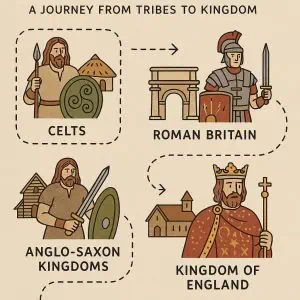
The Domesday Book is a remarkable document that provides a detailed snapshot of England in the late 11th century.

“The Domesday Book is one of the most remarkable documents of medieval England. Its meticulous recording of the landholdings and resources of the country was only possible due to the skills of the surveyors who used sophisticated methods to measure and assess the land.”
Dr. Stephen Baxter, medieval historian and author of “The Earls of Mercia: Lordship and Power in Late Anglo-Saxon England”
It was compiled at the behest of William the Conqueror, who sought to survey his new realm and establish a comprehensive record of land ownership, population, and resources.

While much has been written about the Domesday Book and its historical significance, less attention has been given to the surveying methods and techniques used to produce it.
In this article, we will explore the lost art of medieval surveying and how it contributed to the creation of the Domesday Book.
Surveying Techniques
The Domesday survey was a monumental task that required the collection of data from every corner of England.

Surveyors were dispatched to each county, where they were tasked with recording information about land ownership, land use, population, and resources. To carry out this task, surveyors used a range of tools and techniques that were common in medieval surveying.

“The lost art of medieval surveying was a complex and sophisticated system that involved the use of measuring rods, chains, and compasses. Surveyors had to take into account the curvature of the earth and adjust their measurements accordingly.”
Dr. John Blair, medieval historian and author of “The Church in Anglo-Saxon Society”
One of the primary tools used in medieval surveying was the chain, a long and sturdy rope that was used to measure distances.
The chain was usually 22 yards long, and it was marked with brass rings at one-yard intervals to allow surveyors to accurately measure distances.
Another tool used in medieval surveying was the rod, a long wooden pole that was used to measure areas. Surveyors would walk around the perimeter of a plot of land, using the rod to mark out its boundaries.

Calculations
Once surveyors had collected all the necessary data, it was compiled into a series of records that were then used to create the final Domesday Book.
However, creating these records required a considerable amount of mathematical calculation, which was done using a range of complex formulas and equations.
“The Domesday Book was a tool of royal power that helped William the Conqueror to assert his control over England. The information it provided about land and resources allowed him to tax his subjects more efficiently.”
Dr. David Bates, medieval historian and author of “William the Conqueror”
For example, surveyors would use the area of a plot of land and its estimated value to calculate the amount of tax owed by the landowner.

Social and Cultural Context
The Domesday survey was not simply a technical exercise in data collection; it was also intimately connected to broader social and cultural changes that were taking place in England at the time.
The survey was conducted shortly after the Norman Conquest, and it played a crucial role in consolidating William the Conqueror’s control over the country.

The data collected by the survey was used to establish a standardized system of land ownership and taxation, which helped to cement the power of the Norman aristocracy over the English population.
“The legacy of the Domesday Book and medieval surveying techniques can still be seen today in the boundaries of parishes, manors, and other land divisions. They are a testament to the remarkable skills and ingenuity of medieval surveyors.”
Dr. Christopher Taylor, medieval historian and author of “Village and Parish in Medieval England”
Conclusion
The Domesday Book is an invaluable historical document that provides us with a wealth of information about medieval England. However, it is also a testament to the lost art of medieval surveying, and the technical and mathematical skills required to produce such a comprehensive record.
By understanding the techniques and methods used to create the Domesday Book, we can gain a greater appreciation of the challenges faced by medieval surveyors, and the broader historical context in which the survey was conducted.