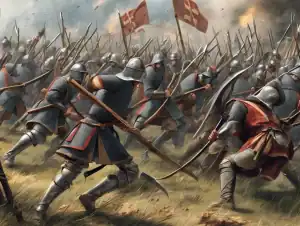
The pike was a formidable pole weapon used extensively by medieval infantry to create defensive formations and fend off cavalry charges. Its impressive length, often reaching up to 18 feet or more, gave foot soldiers a significant advantage in controlling the battlefield. The pike’s use demanded discipline and coordination, playing a key role in the evolution of medieval warfare tactics and helping armies to dominate open-field engagements.

The Pike is a two-handed weapon, rather than a one-handed weapon. Pikes were also known as long spears used for thrusting actions in medieval times, medieval infantry mainly used them. In England soldiers that used Pike, weapons were called Pikemen.
Who used Pike Weapons?
Infantry also known as foot soldiers used Pike weapons, they were also called pikemen in England and various other names in different countries, etc. The pike was a very hard weapon to use and pikemen had to be really strong to be able to lift and control the pike, also different pike formations had to be mastered that became more advanced as military battle tactics advanced.

Pikemen held their pike weapons upright as they marched then lowered them at an angle from the ground up in a defensive formation as the enemy attacked.
Pike weapons were not common in early medieval times but became popular medieval weapons that were commonly used in the high and late medieval periods. The Scots used Pike weapons during the wars of independence, the Flemings who were Germanic Dutch people used them to great effect, and they were effective weapons that kept the enemy at a distance that was used for a long period of medieval history.

Pikemen Armor
Pikemen wore armored protection that consisted of a corselet, breast, and backplates which connected to thigh guards called tassels and they also wore an armored helmet.

Pike Weapon Training
Soldiers that used pike weapons needed to be very strong and soldiers with stocky builds usually made the best pikemen, they would usually pray first thing in the morning followed by stamina and strength training drills practicing various pike formations, they repeated the drills and even practiced their bloodthirsty battle screams.
Pike weapons – medieval battles
Pike weapons were used effectively in many famous medieval battles such as the battle of Bannockburn in 1314 and throughout the Scottish wars of independence. The Flemings who were Germanic people used pike weapons in the battle of the Golden Spurs to great effect.

However as medieval warfare tactical awareness developed opposing armies found ways to defeat the pikemen by using archers, especially crossbowmen to bring down the pikemen from the sides and flanks, they would then attack the remaining pikemen ranks with their own men at arms.

Pike weapons | battle formations
Pikemen were usually packed into tight fighting formations of men that would hold their pike weapons at an angle to create what in effect was a spear or spike wall, this made an attack by mounted Knights and cavalry charges virtually impossible as they would be unable to overcome this wall of steel spikes.

However these tightly packed Pike formations also created their own problems, they left soldiers vulnerable to attack from crossbowmen and longbowmen, any archers could have a field day bringing down soldiers within a pike formation. Pikemen started to wear better Armour to try and nullify these kinds of attacks, but this was still not really effective. The pikemen could then be finished off by knights and foot soldiers.
Defensive positions with pike weapons
It was in defensive positions where the pikemen were most vulnerable to attack from crossbowmen and attacks to their flanks, but the simple spear walls that they could create with pike weapons would keep the enemy at a distance, pikemen would thrust the pole weapons back and forth quickly and the enemy soldiers were kept at a distance and could not use close combat weapons such as swords or battle axes to make any progress.
Taking a defensive position using pike weapons in the pike formation left armies more vulnerable as they had to wait for the enemy’s armies to attack, also armies became wise to the Pike formations and realized that they could take out this static army using Crossbow and longbowmen, however, Medieval soldiers began to adopt aggressive attacking pike formations to counter these new tactics.
Attacking pike formations
There were many battles that were won with the help of pikemen who took the initiative and attacked the enemy aggressively with their pike weapons. This was basically a tightly packed and coordinated infantry charge that showed the enemy a wall of Spikes. However there was a time and place to use these attacking Pike formations and it was usually in narrow confines rather than open spaces so that counter-attacks could not come from the sides and flanks etc.
Using these aggressive Pike weapon formations the Scots were able to overrun a better equipped English army in the battle of Stirling in 1297. Bernese pikemen were also able to overcome the infantry of the Habsburg/Burgundian army in the battle of Laupen in 1339 using attacking pike formations.

Swiss mercenaries and Pike weapons
Towards the end of the late medieval period and into the high medieval period Swiss mercenaries developed a highly-skilled way of fighting using pike weapon formations which involved a disciplined and tactical unity of a very high level. As these soldiers were mercenaries they were able to devote more time to practicing their pike weapon skills as they were paid to do so. They introduced a new pike blocking formation that stopped the vulnerability to attacks of the flanks.
These pike weapon formations were so effective that they were later adopted by the famous German soldiers known as the Landsknechts, who copied the Pike handling of the earlier Swiss mercenaries.

Pike weapons summary
Pike weapons were a very effective weapon used in medieval battles, you could effectively create a wall of Spikes that the opposing armies were unable to get around, however, there were limitations and pikemen were open to attack and particularly vulnerable from attacks from Crossbowman and longbowmen. However, soldiers began to realize that under the right conditions attacking with the pike weapons was more effective than the defensive positions adopted, and taking the battle to the enemy was a more effective way of winning.
The techniques and formations used by pikemen also improved and in later medieval years sophisticated methods of blocking using pike weapon formations were introduced that reduced the vulnerabilities of counter-attacks on the Pike formations considerably, now soldiers were restricted in how they could attack pikemen, especially from the flanks.
Pipe weapons facts
- Pike weapons were heavy and pikemen had to be very strong
- Pike weapons were in effect very long Spears with spikes at the end
- Pipe weapons were long up to 20 feet long and had to be held with two hands
- Pike weapons were wooden poles with some kind of metal spike at the end
- Pike weapons were most effective in tight fighting formations
- Pike formations were vulnerable to attack from archers
- later attacking pike formations were more successful than defensive positions
- Pike weapons were used by pikemen who were footsoldiers
- The Swiss solved the earlier problems and vulnerabilities of Pike formations with blocking techniques
- Many medieval battles such as the battle of Bannockburn owed their victories to pikemen
- Pike formations were difficult to coordinate successfully
- Pike formations were vulnerable to attack from the flanks
- Pike formations would be difficult to maneuver and couldn’t change direction quickly