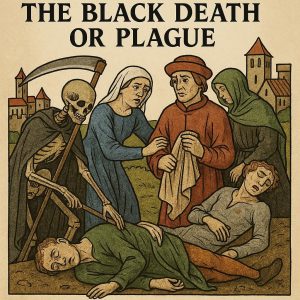
The Black Death, also known as the Bubonic Plague, was one of the deadliest pandemics in human history. Sweeping across Europe between 1346 and 1353, it wiped out an estimated one-third to one-half of the population. The pandemic reshaped medieval society, collapsing economies, shifting power structures, and leaving psychological scars that lasted for generations.

Arrival in Europe: The Genoese Trading Ships
The plague is believed to have arrived in Europe in October 1347 aboard Genoese trading ships returning from the Crimea. When the ships docked at Messina in Sicily, sailors were found dead or gravely ill, covered in dark swellings — the hallmark of the disease.
From these ports, the Black Death spread rapidly along trade routes throughout Italy, France, England, and beyond.

How the Plague Spread
Modern research shows that the bacterium Yersinia pestis was transmitted primarily by fleas carried on black rats. As infected rats died, the fleas sought new hosts — including humans.
Close contact, poor sanitation, and dense populations made towns and cities especially vulnerable.
The disease spread faster than any previous epidemic in Europe, traveling along trade networks by land and sea.
🏙️ Towns and Cities: Perfect Conditions for Disease
Medieval cities were crowded and unsanitary, with open sewers, contaminated wells, and livestock living near humans. People lived in close quarters, making the plague’s transmission almost inevitable once it entered a city.
The result was catastrophic — entire neighborhoods were wiped out, and many urban areas were left half-empty.
💧 Bathing and Hygiene Beliefs
During the Black Death, medieval Europeans held many misconceptions about disease. Some believed that bathing opened the pores and allowed the plague to enter the body.
As a result, many people stopped bathing entirely, believing it would protect them from infection. Ironically, this worsened the general lack of hygiene and may have increased exposure to fleas.
Interestingly, it was during this era that perfumes like Eau de Cologne were developed to mask unpleasant odors, since strong smells were thought to ward off disease.
🕎 Persecution of Jews
In a tragic consequence of fear and ignorance, Jewish communities were blamed for spreading the plague. False rumors claimed they poisoned wells or spread the disease intentionally.
Thousands of Jews were massacred in pogroms, including the murder of 2,000 Jews in Strasbourg in 1349, despite the fact that Jewish populations suffered from the plague as well.
🐀 Fleas: The Real Culprit
It wasn’t until modern science uncovered the truth that the real cause of the Black Death became clear. The flea (Xenopsylla cheopis), a parasite that infested black rats, was the main vector.
When these infected fleas bit humans, they transmitted Yersinia pestis, triggering a fast-spreading and deadly infection.
⚰️ Lasting Impact
The Black Death didn’t just kill millions — it transformed medieval Europe. Labor shortages gave peasants more bargaining power, feudalism began to weaken, and new religious and cultural movements emerged in response to the devastation. It remains one of the defining moments of the Middle Ages, shaping the course of European history for centuries.
❓ Frequently Asked Questions about the Black Death
1. What was the Black Death?
The Black Death, also known as the Bubonic Plague, was a deadly pandemic that swept through Europe between 1347 and 1353, killing millions. It was caused by the bacterium Yersinia pestis.
2. How did the Black Death spread so quickly?
The disease spread primarily through fleas that infested rats, which traveled along trade routes. Poor hygiene and crowded living conditions in medieval towns accelerated transmission.
3. How did medieval people explain the plague?
Many medieval Europeans believed the plague was divine punishment for sins or caused by “bad air” (miasma). Others blamed minority groups such as Jews, leading to tragic persecution.
4. Did the Black Death affect all of Europe equally?
No. Some regions, like Italy and France, suffered immense losses, while others, such as parts of Poland, were relatively less affected due to geography and quarantine measures.
5. What were the long-term effects of the Black Death?
The pandemic led to massive social, economic, and religious changes, including labor shortages, higher wages for peasants, and a decline in the influence of the Church.
🧩 Quiz: How the Black Death Spread
📘 Glossary: Key Terms from the Black Death
Bubonic Plague
The most common form of the plague, caused by the bacterium Yersinia pestis. It was transmitted by fleas and caused swollen lymph nodes called buboes.
Yersinia pestis
The bacterium responsible for the Black Death. It infected fleas that lived on rats, which helped spread the disease throughout medieval Europe.
Pandemic
A disease outbreak that spreads across countries and continents, affecting large numbers of people — the Black Death was one of history’s deadliest pandemics.
Miasma Theory
A medieval belief that diseases like the plague were spread by “bad air” or poisonous vapors, rather than by germs or parasites.
Quarantine
A practice of isolating people or ships to prevent the spread of disease. The word originates from the Italian “quaranta giorni,” meaning forty days.
Flagellant
Members of religious groups who whipped themselves in public as a form of penance, believing it would protect them from the plague’s divine punishment.
Genoese Traders
Merchants from the Italian city of Genoa whose ships carried plague-infected rats and fleas to Europe, spreading the Black Death from Asia in 1347.
Bubo
A painful, swollen lump—usually in the groin, armpit, or neck—caused by infection from the bubonic plague.
Ring Around the Rosie
A children’s nursery rhyme that some historians believe originated from the Black Death, symbolizing symptoms and mass deaths of the plague.