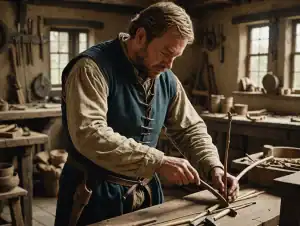
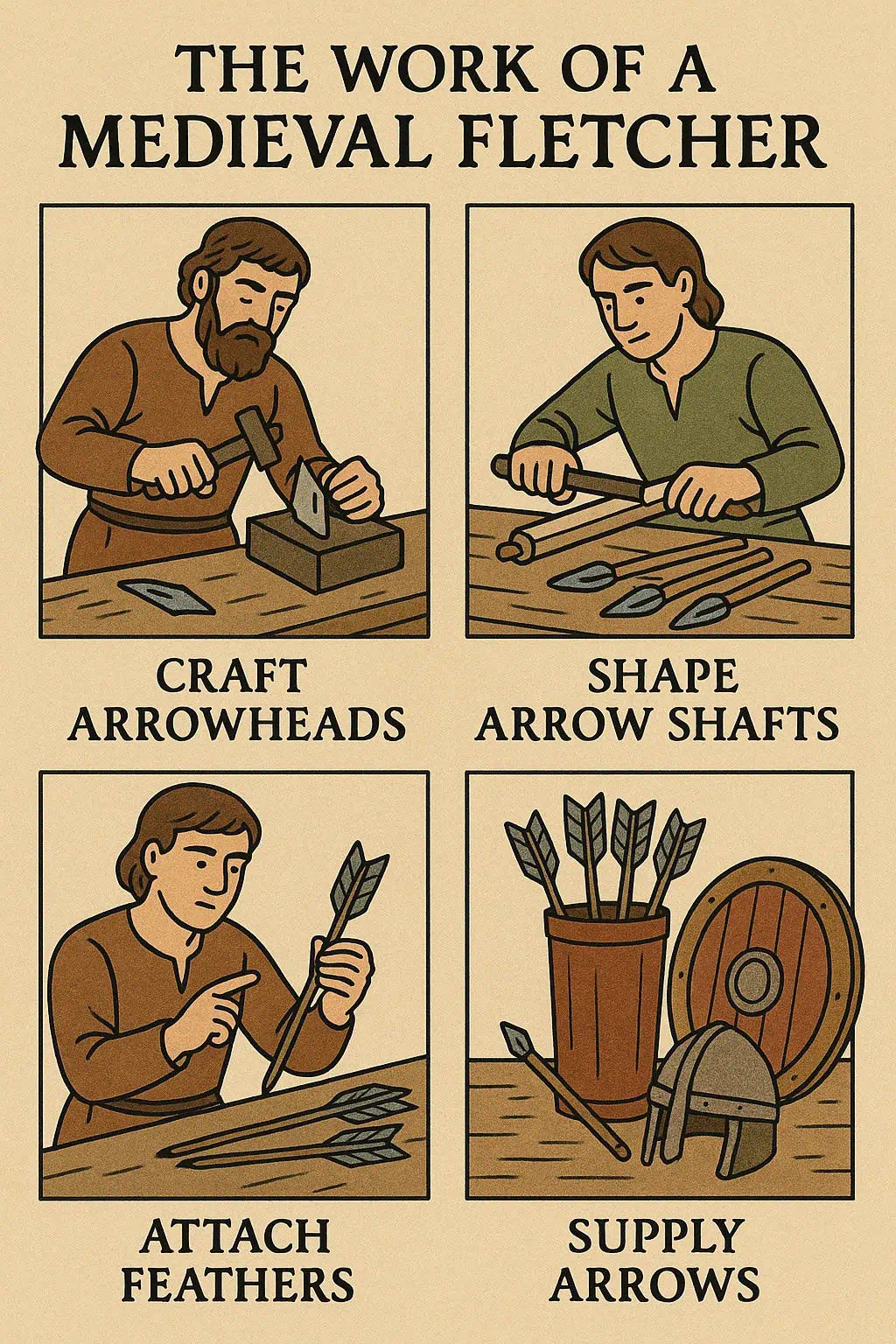
The medieval fletcher was a key figure in the military and hunting life of the Middle Ages, responsible for crafting the arrows that fueled both battle and survival. Using precision tools and fine materials like feather fletchings, wooden shafts, and iron arrowheads,fletchers supplied archers across kingdoms with accurate and deadly projectiles. From castle workshops to village armories, their work ensured that armies were well-equipped and hunters well-prepared. Discover how this often-overlooked artisan shaped the effectiveness of medieval warfare.

This process was especially important during war time, as archers could spend an entire day firing volley after volley into the enemy ranks and needed to have enough arrows in their quiver.

Fletchers were generally one of the most important members of an army, as it was not uncommon for an archer to fire between 12 and 20 arrows per minute if he was in a heated battle.
Medieval Fletcher’s Job
The Medieval fletcher’s job was to create and maintain a supply of arrows. They were usually recruited into armies – one might require ten or so fletchers and their apprentices. The Fletcher used a variety of equipment to fashion arrows.
Bow strings
The medieval fletcher’s tools of the trade included bow strings, arrow shafts, fletching feathers and nocks. Stringers had to make sure that the archer’s bow was strung tightly enough to shoot an arrow but not too tightly as to break or snap it on release.
Shafts were often cut to size with a drawknife before being shaped into arrows by shaping and tapering the wood.

Arrow Heads
The materials of a Fletcher are fairly simple and not too expensive. The tools and equipment used in the process of making arrows include:
- Knives
- Different grades of sandpaper
- Metal files
- Metal saws
- Wooden mallets
- Glue (beech or animal hide)
- Long piece of string or cord to tie arrowhead to shaft (usually linen)
- Straight edge metal rule for cutting arrowheads from sheet stock (iron or steel)
- Paintbrush to apply glue to shafts before attaching heads
Arrowheads themselves could be made out of bronze or steel sheet stock and hammered into shape, usually from a wire template.
They would then be tempered by heating the arrowhead red hot and dunking it into cold water multiple times until it was hard.

Arrow shafts
The shafts of arrows, called shafts, are the most important part of the arrow. A good arrow shaft is made from a durable wood that is straight and free of knots. Arrow shafts can be made from ash or yew.

The length of an arrow shaft affects its weight and how much damage it can do to a target. Extra-long arrows are difficult to handle because they are heavy and slow-moving. On the other hand, short arrows lack distance and power.
Feathers
The feather is the most important part of an arrow. The fletcher would carefully select feathers from a variety of birds and place them in specific positions to create a balanced arrow.
This helped the projectile fly straight and accurate through the air, leading to more successful hunting and war.

Feathers were also used as evidence in criminal cases because they could be traced back to a certain animal or bird species. A well-made arrow could pierce armor too heavy for a sword!
On average, a skilled medieval fletcher could produce anywhere from 12 to 20 arrows in a day. This number could vary significantly. Simple arrows with basic fletching and tips might be produced more quickly, while specialized or ornate arrows, such as those used for hunting or ceremonial purposes, could take longer to craft.
This meant that there were often not enough fletchers during wartime, leading to higher prices when they were commissioned.

Standards
In the early medieval times, bowyers and fletchers were not separate guilds. When Edward III reigned, there was a great demand for bows and arrows. The war between the French and English lasted from 1337 to 1453.
For six hundred years, guilds for bowyers and fletchers had been around.
Medieval Fletcher Summary
A fletcher might use a variety of equipment to fashion arrows.
Common Tools of The Fletcher
Broad Head
Gut String
Feathers
Wood Shafts
Arrowheads
To create arrows they had to work closely with bow makers who would supply them with the right materials.A Fletcher needed to be a skilled craftsman as they used many different materials and techniques to make an arrow.There were also times when a fletcher might have been recruited by an army and required ten or so fletchers and their apprentices.
Also see our article on medieval bowyers.
🏹 Frequently Asked Questions: The Medieval Fletcher
What was a medieval fletcher?
A fletcher in medieval times was a skilled craftsman responsible for making arrows. The term comes from the French word flèche, meaning “arrow.” Fletchers worked alongside bowyers (bow makers) to supply essential weapons for hunting, warfare, and archery practice.
How did fletchers make arrows?
Fletchers crafted arrows by attaching goose or swan feathers to wooden shafts, securing them with glue and thread. The arrowheads, often made by blacksmiths, were then fitted and reinforced to ensure accuracy and penetration in battle or hunting.
What materials did fletchers use?
Common materials included ash, birch, or poplar wood for the shafts, goose feathers for fletching, and iron or steel for arrowheads. Glue from animal hide and fine linen thread were used to bind the components securely.
Were fletchers important to medieval warfare?
Yes — fletchers were essential to medieval armies. A steady supply of arrows was vital for longbowmen and crossbowmen. During major conflicts like the Hundred Years’ War, skilled fletchers ensured that archers had reliable ammunition for extended campaigns.
Did fletchers belong to guilds?
By the late Middle Ages, fletchers often joined craft guilds, particularly in large towns like London and York. These guilds regulated quality, training, and trade, protecting both the reputation and livelihood of skilled artisans.
What was the difference between a bowyer and a fletcher?
The bowyer made the bows, while the fletcher made the arrows. Both trades were crucial and often worked closely together, but their skills were distinct and specialized — one focused on flexibility and tension, the other on balance and precision.
Are there modern fletchers today?
Yes! Traditional fletching is still practiced today by historical reenactors, craftsmen, and archery enthusiasts. Some even use authentic medieval techniques and materials to recreate period-accurate arrows for museums or living history events.
🏹 Perfect Quiz: The Medieval Fletcher
🏹 Glossary: Medieval Fletcher – The Skilled Arrow Maker
Shaft
The long wooden body of an arrow, typically made from ash, birch or poplar, selected for straightness and strength.
Fletching
The arrangement of feathers (usually goose or swan) attached to the arrow shaft to stabilize its flight.
Nock
The notch at the rear end of the arrow shaft that fits onto the bowstring, allowing proper release and accuracy.
Arrowhead
The metal tip of an arrow, often forged from iron or steel by a blacksmith, designed for penetration or hunting purpose.
Glue & Thread Binding
The process by which fletchers used animal-hide glue and fine linen thread to attach feathers and secure arrow components.
Craft Guild
An organisation of skilled tradesmen in medieval towns, including fletchers, that controlled apprenticeship, quality and trade standards.
📜 References & Historical Sources
The following sources were consulted to ensure historical accuracy and authenticity in researching the craft, tools, and social role of the medieval fletcher (arrow maker):
- The British Museum – Medieval Trades and Tools Collection
- Historic England – Medieval Guilds and Craftsmanship
- Current Archaeology – Medieval Weaponry and Archery Artisans
- The Met Museum – Arms and Armor of the Middle Ages
All historical details have been cross-referenced with museum archives and reputable heritage databases. Content aims to preserve the accuracy and context of medieval craftsmanship as featured on Medieval Chronicles.