What Were Medieval Songs?
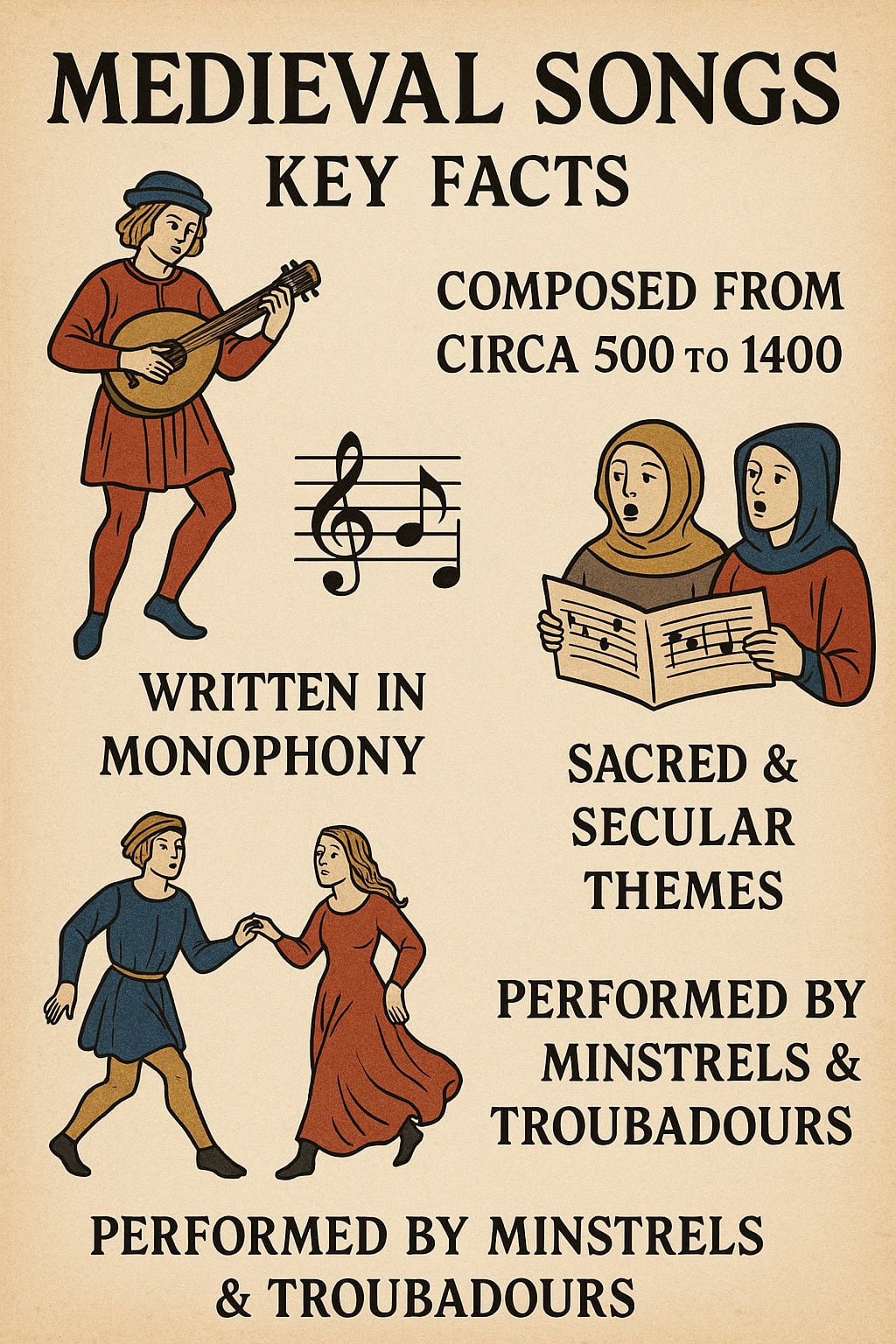
Medieval songs were vocal musical compositions created and performed in Europe during the Middle Ages (c. 500–1500). They played an essential role in religious worship, storytelling, entertainment, and the preservation of history. In a largely illiterate society, songs helped convey religious teachings, heroic legends, and cultural values.
Throughout the medieval period, music evolved significantly. Early medieval songs were dominated by sacred traditions linked to the Christian Church, while later centuries saw the flourishing of secular medieval music performed by minstrels, troubadours, and court musicians.
Early Medieval Songs and Religious Music
The dominance of sacred music
Early medieval music was overwhelmingly religious in nature. The Christian Church was the primary patron of music, and monasteries served as centres of musical composition and performance.
Religious medieval songs were used to:
- Accompany worship services
- Teach scripture
- Mark religious festivals
- Enhance liturgical drama
Because monasteries preserved written notation, much of what survives from early medieval music comes from religious contexts.
🎶 Click to Reveal: Medieval Songs Explained
What Were Medieval Songs?
Medieval songs were vocal musical compositions used for worship, storytelling, and entertainment throughout Europe during the Middle Ages.
Why Was Religious Music So Important?
The Christian Church was the main patron of music, using songs to teach scripture, enhance worship, and mark religious festivals.
What Is Gregorian Chant?
Gregorian chant is a monophonic style of sacred music sung in Latin, forming the foundation of early medieval church music.
When Did Secular Songs Become Popular?
From the 10th century onward, secular medieval songs grew in popularity as courts, towns, and travelling musicians expanded.
Who Performed Medieval Songs?
Medieval songs were performed by monks, clerics, troubadours, trouvères, minstrels, and professional court musicians.
What Were Common Song Themes?
Popular themes included religion, courtly love, chivalry, heroic deeds, and important historical events.
Why Are Medieval Songs Important Today?
Medieval songs laid the foundations for Western music, influencing harmony, notation, and later musical traditions.
Gregorian Chant
What was Gregorian chant?
Gregorian chant was the most important musical tradition of the early Middle Ages. It was a form of monophonic (single-line) vocal music sung in Latin as part of Christian worship.
Key features of Gregorian chant:
- Sung without instrumental accompaniment
- Performed by monks or clergy
- Used free-flowing rhythms
- Closely tied to biblical texts
Gregorian chant laid the foundation for later developments in Western music, including harmony and polyphony.
Liturgical Drama and Sung Storytelling
In addition to formal worship, medieval songs were used in liturgical drama, especially from the 10th century onward. These performances dramatized stories from:
- The Bible
- The lives of saints
- Major religious events such as Easter and Christmas
Music allowed these stories to be understood by audiences who could not read Latin or written texts.
The Rise of Secular Medieval Songs
When did secular songs become popular?
From around the 10th century onward, secular medieval songs became increasingly prominent. This shift reflected changes in society, including:
- The growth of noble courts
- Increased travel and cultural exchange
- The rise of professional entertainers
Unlike religious music, secular songs were often performed in vernacular languages rather than Latin and focused on everyday themes.
Themes of Secular Medieval Songs
Popular subjects included:
- Courtly love
- Chivalry and knighthood
- Heroic legends
- Historical events
- Satire and humour
These songs were commonly performed by troubadours, trouvères, minstrels, and jongleurs, who travelled between courts, towns, and villages.
Types of Medieval Songs
Musical forms and styles
As musical notation and theory developed, medieval songs became more complex.
Important types of medieval songs included:
- Conductus – A rhythmic Latin song, often sung by one or more voices
- Canso – A lyric song of courtly love performed by troubadours
- Sequentia – A chant sung during the Mass
- Motet – A polyphonic composition with multiple vocal lines
- Cantigas – Devotional songs written in vernacular languages
Cantigas de Santa Maria
One of the most famous medieval song collections is the Cantigas de Santa Maria, compiled in the 13th century under King Alfonso X of Castile.
These songs:
- Praise the Virgin Mary
- Are written in Galician-Portuguese
- Include musical notation
- Offer insight into medieval devotion and daily life
Famous Medieval Songs and Epics
The Song of Roland
The Song of Roland is one of the most famous medieval epic poems. Though often recited or sung, it survives today primarily as a literary work.
It tells the story of:
- Charlemagne’s campaigns
- Heroic sacrifice
- Loyalty and honour
Such songs played a crucial role in shaping medieval ideals of heroism and kingship.
Famous Medieval Songwriters and Composers
Important figures in medieval music
Several composers left a lasting mark on medieval song and music.
- Hildegard of Bingen – A German abbess who composed monophonic sacred songs in Latin
- Pérotin – A leading figure of the Notre Dame School, known for developing polyphony
- Guillaume de Machaut – A 14th-century composer who blended sacred and secular traditions
Their work represents the increasing sophistication of medieval musical composition.
Did You Know?
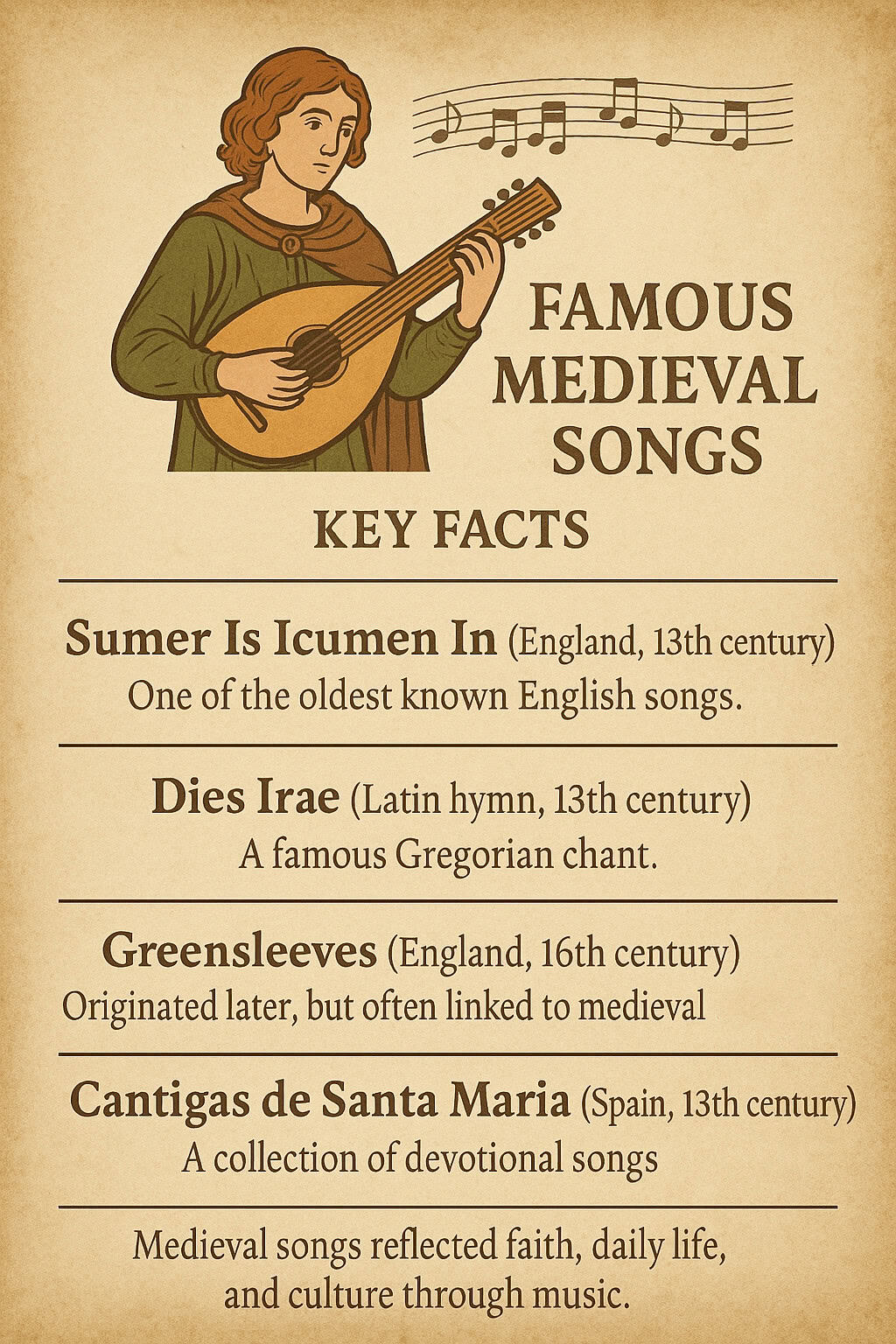
“Greensleeves” is often thought to be a medieval song, but it is not. The famous melody dates to the late 16th century and belongs to the Renaissance period, after the Middle Ages had ended. Its musical style reflects developments in harmony and composition that were unknown in medieval music.
Social Status of Medieval Musicians
How were musicians viewed?
The social status of medieval musicians varied widely.
- Church musicians (monks and clerics) were respected and well-supported
- Court musicians enjoyed noble patronage
- Travelling entertainers often had low social status and depended on generosity
While some secular musicians struggled socially, music itself was highly valued, especially by the Church and nobility.
Instruments and Performance
Although many medieval songs were vocal, instruments were often used, especially in secular contexts.
Common instruments included:
- Harps
- Lutes
- Flutes
- Drums
- Vielles (early fiddles)
Instruments accompanied singing or were used in purely instrumental performances.

The Legacy of Medieval Songs
Why medieval music still matters
Medieval songs laid the foundations for Western musical tradition. Innovations in notation, rhythm, and harmony influenced later Renaissance and modern music.
The legacy of medieval songs can still be seen in:
- Church music traditions
- Folk music structures
- Classical composition techniques
- Modern choral music
In Summary
Medieval songs were central to religious worship, entertainment, and cultural life throughout the Middle Ages. From the sacred chants of monasteries to the lively secular songs of troubadours, medieval music evolved alongside society itself. Despite social challenges faced by musicians, their work shaped the musical traditions that followed and continues to influence music today.
❓ Medieval Songs – Frequently Asked Questions
What were medieval songs?
Medieval songs were vocal musical compositions used for worship, storytelling, and entertainment during the Middle Ages.
Were medieval songs mostly religious?
Early medieval songs were mainly religious, but secular songs became increasingly popular from the 10th century onward.
What is Gregorian chant?
Gregorian chant is a form of monophonic sacred song sung in Latin as part of Christian worship.
Who performed secular medieval songs?
Secular songs were performed by troubadours, trouvères, minstrels, and jongleurs.
What languages were medieval songs sung in?
Religious songs were usually sung in Latin, while secular songs were sung in local vernacular languages.
What is polyphony?
Polyphony is a musical style using multiple independent vocal lines, developed in the Middle Ages.
Are famous medieval songs still known today?
Yes. Works like Gregorian chant and The Song of Roland remain important cultural and historical sources.
Why are medieval songs important?
They preserved history, religious belief, and cultural identity in a largely oral society.
🎵 Medieval Songs Quiz
📜 Glossary of Medieval Song Terms
Gregorian Chant
Monophonic sacred song used in Christian worship.
Secular Song
A non-religious song focusing on love, history, or entertainment.
Polyphony
Music composed of multiple independent vocal lines.
Troubadour
A poet-musician who performed secular songs in medieval courts.
Conductus
A rhythmic Latin song sung by one or more voices.
Motet
A polyphonic composition developed in the Middle Ages.