The Crusades were a series of religious wars sanctioned by the medieval Church between the late 11th and 15th centuries. Their main purpose was to reclaim Jerusalem and the Holy Land from Muslim control and to defend Christian pilgrims traveling to sacred sites.
The Crusading era began in 1095, when Pope Urban II called upon knights across Europe to take up arms in the First Crusade. Over the following centuries, multiple expeditions were launched to the eastern Mediterranean, as well as later campaigns in Spain, the Baltic, and Eastern Europe. While the classical Crusades to the Holy Land ended with the fall of Acre in 1291, the crusading spirit endured for centuries afterward.

🛡️ The Rise of Religious Knighthood
During the Crusades, the ideals of chivalry—the moral and social code that guided medieval knights—became deeply intertwined with faith and holy warfare.
Knighthood evolved from a purely military role into one with a spiritual and moral purpose, transforming the knight into a Christian warrior devoted to God as well as to his feudal lord.
Several military orders were founded to protect pilgrims and defend Christian territories:
- The Knights Templar (founded c. 1119)
- The Knights Hospitaller (Order of St. John)
- The Teutonic Knights (established c. 1190)
These brotherhoods of warrior-monks combined monastic vows of poverty, chastity, and obedience with military service. Their mission was to guard pilgrims, secure routes to Jerusalem, and wage holy war in defense of the faith.

✝️ The Spiritualization of Chivalry
Before the Crusades, chivalry had already emerged in the 11th century as a code of honor, loyalty, and courage among European knights.
The Crusades reinforced and spiritualized this code, adding new ideals of piety, mercy, and devotion to God.
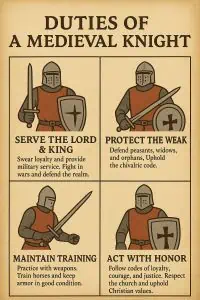
Knights were now called to fight not for personal gain but for righteous causes—to defend the Church, protect the weak, and serve divine justice.
Sermons and Church councils described the knight’s sword as an instrument of faith, meant to protect Christendom and uphold peace under God.
Although not every knight lived by these ideals—many acted from ambition or greed—the concept of the Christian knight became a powerful symbol in medieval culture. The Code of Chivalry came to represent the union of warrior valor and moral virtue.
⚜️ Did You Know?
The First Crusade was launched in 1095 after Pope Urban II’s call at the Council of Clermont, where he urged knights to take up arms to reclaim the Holy Land from Muslim control.
🕊️ Ideals and Contradictions
In theory, chivalric knights were expected to:
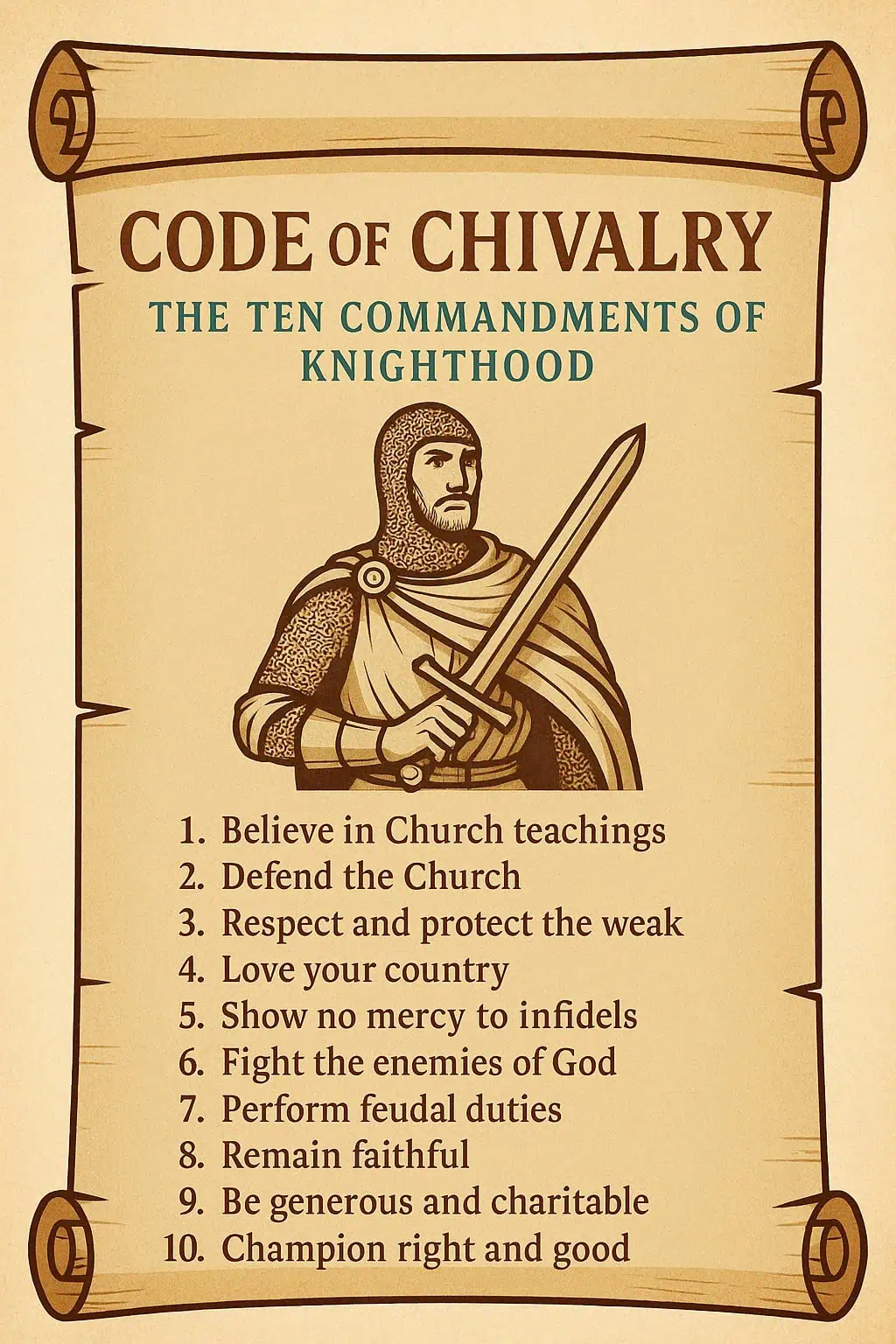
- Defend the Church and the Christian faith
- Protect the weak, widows, and orphans
- Show mercy to defeated foes
- Live honorably and faithfully serve their lords
In reality, the Crusades revealed stark contrasts between ideal and action. Some campaigns led to atrocities, such as the sack of Jerusalem in 1099, showing how easily religious zeal could turn to violence.
Still, the moral language of chivalry—valor, justice, piety, and humility—continued to inspire poets, chroniclers, and reformers throughout the Middle Ages.
⚜️ Did You Know?
The Knights Templar were both monks and warriors. Founded around 1119, they took vows of poverty, chastity, and obedience — yet became one of the most powerful and wealthy orders in medieval Europe.
🏰 The Legacy of the Crusading Knight
By the end of the 13th century, crusading fervor was fading. The rise of gunpowder, professional armies, and new political powers changed the face of warfare. Yet the image of the knight-crusader—a man of courage, faith, and devotion—endured in legend and literature.
The Crusades left a profound legacy: they helped shape Europe’s religious identity, strengthened ties between chivalry and Christianity, and defined the ideal of the noble warrior who fights for justice and God.

⚜️ Did You Know?
Chivalry during the Crusades emphasized religious duty as much as battlefield courage. Knights believed their service in war could earn spiritual salvation — a fusion of faith and valor unique to the medieval world.
⚜️ Summary
- The Crusades began in 1095 and continued in various forms until the 15th century.
- They sought to reclaim Jerusalem and defend the Christian faith.
- The Knights Templar, Hospitaller, and Teutonic Knights arose to protect pilgrims and holy lands.
- The Code of Chivalry was deepened and spiritualized through crusading ideals.
- Though often flawed in practice, these values influenced medieval ethics and European culture for centuries.
⚜️ Frequently Asked Questions about Chivalry and the Crusades
What were the Crusades?
The Crusades were a series of religious wars fought between the 11th and 15th centuries, launched by the Church to reclaim the Holy Land from Muslim control and protect Christian pilgrims.
When did the Crusades begin and end?
The first Crusade began in 1095 after Pope Urban II’s call at the Council of Clermont. The main Crusades to the Holy Land ended with the fall of Acre in 1291, though later campaigns continued into the 15th century.
Who were the Knights Templar?
The Knights Templar were a military and religious order founded around 1119. They protected pilgrims and fought in the Holy Land, combining monastic vows with military service.
How did the Crusades influence the Code of Chivalry?
The Crusades helped to spiritualize chivalry, linking knighthood with Christian devotion and reinforcing the duty to protect the Church, the weak, and the faith.
Did all knights follow the Code of Chivalry?
Not always. While many knights aspired to live by the code’s ideals of honor, faith, and justice, others were motivated by power or wealth. The code was an idealized moral standard, not a legal rule.
What were the main knightly orders of the Crusades?
The three most famous orders were the Knights Templar, the Knights Hospitaller, and the Teutonic Knights, all dedicated to defending Christian pilgrims and territories.
How did the Crusades shape medieval Europe?
The Crusades expanded trade, cultural exchange, and religious identity across Europe. They also helped define the ideal of the Christian knight as a defender of faith and honor.
🧠 Test Your Knowledge: Chivalry and the Crusades
📚 Further Reading & Resources
- Encyclopedia Britannica – The Crusades
A comprehensive overview of the Crusades, their causes, campaigns, and long-term impact on Europe and the Middle East. - BBC History Extra – What Were the Crusades?
A readable and balanced summary of the Crusades’ motivations, outcomes, and myths. - National Geographic – The Crusades: Religion and War
A richly illustrated account exploring how religion, power, and faith shaped the Crusading world. - Metropolitan Museum of Art – The Crusades (Timeline of Art History)
Explores the art, armor, and symbolism of crusading knights and their influence on medieval culture.