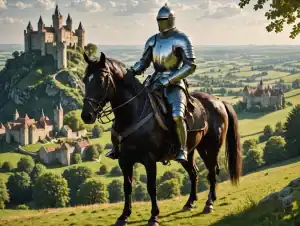
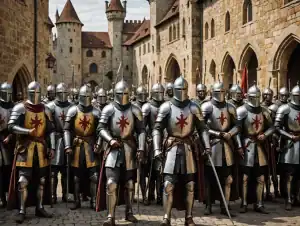
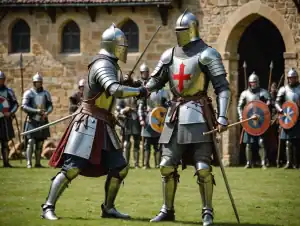
The medieval period, lasting from the 5th to the 15th century, saw the rise of knights as elite warriors and protectors of lands and kingdoms. From a young age, knights were trained in combat skills, including swordsmanship, horsemanship, and battlefield strategy. Over the centuries, their armor and weapons evolved to meet changing warfare techniques, while knights upheld the code of chivalry, emphasizing honor, loyalty, and courage. Medieval knights played a crucial role in defending territories, participating in tournaments, and serving their lords with discipline and skill.
“The knight was the epitome of the medieval warrior, embodying the ideals of chivalry, courage, and martial prowess.”
Richard W. Kaeuper, Professor of History at the University of Rochester and author of numerous books on medieval chivalry and warfare.

In this article, we will explore the different types of knights and their roles in society, as well as the development of their armor and weapons over time.
From the chain mail of the early medieval period to the full plate armor of the late medieval period, we will delve into the evolution of knightly equipment and its significance in the history of medieval Europe.
Early Medieval Period (5th century to 11th century)
5th to 7th century: Migration Period; Germanic and Celtic warriors use chain mail, helmets, and shields.

8th to 11th century: Carolingian Empire; knights wear chain mail with reinforced leather, conical helmets, and carry a sword and a shield.

High Medieval Period (11th century to 13th century)
11th century: Norman Conquest of England; knights wear mail hauberks, kite-shaped shields, and carry swords and spears.
“The rise of the knightly class in the Middle Ages was one of the most significant developments in the history of Western Europe.” –
John France, Emeritus Professor of History at Swansea University and author of several books on medieval warfare and society.

12th century: Crusades; knights wear mail hauberks, surcoats with coats of arms, great helms, and carry swords, lances, and maces.

13th century: Knights Templar and Teutonic Knights; knights wear plate armor, great helms, and carry swords, lances, and battle axes.

Late Medieval Period (14th century to 15th century)
14th century: Hundred Years’ War; knights wear full plate armor, including plate chausses, gauntlets, and breastplates, and carry swords, lances, and war hammers.
“Knights were a product of their society, and their values and behaviors reflected the social and cultural norms of medieval Europe.”
Kelly DeVries, Professor of History at Loyola University Maryland and author of several books on medieval warfare and chivalry.

15th century: Wars of the Roses; knights continue to wear full plate armor, but with more emphasis on decoration and heraldry. The longsword becomes the primary weapon, with the use of firearms starting to become more prevalent.
“The medieval knight was more than just a warrior; he was a symbol of social and political power, a representative of his lord, and a guardian of the Christian faith.”
Matthew Strickland, Professor of Medieval History at the University of Glasgow and author of numerous books on medieval warfare and society.

Note: It’s worth noting that the exact dates and developments of knightly armor and weaponry varied across different regions of medieval Europe. This timeline is intended to provide a general overview.


The medieval knight was a complex figure, embodying both the ideals of chivalry and the harsh realities of feudal society.
Susan B. Edgington, Emeritus Professor of Medieval History at Queen Mary University of London and author of several books on medieval chivalry and culture.
Great Books about the Timelines of Medieval Knights
“The Knight in History” by Frances Gies
This classic work provides an overview of the evolution of the knight from its origins in the Roman
Empire to the decline of chivalry in the late Middle Ages.
“Medieval Warfare: A History” by Maurice Keen – This book provides a detailed examination of the development of medieval warfare, including the role of knights on the battlefield.
“Chivalry” by Maurice Keen
This book explores the ideals of chivalry that shaped the behavior of knights in the Middle Ages, including their duties to God, their lord, and their lady.
“Knights: In History and Legend” by Constance Brittain Bouchard
This book provides a comprehensive overview of the history of knights, their social and cultural significance, and their portrayal in literature and legend.
“The Knight and Chivalry” by Richard Barber
This book examines the cultural and social context of chivalry and the knightly class, including their origins, their role in society, and their decline in the late Middle Ages.
Frequently Asked Questions About the Evolution of Medieval Knights
When did knights first appear in medieval Europe?
Knights emerged during the early medieval period, around the 9th and 10th centuries, as mounted warriors serving lords and kings.
How did knight armor evolve over the centuries?
Armor evolved from simple chainmail in the early medieval period to full plate armor by the late Middle Ages, improving protection and mobility.
What changes occurred in knights’ weapons?
Knights’ weapons progressed from swords, lances, and axes to more specialized equipment like maces, polearms, and crossbows as warfare advanced.
Did the role of knights change over time?
Yes, knights shifted from purely military roles to also performing administrative, ceremonial, and policing duties within their lord’s territories.
How did training evolve for knights?
Training began as pages and squires, focusing on combat skills and horsemanship. Over time, training became more formalized, including tournaments and strategy.
What is the code of chivalry and did it change?
The code of chivalry emphasized honor, loyalty, and courage. Over centuries, its interpretation adapted to social, religious, and military changes.
Were all knights wealthy landowners?
No, some knights were retainers or professional warriors who served a lord without holding significant lands themselves.
How did tournaments influence knight evolution?
Tournaments helped knights refine combat skills, test new weapons and armor, and gain prestige, shaping both martial and social aspects of knighthood.
Did knights’ roles continue after the medieval period?
By the late Middle Ages, knights’ military importance declined, but their social and ceremonial roles continued in orders and chivalric traditions.
How did the hierarchy of knights evolve?
The hierarchy evolved with ranks like page, squire, Knight Bachelor, and Knight Banneret, with higher honors granted for battlefield merit or royal favor.