Medieval chronicles are among the most important sources we have for understanding the Middle Ages. Long before modern history books existed, chroniclers carefully recorded wars, rulers, disasters, political struggles, and religious events — often as they unfolded.
These records shaped how entire generations understood their world, and today they remain essential tools for historians trying to reconstruct the past.
But what exactly qualifies as a medieval chronicle, who wrote them, and why are they still so valuable centuries later?
This guide explains everything you need to know.
Medieval Chronicles — Simple Definition
Medieval chronicles are chronological historical records written during the Middle Ages that document important political, religious, and social events. They were typically composed by monks, scholars, or royal scribes, providing some of the most valuable firsthand insights into medieval history.
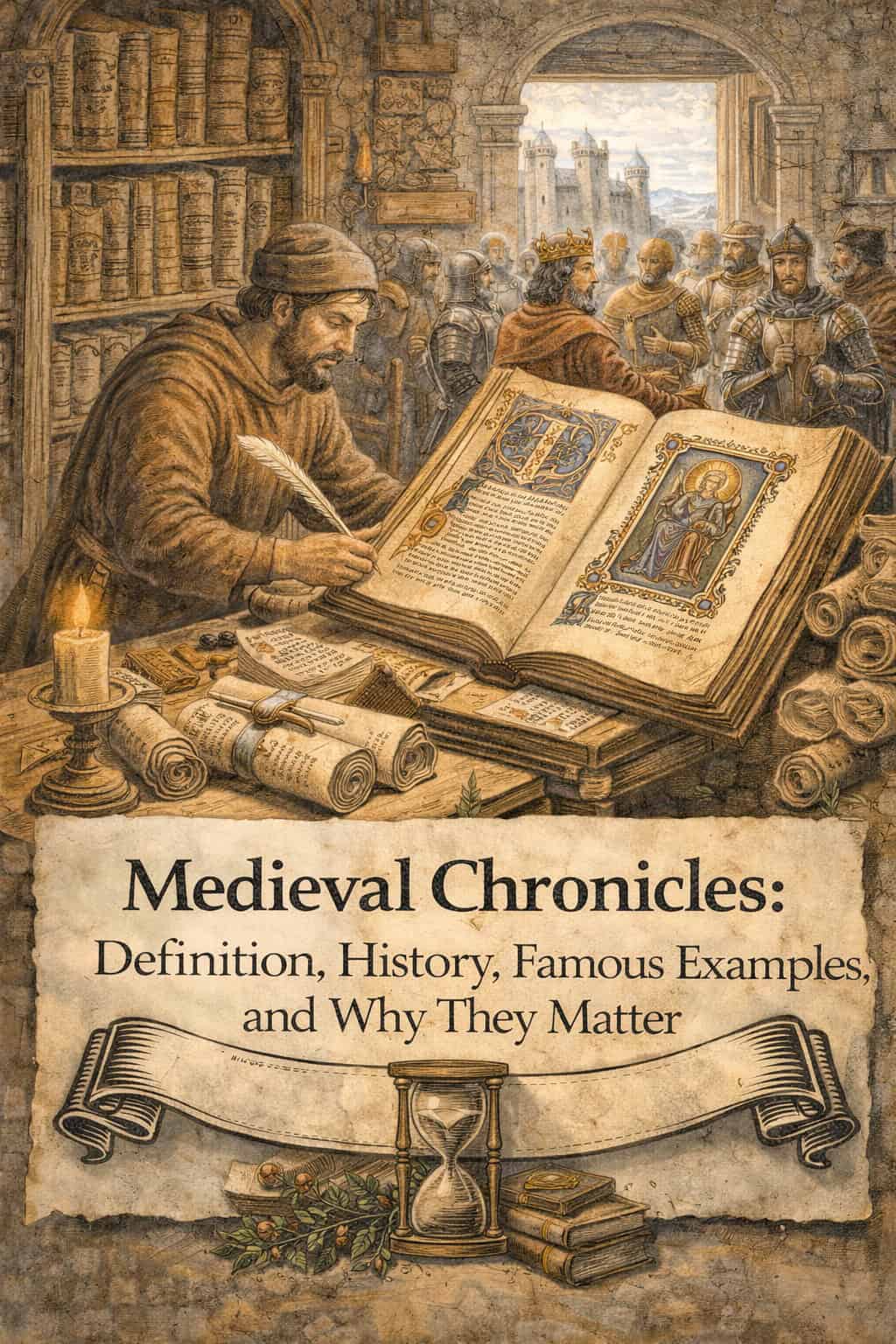
What Are Medieval Chronicles?
At their simplest, medieval chronicles are historical accounts written during the Middle Ages that document events in chronological order, typically year by year.
The term chronicle comes from the Greek word chronika, meaning “records arranged by time.”
Unlike modern historical works, chronicles usually did not attempt deep analysis. Instead, they focused on preserving a timeline of important events.
A typical entry might look something like:
“In this year, a great famine struck the land, and many perished.”
Short. Direct. Focused on memory rather than interpretation.
Without these records, huge portions of medieval history would be completely unknown.
Key Characteristics of Medieval Chronicles
Although medieval chronicles varied across regions and centuries, most shared defining characteristics that shaped how history was recorded and understood.
Chronological Structure
Events were recorded sequentially rather than grouped by theme. This structure created continuity and allowed future readers to trace political, religious, and social change over time.
Written by Educated Observers
Most chroniclers belonged to the small literate population. Many were:
- Monks
- Clergy
- Royal scribes
- Court historians
- Scholars
Because monasteries safeguarded literacy, they became some of medieval Europe’s earliest historical archives.
Focus on Major Events
Chroniclers prioritized developments they believed were historically significant, including:
- Wars and invasions
- Royal successions
- Religious conflicts
- Natural disasters
- Plagues
- Political alliances
Everyday life appeared less frequently unless it intersected with major crises.
A Blend of Fact and Belief
Medieval writers did not separate the natural from the supernatural in the way modern historians do.
Reports of comets, prophecies, miracles, and divine punishment often appeared alongside battlefield accounts. To medieval readers, these were not myths — they were meaningful explanations of unfolding events.
Who Wrote Medieval Chronicles?
The people behind these records are known as chroniclers, and their perspectives shaped how history was preserved.
Many belonged to religious institutions, which influenced how events were interpreted. A victory might be described as God’s favor, while defeat could be framed as divine judgment.
Others wrote under royal patronage, meaning their works sometimes reflected political loyalties.
This does not make chronicles useless — far from it.
Instead, historians treat them as both historical evidence and windows into medieval thought.
Understanding what a chronicler believed can reveal just as much as the event itself.
📜 Famous Medieval Chronicles That Shaped History
Some medieval chronicles became foundational historical records for entire regions. Without them, historians would struggle to reconstruct major political shifts, wars, and cultural transformations that defined the Middle Ages.
⚔️ The Anglo-Saxon Chronicle
One of the most important historical records of early England, this chronicle traces events from the early medieval period through the Norman Conquest and beyond. Surviving in multiple versions, it offers rare insight into how history was preserved across generations.
🛡️ Froissart’s Chronicles
Written in the 14th century, these accounts provide vivid descriptions of the Hundred Years’ War, knightly culture, and court politics. They remain some of the richest narrative sources for understanding late medieval warfare and aristocratic life.
✒️ The Chronicle of Matthew Paris
Matthew Paris, a monk and historian, produced detailed writings covering 13th-century England and parts of Europe. His work is especially valued for its observational depth and occasional skepticism — a perspective that was relatively uncommon for the period.
Chronicle vs. Annals vs. Modern History
Understanding the difference helps clarify why chronicles matter.
Annals usually recorded events briefly, often just a sentence per year.
Chronicles expanded on this format, sometimes offering commentary or storytelling.
Modern history, by contrast, analyzes causes, compares sources, and builds arguments.
Think of chronicles as the foundation layer of historical knowledge — the raw material historians interpret.
Are Medieval Chronicles Reliable?
This is one of the most common questions — and the answer is nuanced.
Chronicles are invaluable, but they are not perfectly objective.
Writers brought their own:
- loyalties
- religious views
- political pressures
- cultural assumptions
Historians account for this by comparing multiple sources and supporting them with archaeology, letters, and administrative records.
Even when a chronicle exaggerates, it still reveals how people perceived events — which is historically significant in its own right.
Why Medieval Chronicles Still Matter Today
The importance of medieval chronicles is difficult to overstate. Without them, modern understanding of the Middle Ages would be dramatically reduced, leaving major historical developments uncertain or entirely unknown.
Building Historical Timelines
Chronicles allow historians to establish reliable sequences of events, helping transform fragmented records into structured historical narratives.
Reconstructing Conflicts
Descriptions of wars, invasions, and political struggles provide essential evidence for understanding how medieval power shifted across regions.
Tracking Dynasties
Records of royal births, marriages, and successions help map the rise and fall of ruling families that shaped medieval politics.
Understanding Beliefs and Fears
Chronicles reveal how medieval people interpreted the world — from religious devotion to reactions toward disasters, omens, and disease.
Observing Social Change
Over time, these records expose shifts in governance, culture, warfare, and daily life that might otherwise remain invisible.
Preserving Lost Voices
Perhaps most importantly, chronicles safeguard fragments of the past. In many cases, if a chronicler had not written something down, that knowledge would have vanished forever.
Medieval Chronicles as Storytelling
Beyond their academic value, chronicles are also deeply human documents.
They capture anxiety during invasions, awe during celestial events, and hope in moments of victory.
Some are surprisingly dramatic — filled with betrayals, heroic last stands, political intrigue, and collapsing kingdoms.
Seen this way, chronicles are not just records.
They are the earliest long-form narratives of European history.
How Medieval Chronicles Shaped Modern History
Later historians relied heavily on these texts when constructing national histories.
In fact, many stories taught for centuries originated in chronicle traditions.
Even today, scholars revisit them to reinterpret events using new evidence and perspectives.
Chronicles are not frozen artifacts — they remain active participants in historical debate.
The Lasting Legacy of Medieval Chroniclers
The individuals who wrote these works rarely imagined a global audience centuries later.
Yet their efforts created one of humanity’s most important bridges to the past.
They remind us that history survives only when someone chooses to record it.
Every preserved chronicle is proof of that decision.
Medieval Chronicles – Simple Definition
Medieval chronicles are chronological historical records written during the Middle Ages that document important political, religious, and social events, usually by monks, scholars, or royal scribes.
Final Thoughts
Medieval chronicles sit at the intersection of memory and interpretation. They are not flawless accounts, but without them the medieval world would be vastly harder to understand.
For modern readers, they offer something rare — the chance to see history through the eyes of those who lived it. And in doing so, they ensure that centuries-old voices continue to shape how we understand the past
❓ Frequently Asked Questions
A medieval chronicle is a historical record written during the Middle Ages that documents events in chronological order, typically year by year.
Most chronicles were written by monks, clergy members, scholars, and royal scribes — individuals with the education and resources to preserve historical events.
While invaluable, chronicles often reflect the biases and beliefs of their authors. Historians typically compare multiple sources to verify accuracy.
The Anglo-Saxon Chronicle is widely considered one of the most important medieval historical records, offering detailed insight into early English history.
They provide firsthand perspectives on wars, rulers, religious life, and social change — forming the foundation of much of our knowledge about the medieval world.
📖 Medieval Chronicles Glossary
A writer who recorded historical events in chronological order during the Middle Ages.
Brief yearly records of events that influenced the development of later chronicles.
Original historical material created during the period being studied.
A handwritten document, often preserved in monasteries or royal archives.