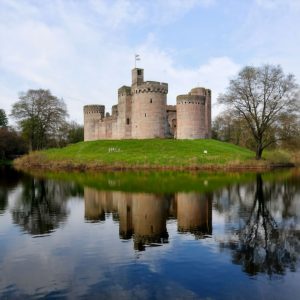
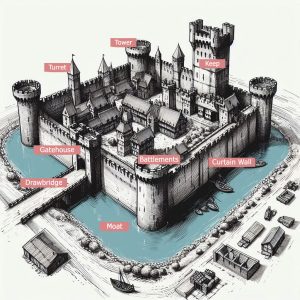
The castle keep was the strongest and most secure part of a medieval castle, often serving as the last line of defense during an attack. Typically a large, fortified tower at the heart of the castle, it contained the lord’s living quarters, storage rooms, and sometimes a chapel. Its thick stone walls and elevated position made it difficult to capture, while providing a commanding view of the surrounding landscape. Beyond its defensive role, the keep was a symbol of power and authority, central to both daily life and military strategy throughout the Middle Ages.

Purpose of a Medieval Castle Keep Serve
Like many other castle parts, the castle keep served multiple purposes. Its most obvious function was as the residence of the lord of the castle, with the upper levels typically reserved for the lord and his family. The lower levels were primarily used for storage and defensive functions, while the middle floors often contained the great hall, where important gatherings and administrative activities took place.
🏰 Fun Fact
The central keep of a medieval castle wasn’t just for defense—it was also the lord’s residence, storage for treasures, and a symbol of authority over the surrounding lands.
In the late medieval period, keeps could also serve as prisons for political detainees, particularly in their secure lower chambers. During attacks or sieges, the keep provided a strategic defensive position, with its elevated location allowing archers and defenders to repel enemies effectively while remaining protected by the thick stone walls.

Donjon / Terminology & Motte-and-Bailey Context
Castle keeps could also be known as a donjon, the French term for a stronghold. Keeps were often centrally located within a castle and sometimes placed on higher ground, particularly in Norman motte-and-bailey designs, where the keep sat atop an artificial mound called a motte. While this design became common in England after the Norman Conquest of 1066, stone keeps and fortified towers existed elsewhere in Europe before this period, serving both defensive and residential purposes.

Nobles’ Residence & Function Shift
In earlier medieval periods, nobles and the lord’s family lived in the castle keep, which was the safest part of the castle. Over time, as castles grew larger and more elaborate, the keep became primarily defensive, while nobles moved to more opulent chambers elsewhere in the castle. Despite this shift, the keep remained a symbol of power and authority, central to both defense and daily life.

Who lived in a Medieval Castle Keep?
The keep was often the residence of the lord, his family, and other important personnel. While the upper levels were reserved for high-ranking occupants, the lower sections primarily served storage and defensive purposes rather than housing ordinary workers. This arrangement ensured that the most valuable people and resources were kept in the safest areas of the castle.

Prison and Strategic Importance
A castle keep was not only a fortified tower but also sometimes used as a prison for political detainees, particularly in its lower, secure levels. Its thick stone walls, limited access points, and elevated position made it one of the most impenetrable parts of a castle, ideal for both defense during sieges and the detention of important captives.
Construction & Materials
During the early medieval period, many castle keeps were constructed from wood, making them vulnerable to fire and decay. In the late medieval period, keeps were increasingly built from stone, which provided greater security, durability, and authority. Stone keeps required more resources and skilled labor to construct, but their thick walls, arrow loops, and limited entrances made them formidable defensive structures.
💡 Did You Know?
Some castle keeps had secret staircases and hidden chambers to protect valuables and provide escape routes during sieges. These hidden spaces could also store weapons and food for months.
Administration / Command of the Keep
Responsibility for a castle keep was usually assigned to a castellan or appointed officer, especially during sieges or military campaigns. The castellan oversaw the defense, maintenance, and administration of the keep, ensuring that its multiple functions—residential, defensive, and sometimes prison-related—were effectively managed.
.

Medieval Castle Keep Summary
Castle keeps were central to the function and symbolism of medieval castles. They combined defense, residence, storage, and authority, evolving from timber to stone structures over time. Whether serving as a lord’s residence, a secure refuge during attacks, or a prison, the keep remained one of the most critical and iconic parts of a castle throughout the Middle Ages.
🔑 Key Insight
The height and thickness of a keep’s walls were carefully calculated to withstand attacks, making it the most secure structure in the castle. Keeps often had multiple floors for living, defense, and storage.
Medieval Castle Keep FAQ
What was the main purpose of a castle keep?
The keep was the fortified heart of a medieval castle, serving as the lord’s residence, a last line of defense, and a storehouse for valuables and supplies.
Who lived in the keep?
The lord, his family, and select high-ranking guards or officials resided in the keep. It was the most secure and prestigious part of the castle.
What defensive features did keeps have?
Keeps were tall, thick-walled structures often with battlements, arrow slits, and narrow entrances to withstand sieges and protect inhabitants.
How did keeps support daily life?
Keeps contained living quarters, kitchens, storerooms, and sometimes chapels, providing both comfort and security for daily medieval life.
Castle Keep Quiz
1. What was the primary function of a castle keep?
2. Who typically lived in the keep?
3. Which defensive features were common in keeps?
Castle Keep Glossary — Key Terms Explained
Learn the meanings of key terms related to medieval castle keeps and fortresses.