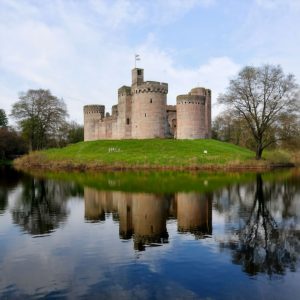
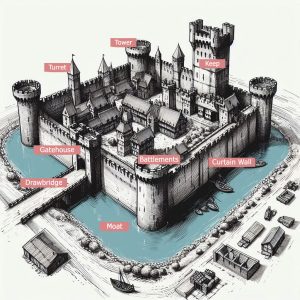
One of the most famous defensive features of a medieval castle was the moat—a deep ditch, sometimes filled with water, designed to slow down attackers and keep siege engines away from the walls. But moats created a problem as well: if a castle was surrounded by a ditch, how could people enter and leave safely? The answer was the drawbridge, a movable bridge that could be lowered for friendly access and raised in seconds during danger.
A castle drawbridge was not just a bridge—it was a key part of the castle’s gate defense system, working alongside features like the gatehouse, portcullis, and sometimes a barbican. Together, these defenses turned the entrance into one of the deadliest places for an attacker to approach.
Part of the Medieval Castle Parts Guide
Drawbridges were one of many defensive features used in medieval fortifications. Explore our full guide to Medieval Castle Parts to learn about keeps, moats, battlements, towers, and other essential structures.
🔎 Click & Reveal: Castle Drawbridge Truths
Were all castle moats full of water?
No. Many castles used dry moats (deep defensive ditches). Dry moats still prevented easy access to walls and made it difficult to bring siege engines close.
Did a drawbridge work alone?
Rarely. A drawbridge was part of a full entrance defense system including the gatehouse, portcullis, strong doors, and firing positions above the passage.
What raised the drawbridge?
Most drawbridges were lifted by ropes or chains connected to a windlass. Later systems added pulleys and sometimes counterweights to handle heavier bridges.
Why was the entrance so dangerous for attackers?
Attackers approaching the gate were exposed to missile fire from above and could be trapped if defenders raised the drawbridge and dropped the portcullis.
Is a bascule bridge the same as a drawbridge?
A bascule bridge is a type of drawbridge that pivots upward using balance and weight. But medieval castles used several drawbridge styles depending on design and resources.
What was the drawbridge’s main job?
Its main job was access control—allowing entry for residents and allies, while denying attackers a direct route to the gate during raids or sieges.
🏰 Castle Drawbridge Definition
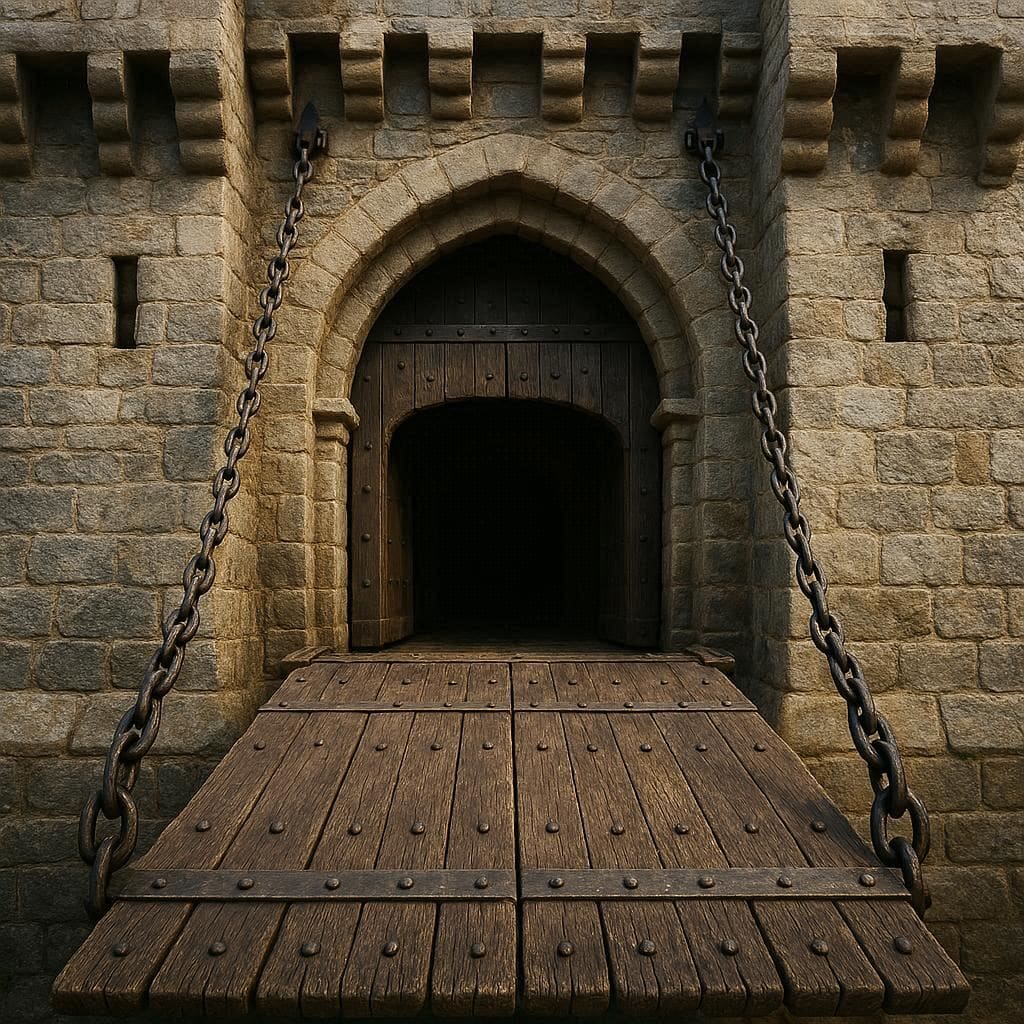
A castle drawbridge was a heavy movable bridge, usually built from timber, that crossed a moat or defensive ditch. It formed the main route into a fortified site and could be raised or lowered to control access—especially during an attack.
When lifted, a drawbridge removed the easiest path to the gate and forced attackers to attempt slower, riskier alternatives—often while defenders fired from the gatehouse, towers, or wall-walks above.
Not every drawbridge was huge or dramatic. Designs depended on the castle: some spanned narrow ditches, while others crossed wider moats and needed stronger lifting systems using ropes, chains, windlasses, and sometimes counterweights.

Why Castles Used Drawbridges
The drawbridge mattered because the castle entrance was always a weak point. Even the thickest stone walls had to include a gate somewhere, and attackers knew that gates were the best target during a siege.
A raised drawbridge helped defenders by:
- stopping enemies from rushing the entrance
- preventing ladders and rams from reaching the gate easily
- slowing down siege troops long enough for archers to fire
- forcing attackers into a narrow “kill zone” in front of the gatehouse
In short, a drawbridge helped control who could approach the castle and when.

How a Castle Drawbridge Worked
Early medieval drawbridges were often simple wooden platforms that could be moved using manual force, ropes, and basic lifting methods. Over time, drawbridges became more advanced, especially in the later Middle Ages, when castles faced more organized sieges and stronger armies.
Many drawbridges worked using:
- thick ropes (early designs)
- stronger chains (later designs)
- a rotating mechanism called a windlass
- pulleys to help distribute weight and improve control
The windlass was typically located inside the gatehouse, where defenders could raise or lower the bridge while staying protected.

Defending the Castle Entrance
A drawbridge rarely worked alone. Medieval builders designed entrances as layered defensive traps, especially in stone castles from the 12th century onward.
A typical defensive sequence might include:
- the moat or defensive ditch
- the drawbridge
- a heavy wooden gate reinforced with iron
- a dropping portcullis (spiked metal or wooden grille)
- arrow loops and murder holes inside the gate passage
This meant attackers could be stopped outside, crushed in the entry tunnel, or trapped under fire while trying to force their way in.
🛡️ The Castle Gate and Its Defenses
The main gate of a medieval castle was usually a thick wooden door strengthened with iron strips and metal studs. But as siege warfare evolved, the simple gate became a complex defensive structure designed to slow, trap, and break an attacker’s momentum.
The gatehouse developed into a powerful defensive building protecting the entrance, often including:
- Multiple doors to delay entry
- One or more portcullises (heavy drop-gates)
- Guard rooms for soldiers controlling access
- Upper firing positions for arrows or missiles
- Narrow passageways to slow and trap attackers
Some castles also added a barbican, a fortified outer gateway placed in front of the main entrance. Barbicans forced enemies to fight through another defended choke point before even reaching the drawbridge and gate.
Quick Defensive Response
One of the greatest strengths of a drawbridge was speed. In a surprise attack or sudden raid, guards could raise the bridge quickly, cutting off the easiest route into the castle.
During a serious assault, defenders might use multiple actions at once:
- raise the drawbridge
- drop the portcullis
- lock or bar the main gate
- fire arrows or crossbow bolts from above
This combination could stop an enemy advance instantly, even if the attackers reached the moat.
Castle Drawbridge History
Drawbridges existed in various forms long before the medieval period, but the classic castle drawbridge became widespread as stone castles developed across Europe.
Early medieval drawbridges were generally simpler and relied heavily on manpower. As castles became larger and gatehouses more complex, drawbridge technology improved, especially between the 12th and 14th centuries.
Later medieval drawbridges sometimes used:
- chains instead of rope
- improved windlass systems
- stronger internal timber frames
- mechanical help such as counterweights
These improvements allowed heavy bridges to be raised more smoothly and safely, even under pressure during a siege.
⚙️ Bascule Bridges (A More Advanced Type of Drawbridge)
Some later medieval drawbridges worked as bascule bridges—a more advanced design that pivots upward like a seesaw. The word bascule comes from French and refers to a balancing mechanism that helps lift heavy structures with less effort.
Instead of relying only on manpower, a bascule drawbridge could use carefully engineered parts to make raising and lowering smoother and faster.
🏗️ A bascule drawbridge could use:
- Internal counterweights hidden inside the gatehouse
- Long wooden arms and support beams to control the pivot motion
- Chains and pulleys to guide movement and stabilize the lift
This design reduced the effort needed to lift the bridge, made the entrance easier to secure in emergencies, and allowed defenders to control the castle’s most vulnerable access point with greater speed and reliability.
⚔️ Castle Drawbridge Fast Facts
- A drawbridge was designed to protect the castle gate, the most vulnerable entry point.
- Some moats were wet, but many were dry defensive ditches.
- Many drawbridges were raised using a windlass and later strengthened with chains.
- Later systems could include counterweights, especially in larger castles.
- Drawbridges worked alongside portcullises, gatehouses, and sometimes barbicans.
Drawbridge Working Parts
A drawbridge system could include several key mechanical parts, depending on the castle design:
- Windlass – the rotating mechanism used to raise and lower the bridge
- Chains or ropes – used to pull the bridge upward
- Trunnions – pivot points that helped the bridge rotate
- Counterweights – used in heavier systems to balance the bridge
- Guide slots / supports – to keep the bridge aligned as it moved
Not every castle used every part, but the most advanced designs combined several of these features for speed and strength.

Visit a Working Drawbridge: Helmingham Hall
If you want to see a drawbridge in action, Helmingham Hall in England is famous for its historic working drawbridge. It’s a rare example of a drawbridge surviving into the modern age and still being used as a functioning entrance feature.
Alnwick Castle Drawbridge
Alnwick Castle is one of the best-known castles in England and remains a popular place to visit. Its entrance and defensive design help visitors understand how drawbridges, gatehouses, and fortified gateways worked together to protect medieval strongholds.

Conclusion
The castle drawbridge was far more than a dramatic medieval feature—it was a practical and powerful defensive tool. By controlling access across a moat or defensive ditch, the drawbridge helped protect the castle’s most vulnerable point: the entrance. Combined with the gatehouse, portcullis, and other layered defenses, it formed a deadly barrier that could stop attackers in seconds.
To understand medieval castle defense fully, it helps to explore related castle parts such as the moat, barbican, and gatehouse, which all worked together as part of a complete fortress system.
🏰 Castle Drawbridge FAQ
What is a medieval castle drawbridge?
A castle drawbridge was a heavy movable bridge used to cross a moat or defensive ditch. It could be lowered for entry and raised quickly to block attackers from reaching the gate.
Did all medieval castles have drawbridges?
No. Many castles had a fixed bridge, a simple causeway, or no moat at all. Drawbridges were most common where a castle had a moat or a deep defensive ditch that needed controlled access.
Were moats always filled with water?
No. Some moats were wet moats, but many were dry ditches. A dry moat could still be extremely effective because it slowed attackers and made siege equipment harder to position.
How did a drawbridge work?
Most drawbridges were lifted using ropes or chains connected to a windlass (a turning drum mechanism). Later designs used improved pulleys and sometimes counterweights to help lift heavier bridges.
What is the difference between a drawbridge and a portcullis?
A drawbridge controlled access across the moat, while a portcullis was a heavy dropping grille inside the gatehouse. Castles often used both together for stronger layered defense.
What is a bascule bridge?
A bascule bridge is a type of drawbridge that pivots upward using a balancing system, often assisted by counterweights. Not all drawbridges are bascule bridges, but some later medieval examples worked this way.
Why was the gatehouse such a major defensive feature?
The gate was the weakest point in any castle wall. The gatehouse added protection with thick doors, guard rooms, firing positions, and features like a portcullis to trap attackers at the entrance.
🧠 Castle Drawbridge Quiz
Click an answer to see if you’re right. Correct answers turn green and wrong answers turn red.
1) What was the main purpose of a castle drawbridge?
2) Were all medieval castle moats filled with water?
3) What mechanism was commonly used to raise and lower a drawbridge?
4) What was a portcullis used for?
5) What is a bascule bridge?
📜 Castle Drawbridge Glossary
Drawbridge
A movable bridge used to cross a moat or ditch, raised to block attackers.
Moat
A defensive ditch around a castle, either wet (water-filled) or dry.
Gatehouse
A fortified entrance structure designed to protect the castle’s most vulnerable point.
Portcullis
A heavy dropping grille used to block the gateway, often with sharp points at the base.
Windlass
A turning drum mechanism used to raise and lower the drawbridge with ropes or chains.
Counterweight
A balancing weight used to help lift heavy drawbridges more efficiently.
Bascule Bridge
A type of drawbridge that pivots upward using balance and mechanical assistance.
Barbican
An outer fortified gateway placed in front of the main gatehouse for added defense.