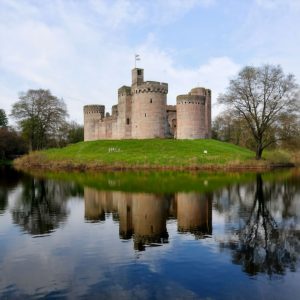
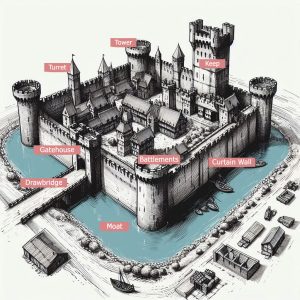
Castle battlements are one of the most iconic features of medieval fortifications, designed to provide defenders with protection while allowing them to launch attacks on enemies below. Typically located along the top edges of castle walls and towers, battlements consist of alternating high sections called merlons and low gaps known as crenels or embrasures. This distinctive pattern allowed archers and soldiers to shield themselves from incoming projectiles while firing arrows, crossbows, or other weapons. Battlements played a crucial role in castle defense, combining functionality with the imposing silhouette that castles are known for today.
Battlement Definition (Click to Reveal)
A battlement is the defensive structure built along the top of a castle wall, tower, or gatehouse. It protected defenders while allowing them to watch and fire at attackers.
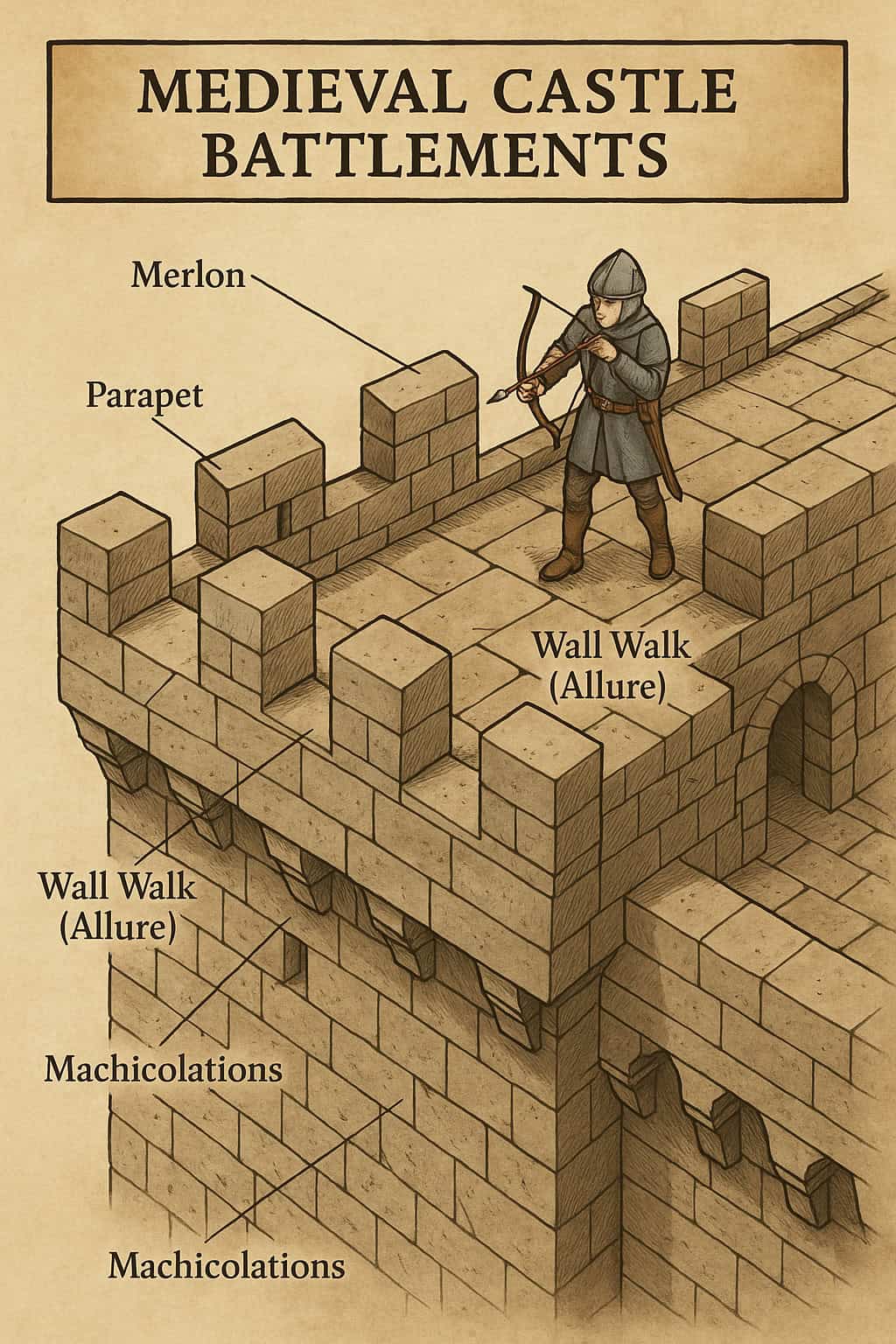
Battlement Parts
- Parapet – the low protective wall at the top of the main wall
- Merlons – the solid upright blocks that provide cover
- Crenels – the gaps/openings between merlons used to fire through
- Crenellation – the repeating pattern of merlons and crenels (or the act of adding them)
What Battlements Were Used For
- Provided cover for defenders during attacks
- Allowed archers and crossbowmen to fire through crenels
- Let defenders reload safely behind merlons
- Helped guards observe the surrounding area
Decline of Battlements
Battlements became less effective with the rise of gunpowder weapons and cannons, which could break traditional stone walls more easily.
Battlement Parts (Castle Wall Features)
A battlement is made up of several key parts:
- Parapet – the low protective wall at the top of the main wall
- Merlons – the solid upright blocks that provide cover
- Crenels – the gaps/openings between merlons used to fire through
- Crenellation (or crenellations) – the repeating pattern of merlons and crenels, or the act of building/adding this pattern
Battlements were most commonly built along curtain walls and towers, but they could be added to almost any elevated defensive wall.

What Were Battlements Used For?
Castle battlements had several practical purposes:
- They provided cover for defenders during battle
- Archers and crossbowmen could shoot through the crenels
- Defenders could reload or retreat behind the merlons for protection
- Guards could watch the area outside the walls from an elevated position
In many castles, battlements were also combined with other defensive features such as walkways, arrow slits, and sometimes machicolations for dropping objects or firing downward.

Decline of Castle Battlements
Battlements became less important as warfare changed. The rise of gunpowder weapons, especially cannons, made traditional high stone walls easier to damage. Over time, many castles were replaced by lower, thicker fortifications designed to resist artillery, and battlements became less useful as a primary defensive feature.


The decline of medieval Castle battlements
The decline of medieval Castle battlements and the decline of castles themselves can be attributed to the advancement of medieval weaponry, in particular Cannons. These new gunpowder weapons and the start of the age of enlightenment which was called the “Renaissance period” led to the decline of medieval castles and medieval castle battlements were no longer required.

❓ Battlements – Frequently Asked Questions
What is a battlement?
A battlement is a defensive structure built along the top of a castle wall, tower, or gatehouse. It protected defenders while allowing them to fight from behind cover during an attack.
What is the difference between crenels and merlons?
Crenels are the open gaps in a battlement, while merlons are the solid upright sections between the gaps. Defenders could shoot through the crenels and then step back behind the merlons for protection.
What is crenellation?
Crenellation refers to the repeating pattern of merlons and crenels along the top of a wall. The word can also describe the act of adding that pattern to a parapet.
What is a parapet?
A parapet is a low protective wall built along the edge of a roof, rampart, or castle wall. Battlements are usually built on top of the parapet.
Were battlements used only on castles?
No. Battlements were also used on fortified town walls, watchtowers, and gatehouses. In some later buildings, battlements were added mainly for decoration rather than defense.
Why did battlements become less effective over time?
Battlements became less useful as gunpowder weapons (especially cannons) became more common. Artillery could damage high stone walls, and new fort designs developed that were better suited to resisting cannon fire.
🧠 Battlements Knowledge Quiz
📜 Glossary of Castle Battlement Terms
Battlement
A defensive structure built along the top of a castle wall or tower, designed to protect defenders while they fight.
Parapet
A low protective wall at the edge of a roof, rampart, or castle wall. Battlements are built into the parapet.
Crenellation
The pattern of alternating openings and solid sections along a parapet, forming the classic “castle teeth” shape.
Crenel
The open gap in a battlement where defenders could shoot arrows or throw objects at attackers.
Merlon
The solid upright section between crenels, used as cover to shield defenders from enemy arrows or missiles.
Embrasure
A general term for an opening in a defensive wall used for firing weapons. Crenels are one type of embrasure.
Arrow Loop (Arrow Slit)
A narrow vertical opening in a wall that allowed archers to shoot while remaining mostly protected.
Rampart / Wall Walk
The walkway behind a parapet where defenders stood to patrol and fight from the top of the wall.
Machicolation
A projecting stone gallery with openings in the floor, allowing defenders to drop objects directly onto attackers below.
Curtain Wall
A long defensive wall connecting towers, often topped with battlements for protection and visibility.