In the vast sweep of England’s history, the medieval period stands out as a defining age shaped by conflict, ambition, and the continual struggle for power and security. As rival kingdoms fought for dominance and borders shifted through warfare and diplomacy, the landscape filled with imposing medieval castles—monumental fortresses that embodied military strength, noble authority, and extraordinary architectural ingenuity.
Far more than simple strongholds, these medieval fortresses served as centers of governance, residences for lords and monarchs, and crucial defenses against rebellion and foreign invasion. Built from stone, strategy, and centuries of refinement, England’s castles became essential pillars of medieval life and left a lasting legacy etched across the countryside

As formidable symbols of royal authority and strategic strongholds, the Top 10 Most Important Medieval Castles in England have etched their names into the very fabric of the nation’s narrative.
From the iconic Tower of London to the legendary Warwick Castle, each fortress on this distinguished list has played a pivotal role in shaping the course of English history.

Join us on a journey through time as we explore these magnificent structures, each a testimony to the resilience, grandeur, and drama of the medieval era.
1. Windsor Castle
The most famous, largest, and oldest official royal residence in the world Is located in England, about 20 miles west of London.
Windsor Castle is more than 900 years old and over a million people visit it each year.
🏰 Medieval Features of Windsor Castle
Windsor Castle has evolved over nine centuries, but several of its most important structures date directly to the medieval era. These elements formed the core of the Norman fortress and later Plantagenet royal residence, shaping the castle’s defensive strength and symbolic power during the Middle Ages.
- The Norman Gatehouse (13th Century): One of the best surviving medieval defensive features, built to protect the Upper Ward and fortified with towers, arrow slits, and heavy doors.
- The Round Tower (12th Century Origins): Although altered over time, its core structure was built under Henry II as part of the castle’s strengthened keep. Positioned on a motte, it offered commanding views over the Thames Valley.
- Medieval Curtain Walls & Battlements: Significant sections of Windsor’s outer walls and towers date from the Norman and Plantagenet periods, forming the backbone of the castle’s military defenses.
- St. George’s Chapel (1475–1528): A masterpiece of late medieval Gothic architecture, founded by Edward IV. It became the spiritual heart of the Order of the Garter and remains one of the finest ecclesiastical buildings of the Middle Ages.
- Medieval Lower Ward Layout: The overall structure of the Lower Ward—its gateways, walls, and circulation routes—reflects centuries of medieval development, even though many interiors were later refurbished.
Note: Many famous features of Windsor Castle—such as the State Apartments, Queen Mary’s Dolls’ House, the Waterloo Chamber, and the Long Walk—are not medieval. These were constructed or redesigned between the 17th and 20th centuries and should not be listed as medieval features.


Official Windsor Castle Website
2. Tower of London
The Tower of London is a structure that for over 1000 years has dominated the skyline of the city. The tower which has housed the royal family and their jewels receives 2 million visitors each year, all of them eager to witness the crown jewels which are on display.
🏰 Medieval Features of the Tower of London
The Tower of London began as a Norman fortress and evolved into one of medieval England’s most important royal, administrative, and military centers. While the site contains structures from many eras, several major features date directly to the Middle Ages and defined the castle’s role in warfare, governance, and royal authority.
- The White Tower (11th Century): Built by William the Conqueror shortly after 1078, the White Tower is the oldest and most iconic part of the complex. This massive keep exemplifies Norman military architecture and served as a royal residence, stronghold, and symbol of conquest.
- The Medieval Palace (13th Century): Constructed during the reigns of Henry III and Edward I, this palace included luxurious lodgings such as St. Thomas’s Tower, Wakefield Tower, and the Lanthorn Tower. It represents the Tower’s role as both fortress and royal home.
- The Bloody Tower (13th Century): Originally known as the Garden Tower, this fortified gateway dates to the reign of Henry III. Its later association with the “Princes in the Tower” gives it a dramatic place in medieval and early Tudor history.
- Medieval Curtain Walls & Wall Walk: Large sections of the Tower’s outer defensive walls and towers were built between the 12th and 13th centuries, forming an advanced system of battlements, arrow slits, and wall walks used by medieval guards and soldiers.
- Tower Green: A central medieval courtyard area used for military mustering, ceremonies, and later, some high-profile executions. While the famous executions occurred mostly during the Tudor era, the Green itself is medieval in origin.
- Early Royal Menagerie (13th Century Origins): The Tower housed exotic animals as early as the reign of Henry III, beginning with lions gifted by foreign rulers. This medieval menagerie grew over the centuries, reflecting royal prestige and diplomatic ties.
Note: Modern features such as the Crown Jewels display, Yeoman Warder uniforms, the ravens tradition, and Tower Bridge are not medieval and are therefore not included in this section.


3. Bodiam Castle
Bodiam Castle, a picture-perfect medieval fortress located in East Sussex, England, stands as an enchanting embodiment of architectural beauty and defense.
🏰 Bodiam Castle – Best Medieval Features
Bodiam Castle, built in 1385 by Sir Edward Dalyngrigge, is one of England’s most visually striking late-medieval fortresses. Designed to serve both defensive and residential purposes, its elegant symmetry and iconic moat make it a unique example of 14th-century castle architecture.
- Moat and Entrance Bridge: Bodiam’s wide, water-filled moat provides both strong defensive protection and dramatic visual appeal. The stone bridge and causeway create an imposing approach to the castle.
- Symmetrical Corner Towers: Four evenly spaced corner towers give Bodiam its distinctive balanced silhouette, blending strength with architectural elegance.
- Central Courtyard and Great Hall Site: Within the castle walls lies the remains of the Great Hall, once the social, administrative, and ceremonial heart of the medieval household, surrounded by domestic chambers.
- Fortified Gatehouse: Equipped with a portcullis, arrow loops, and defensive murder holes, the gatehouse served as Bodiam’s main entrance and first line of protection during siege or attack.
- Stone Fireplaces and Chimneys: Numerous fireplaces throughout the interior reveal Bodiam’s role as a noble residence, offering warmth and comfort to its occupants.
- Large Window Openings: Unusually large for a medieval fortress, Bodiam’s broad windows demonstrate its dual purpose—defense paired with status, comfort, and visual grandeur.
- Spiral Staircases: These winding staircases inside the towers connect different floors and battlements, offering elevated views of the surrounding landscape.
- Machicolations and Arrow Slits: Defensive features above the walls allowed defenders to drop projectiles or fire arrows while remaining protected—hallmarks of late-medieval military design.
- Picturesque Setting and Surroundings: Set within a scenic landscape, Bodiam’s gardens and reflective moat enhance its reputation as one of England’s most photographed castle ruins.
- Romantic Medieval Ruins: Though roofless and partly collapsed, Bodiam’s preserved stonework allows visitors to visualize the layout and function of a 14th-century noble fortress.


4. Warwick Castle
Warwick Castle is one of the grandest and best preserved medieval castles in all of England, it is a Norman castle that was built on the remains of a Roman Fort in 1068 on the orders of William the Conqueror.
Warwick Castle Official Website
🏰 Medieval Features of Warwick Castle
Warwick Castle began as a Norman fortification and evolved into one of the strongest medieval strongholds in England. While the site includes later restorations and modern attractions, several of its most significant structures date directly to the Middle Ages and reflect the castle’s military and political importance during the feudal era.
- The Norman Motte and Original Fortifications (1068): Founded by William the Conqueror, the earliest version of Warwick Castle was a classic motte-and-bailey fortress built to secure Norman control over the Midlands.
- Medieval Curtain Walls & Defensive Towers: Much of the castle’s stone curtain walling developed between the 12th and 14th centuries, forming the backbone of Warwick’s military defenses.
- Caesar’s Tower (14th Century): One of the most impressive medieval fortification towers in England, Caesar’s Tower was constructed during the reign of Thomas Beauchamp. Its massive structure and height made it a formidable defensive asset.
- Guy’s Tower (14th Century): Built around 1395, Guy’s Tower is a superb example of late-medieval military architecture. Standing 39 meters tall, it housed soldiers, storage areas, and defensive positions.
- The Gatehouse & Barbican: Strengthened in the Middle Ages, these fortifications protected the main entrance and served as the first line of defense against attackers.
- Foundations of the Medieval Great Hall: The medieval Great Hall once served as the political and social heart of the castle. Although rebuilt in the 17th century after a fire, the hall stands on medieval foundations and follows the footprint of the earlier structure.
- Medieval Domestic Buildings: Portions of the residential quarters and service areas retain their medieval origins, reflecting the castle’s evolution from a military bastion to a noble residence.
Note: Popular attractions such as the State Rooms, Time Tower, Rose Garden, Princess Tower, and modern dungeon experience are not medieval and were therefore excluded from this section. They belong to later historical periods or contemporary visitor installations.


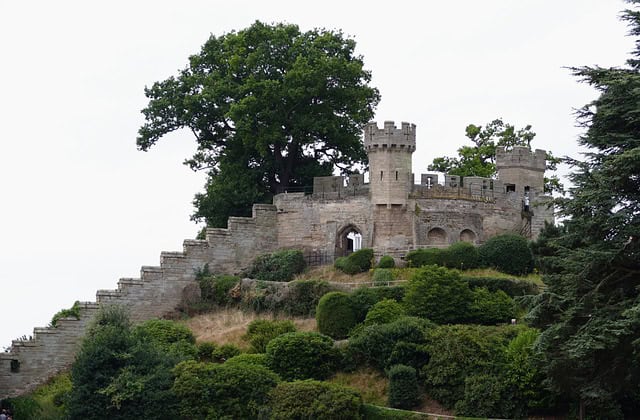

5. Dover Castle
Perched majestically atop the famous White Cliffs of Dover, Dover Castle stands as a sentinel of England’s history, a testament to its enduring strength and strategic importance. With a legacy that spans over nine centuries, this formidable fortress has witnessed countless pivotal moments in the nation’s past.
🏰 Medieval Features of Dover Castle
Dover Castle is one of the most strategically important medieval fortresses in England, guarding the shortest crossing to continental Europe. Although the site contains structures from the Roman, Tudor, Victorian, and modern eras, several of its most iconic and influential components date directly to the Middle Ages.
- The Great Tower (12th Century): Commissioned by King Henry II, this monumental keep served as both a royal palace and a powerful symbol of English authority. Its grand halls, chambers, and thick defensive walls reflect high medieval military and ceremonial architecture.
- Medieval Curtain Walls & Gate Defenses: Much of Dover Castle’s formidable stone walling was expanded or rebuilt in the 12th and 13th centuries. These concentric defenses, reinforced by numerous towers, made Dover one of the most secure fortresses in medieval Europe.
- 13th-Century Medieval Tunnels: Built during the reign of King John, these underground passages supported troops during sieges, allowing movement of supplies and enabling secure communication beneath the castle’s defenses.
- Inner Bailey & Medieval Courtyard Layout: The organization of open courtyards, defensive gatehouses, and service buildings reflects Dover’s medieval role as both a military garrison and an administrative center.
- The Roman Pharos (Adjacent but Historically Relevant): Although not medieval, this ancient lighthouse stood beside the medieval church of St. Mary in Castro and was used as a landmark and signaling point throughout the Middle Ages.
- Church of St. Mary in Castro (Rebuilt in the 12th Century): Located within the castle walls, this medieval church served garrison soldiers and remains one of the best-preserved castle churches in England.
Note: Later additions—including the Tudor Constable’s Gate, Victorian Fire Command Post, and World War II tunnels—are not medieval and are therefore excluded from this section.


🏰 Frequently Asked Questions: Important Castles in England
Which castles in England are considered most historically significant?
Castles such as **Windsor Castle, Tower of London, Dover Castle, and Warwick Castle** played crucial roles in England’s history, serving as **royal residences, military fortresses, and administrative centers**.
What was the primary purpose of these castles?
Medieval castles were built for **defense, control of territory, and protection of rulers and their subjects**, often also serving as symbols of power and prestige.
Why is Windsor Castle famous?
**Windsor Castle** is one of the oldest and largest inhabited castles in the world, historically significant as a **royal residence, military stronghold, and site of state ceremonies**.
What makes the Tower of London historically important?
The **Tower of London** served as a **fortress, royal palace, prison, and treasury**, making it a central site for English history, intrigue, and royal authority.
Did castles serve only military purposes?
No. Many castles had **administrative functions, courts, chapels, and living quarters**, reflecting their role in governance and daily life beyond warfare.
How did castles evolve over time in England?
Castles evolved from **motte-and-bailey wooden structures** to **stone fortresses**, adding features like **gatehouses, moats, towers, and battlements** to adapt to new military technologies and political needs.
Can you visit these castles today?
Yes. Many historic castles like **Warwick, Dover, and Windsor** are open to the public, offering tours that showcase **medieval architecture, royal history, and fascinating artifacts**.
🏰 Test Your Knowledge: Important Castles in England
🏰 Glossary of English Castle Terms
Castle
A fortified residence built for defence and control, commonly used by nobles and kings in medieval England.
Motte and Bailey
An early Norman castle design consisting of a wooden or stone keep on a mound (motte) and an enclosed courtyard (bailey).
Keep
The strongest and most secure tower of a castle, serving as the lord’s residence and final defensive refuge.
Curtain Wall
The defensive outer wall of a castle, often reinforced with towers and walkways for soldiers.
Bailey
The enclosed courtyard of a castle containing workshops, stables, and living quarters.
Moat
A deep ditch, often filled with water, built around a castle to hinder attackers.
Barbican
A fortified outer gateway designed to protect the main entrance of a castle.
Portcullis
A heavy metal or wooden grille that could be dropped to block a castle entrance.
Concentric Castle
A castle with multiple layers of defensive walls, common in later medieval England.
Siege
A military strategy involving surrounding a castle to cut off supplies and force surrender.