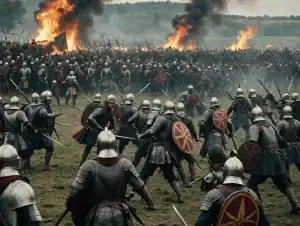
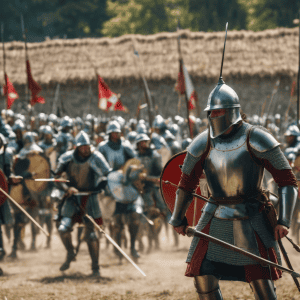
The Battle of Hastings, fought on October 14, 1066, was a pivotal moment in English history that forever changed the course of the nation.
Here are 10 key facts that shed light on this historic battle and its enduring significance.
1. The Norman Conquest
The Battle of Hastings marked the culmination of the Norman Conquest of England, as Duke William of Normandy, later known as William the Conqueror, sought to claim the English throne.

2. Claimants to the Throne
The battle arose from the disputed English throne. King Harold Godwinson, the reigning monarch, faced a challenge from William and Harald Hardrada, King of Norway, both of whom had claims to the throne.

3. Battle Location
The battle took place near the town of Hastings, in East Sussex, England, at a site known as Senlac Hill, which offered a strategic advantage to the English.
4. The Shield Wall
The English army, led by Harold, formed a shield wall, a defensive tactic designed to protect against Norman cavalry charges. This formation was effective initially.

5. The Norman Knights
William’s army, predominantly comprised of Norman knights, deployed a combination of archers and cavalry, which included knights on horseback.

6. Harold’s Death
Harold’s death during the battle, traditionally believed to have been caused by an arrow to the eye, was a turning point in the conflict. His demise weakened the English resolve.

7. The Bayeux Tapestry
The Bayeux Tapestry, an embroidered cloth, provides a detailed visual account of the battle. It is a valuable historical source for understanding the events of the time.

8. Impact on England
The Norman victory at Hastings led to sweeping changes in England. William the Conqueror became King of England, bringing Norman culture, language, and administration to the country.
9. Linguistic Legacy
The battle’s aftermath contributed to the development of Middle English, as Old English and Norman French merged to form the English language.
10. Long-Lasting Influence
The Battle of Hastings has left a lasting impact on English history, shaping the monarchy, the legal system, and the English language. It laid the foundation for the Plantagenet and Tudor dynasties and, ultimately, the British Empire.
The Battle of Hastings remains a pivotal moment in English history. It marked the Norman Conquest, the transformation of England’s leadership, and the fusion of languages and cultures that continue to define the nation today.
The events of that fateful day on Senlac Hill in 1066 continue to resonate through the annals of time.