
Feudalism is commonly used by historians to describe the dominant social, political, and economic arrangements of medieval Europe. Rather than a single uniform system, feudalism is best understood as a set of practices centered on landholding, loyalty, and service that structured relationships between kings, nobles, warriors, and peasants.

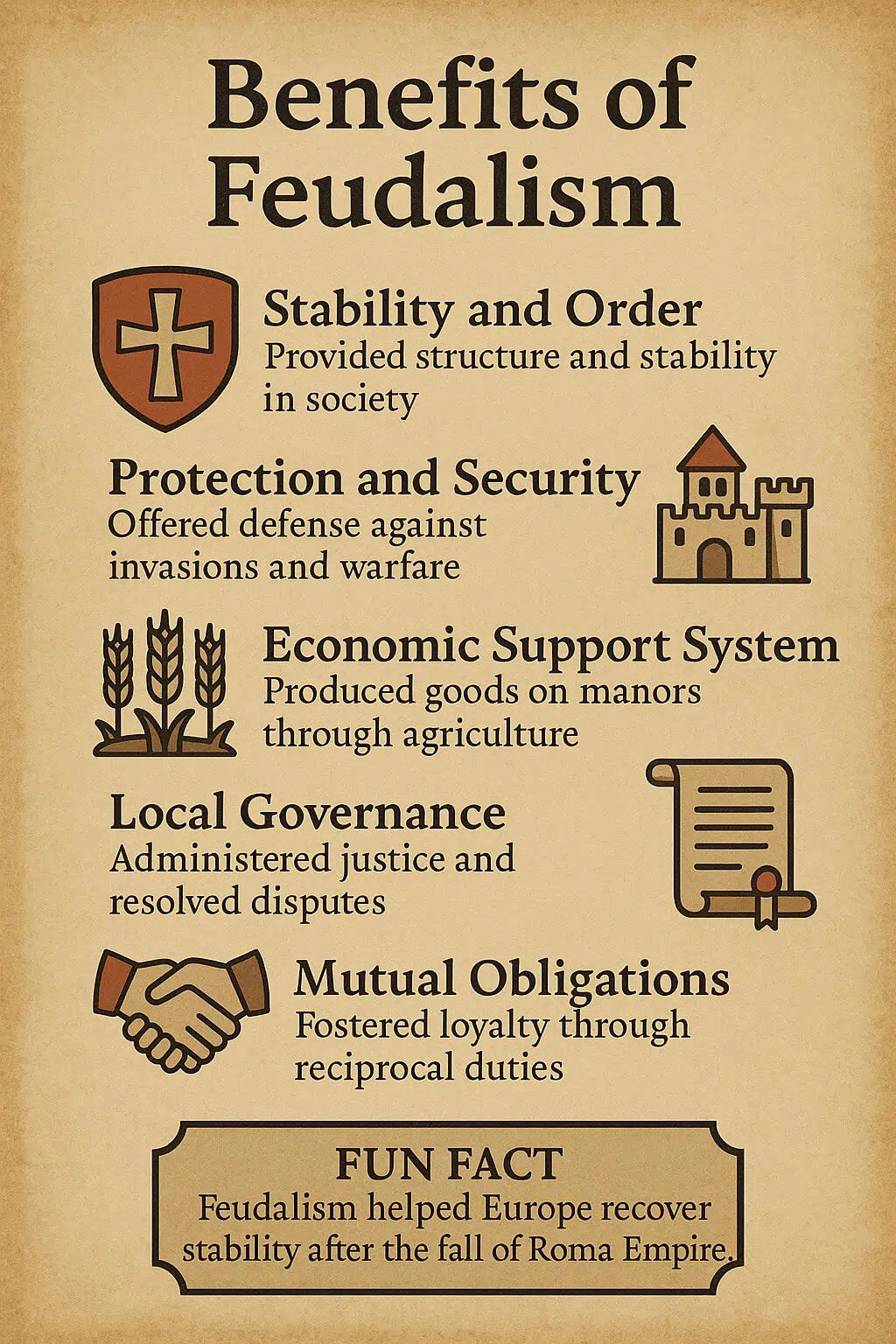
At its core, feudalism involved the exchange of land and protection for service and allegiance, creating a hierarchical society in which authority and wealth were closely linked. This framework helped provide stability in the centuries following the collapse of Roman imperial rule.
📜 Click to Reveal: Feudalism Explained
Click each section below to explore how feudalism shaped power, land, and society in the Middle Ages.
What Is Feudalism?
Feudalism is a term used by historians to describe systems of landholding, loyalty, and service that structured power in medieval Europe, particularly between kings, nobles, and warriors.
How Feudal Relationships Worked
Lords granted land to followers in return for allegiance and service. These relationships created networks of obligation that supported governance and military defense.
Vassals and Fiefs
Vassals held land, known as fiefs, under agreed conditions. While military service was common, obligations varied widely by region and period.
Feudalism and Manorialism
Feudalism governed elite relationships, while manorialism structured agricultural labor and rural life. The two systems were closely interconnected.
Different Historical Interpretations
Some historians emphasize legal and military bonds among the nobility, while others view feudalism as part of a broader social order that included clergy and peasants.
Modern Historical Debate
In the 20th century, scholars questioned whether feudalism was a single coherent system, emphasizing regional diversity and local custom instead.
Why Feudalism Still Matters
Feudalism remains a useful framework for understanding medieval power and landholding when applied cautiously and with attention to historical variation.
Feudal Relationships in Practice
In medieval Europe, land was often granted by a lord to a follower under agreed conditions. Those who received land—commonly referred to as vassals—were expected to offer loyalty, counsel, and, in many cases, military service when called upon.
This arrangement allowed lords to raise armed forces efficiently while binding warriors to them through personal obligation. Knights were frequently granted land for this reason, making feudal ties an important element of medieval warfare and governance.
📌 Key Terms
Vassal
In medieval usage, a vassal was a person who held land from a lord under conditions of homage and allegiance, often fulfilling military or administrative duties in return.
Fief
A fief referred to land or income granted by a lord in exchange for service. While military obligations were common, the precise nature of these arrangements varied by region and period.
Interpreting Feudalism
Modern historians have approached feudalism in different ways. Some scholars have emphasized formal legal and military relationships among the warrior elite, focusing on lords, vassals, and landholding as the central elements of feudal arrangements.
Other historians have taken a broader social approach, viewing feudalism as part of a wider feudal society that included not only the nobility but also the clergy and peasantry. From this perspective, feudal relationships are closely connected to manorialism, agricultural production, and rural life.
📜 Feudalism as a Historical Concept
During the 20th century, historians increasingly questioned whether feudalism should be treated as a single, coherent system. Influential scholarship has shown that medieval practices were often highly regional, flexible, and shaped by local custom, rather than governed by a universal model.
As a result, many modern historians use the term “feudalism” cautiously—as an analytical tool for understanding patterns of power and landholding, rather than as a rigid blueprint for medieval society.
Important Works on Feudalism
Several influential studies have shaped modern debates about feudalism, including works that challenge traditional definitions and emphasize the diversity of medieval social arrangements.
These works highlight the importance of treating feudalism as a historical framework, not a fixed or universally applied system.
Feudalism remains a useful concept for understanding medieval Europe when applied carefully and critically. While medieval society was not governed by a single uniform system, relationships based on land, loyalty, and service played a central role in shaping political authority and social hierarchy throughout the Middle Ages.
By recognizing both the patterns and the variations within feudal arrangements, historians gain a clearer and more accurate picture of how medieval societies functioned.
❓ Feudalism – Frequently Asked Questions
What is feudalism?
Feudalism is a term historians use to describe medieval arrangements based on landholding, loyalty, and service, especially the relationships linking kings, nobles, and warrior elites.
How did feudalism work in practice?
In many regions, a lord granted a follower land or income (a fief) in return for allegiance and agreed service—often military support, but obligations could vary by time and place.
What is a vassal?
A vassal was typically a person who held land from a lord under conditions of homage and allegiance, providing service such as military duty or administrative support.
What is a fief?
A fief was land or income granted by a lord in exchange for service. While military obligations were common, the exact terms depended on local custom and historical context.
Is feudalism the same as manorialism?
Not exactly. Feudalism generally refers to political and military relationships among elites, while manorialism describes the economic organization of rural estates and peasant labor. The two often overlapped.
Why do historians debate the term “feudalism”?
Many historians argue that medieval landholding and obligations were regional and flexible, shaped by local law and custom. Because practices varied, scholars often use “feudalism” cautiously as a helpful framework rather than a universal model.
Why is feudalism important to understanding the Middle Ages?
Feudalism helps explain how power, land, and protection were organized in medieval Europe, shaping politics, warfare, and social hierarchy across many regions.
🧠 Feudalism Knowledge Quiz
📚 Glossary: Feudalism and Medieval Society
Feudalism
A term used by historians to describe medieval systems of landholding, loyalty, and service that structured power relationships.
Fief
Land or income granted by a lord in exchange for service, often military, though obligations varied by region and period.
Vassal
A person who held land from a lord under conditions of homage and allegiance, providing agreed service in return.
Homage
A formal ceremony in which a vassal pledged loyalty to a lord, creating a personal bond.
Allegiance
The obligation of loyalty owed by a vassal to a lord, often reinforced by oath.
Manorialism
The economic system that organized agricultural labor and production on manor estates.
Lord
A noble who granted land, exercised authority over dependents, and provided protection.
Knight
A mounted warrior who often held land in return for military service.
Serf
A peasant bound to the land who owed labor and dues as part of manorial obligations.
Feudal Society
A broader interpretation of medieval society that includes nobles, clergy, and peasants bound by land-based relationships.


