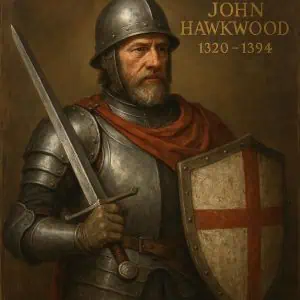
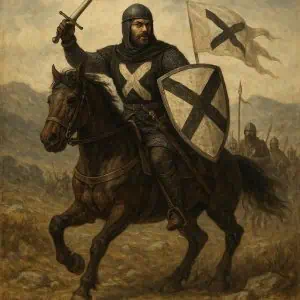
The Black Knight is a recurring and enigmatic figure found throughout Arthurian legend and medieval literature. In many tales of King Arthur, the title “Black Knight” is used to describe a mysterious or rival warrior who appears suddenly to challenge the Knights of the Round Table. In some stories, the Black Knight serves as a test of valor for knights like Sir Gawain or Sir Lancelot, while in others, it becomes a disguise used by Lancelot du Lac himself to conceal his identity during quests or tournaments.

One of the most remarkable interpretations of this motif appears in the 13th-century Middle Dutch romance Morien, where the hero is identified as the son of a Moorish princess and a knight of Arthur’s court. Known as Sir Morien (or Moriaen), he is celebrated as the Black Knight of African descent, a symbol of both courage and diversity in the legendary world of King Arthur’s Britain. His story reflects the rich cultural tapestry of medieval Europe and the enduring appeal of Arthurian myths.
The Black Knight as Sir Morien
Sir Agrovale, one of the Knights of the Round Table, set out to look for Sir Lancelot when he became lost. During his search in far-off lands, he came across a Moorish princess whom he bedded. From this union, Sir Morien was later born. Agrovale abandoned the Moorish princess and his illegitimate son and returned back to King Arthur’s court. Arthurian legends state that when Morien grew up, he set out to seek his father and reached England on this quest.

📜 Did You Know? The Black Knight Morien in Arthurian Legend
- The figure of the Black Knight appears throughout many tales of Arthurian legend, often symbolizing mystery, strength, and moral testing for the Knights of the Round Table.
- In some versions, the title Black Knight was used by Sir Lancelot when he fought incognito, allowing him to test other knights without revealing his royal favor.
- The story of Sir Morien originates from a 13th-century Middle Dutch romance known as Moriaen, one of the earliest depictions of a knight of African heritage in medieval Europe.
- Sir Morien is described as the son of a Moorish princess and a knight of King Arthur’s court, making him a symbol of chivalric virtue that transcended race and origin.
- His black armor and shield were not marks of villainy, but of identity and pride — reflecting the broader themes of honor, courage, and diversity found in medieval romance literature.
The Black Knight and Sir Lancelot
In the version where Sir Morien is considered to be the Black Knight, a story is related to his confrontation with Sir Lancelot. According to this story, Sir Morien was pitted against Sir Lancelot as a teenager.
The combat continued for a long-time and in this hand-to-hand combat, neither was able to overpower the other. Finally, Sir Gawain intervened and asked the two to stop fighting in the spirit of good knights who meet a fine adversary.
The Black Knight and His Armour
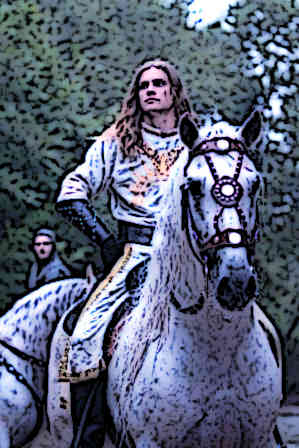
Since the origins of Sir Morien are described to be Moorish in Arthurian legends, subsequent stories related to him state that he always wore North African armour, very different from the armour of other Arthurian knights. Even the shield he bore was said to be of a Moorish make and shape.

The Black Knight and His Appearance
Since Sir Morien was of African descent and had black skin, he has been described to be of an exceptional appearance in Arthurian legends.
One legend, for instance, repeatedly refers to his skin color as an unusual feature. According to these sagas, Sir Morien was black throughout and only his teeth were white, which is an obvious fact for a person of different skin colour but apparently a surprising fact for medieval authors.
The legends further state that no one would have dared to face Sir Morien had he not called upon God in front of them and affirmed that he was not the devil.
This exasperation of other knights over his appearance, the legends state, was also for the fact that he was exceptionally tall and very skilled in combat.

The Black Knight and His Bravery
Sir Morien figures only in a few Arthurian stories but his tales are full of acts of bravery. One of them, for instance, is his combat with Sir Lancelot when despite his being a teenager, he held out against one of the most competent warriors of King Arthur.

He was reputed for having an excellent horse and braving the best of adversaries in combat.

The Black Knight Goes Back
Towards the end of the Arthurian saga mentioning Sir Morien, he is finally able to meet up with his actual father, Sir Agrovale.
He demands Sir Agrovale accompany him back to his native land and marry his mother so that the union could be legitimized and Morien deemed his rightful son.
Sir Agrovale agrees to do so and returns with Sir Morien to the Moorish land which is home to Sir Morien. Here, Sir Agrovale marries Morien’s mother, the Moorish princess, and became the king of her kingdom.
The Black Knight and Sir Calogrenant
Sir Calogrenant was one of the notable Knights of the Round Table. He was a cousin to the famous Arthurian knight, Sir Ywain. In one of the legends, Sir Calogrenant summoned a Black Knight, who was a supernatural figure.
The Black Knight defeated Calogrenant and this persuaded Sir Ywain to become a party to the dispute, in order to avenge his cousin’s defeat. Sir Ywain finally defeated and killed the Black Knight.
The Black Knight and Sir Percival
Sir Percival was one of the Knights of the Round Table. In the early Arthurian tales, he was credited with finding the Holy Grail, a role which was later ascribed to Sir Galahad.
In one of the stories of Sir Percival, he exchanges rings with the wife of a Black Knight. The Black Knight, when he gets to know of this, ties his wife to a tree and begins beating her.
Sir Percival comes back to rescue the woman, defeats the Black Knight, and then assures him that the exchange of rings was an innocent transaction. This ameliorates the Black Knight and reconciles him with his wife.
Sir Lancelot as the Black Knight
In many stories related to Sir Lancelot, he is reported to have dressed up as a Black Knight in order to escape notice. Among the titles typically associated with Lancelot were the White Knight, the Red Knight, and the Black Knight.
In some cases, dressing up as Black Knight and hiding his true identity also caused trouble for Lancelot.

The Black Knight Summary
Black Knight refers to a character as well as a recurrent motif in Arthurian legends. As a character, the Black Knight refers to Sir Morien who was of Moorish descent and was the son of an Arthurian knight.
He came to King Arthur’s court in search of his father and remained as the King’s knight for a time. According to legends, he was exceptionally gifted in combat and strong physique.
As a motif, Black Knight in Arthurian legends refers to a villainous, often supernatural, character pitted against one of the noble Knights of the Round Table.
❓ Frequently Asked Questions About the Black Knight Morien
1. Who was the Black Knight Morien?
Sir Morien, also known as the Black Knight, was a hero from a 13th-century Middle Dutch Arthurian romance. He was described as the son of a Moorish princess and a knight of King Arthur’s Round Table.
2. Why was Morien called the Black Knight?
He was called the Black Knight due to his African heritage and his dark armor and shield, which became symbols of both identity and chivalric pride rather than villainy.
3. What is the origin of Morien’s story?
The tale of Morien appears in a 13th-century Middle Dutch romance that forms part of the Arthurian literary cycle, highlighting the diversity of knights within medieval literature.
4. Was the Black Knight always Morien?
Not always. The term Black Knight often appears elsewhere in Arthurian legend as a mysterious warrior, sometimes even a disguise used by Sir Lancelot during secret quests.
5. What does Morien’s story symbolize?
The legend of Sir Morien symbolizes chivalric virtue, honor, and inclusion — representing the universal ideals of courage and justice that transcended race in the Middle Ages.
6. Why is Morien important today?
Morien stands out as an early example of a Black hero in European literature. His tale continues to inspire modern audiences by challenging assumptions about diversity in the medieval world.