The Code of Chivalry was a moral and social framework that guided the behavior of medieval knights. Emerging during the High Middle Ages, it blended warrior ethics, Christian values, and feudal loyalty into an idealized model of knighthood.
Although not a single written law, chivalry shaped expectations of how knights should fight, serve their lords, protect the vulnerable, and conduct themselves in courtly society. Over time, it became one of the defining cultural ideals of medieval Europe.
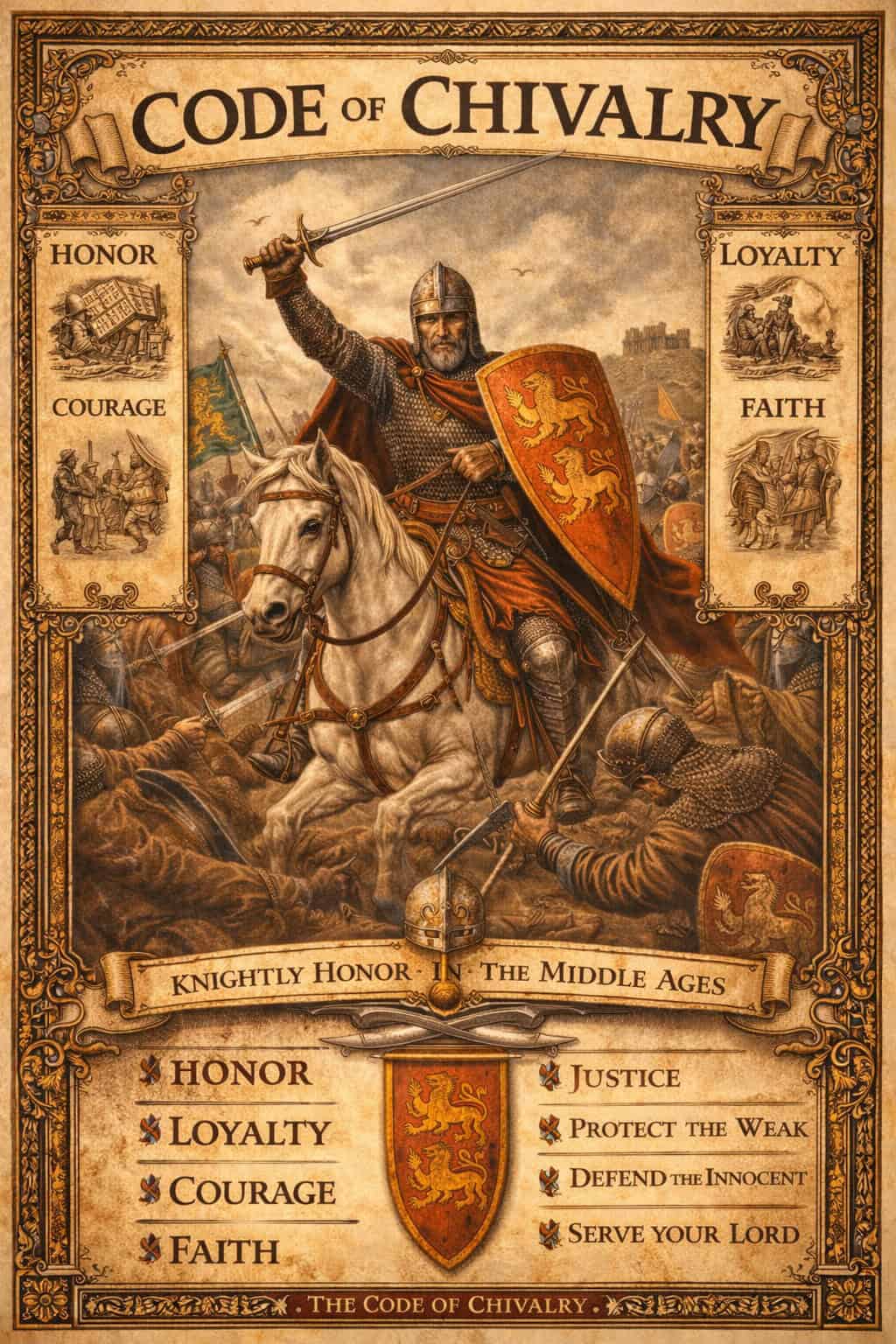
The Code of Chivalry was a system of moral principles that guided the conduct of medieval knights. Emerging during the High Middle Ages, it emphasized loyalty, courage, honor, religious devotion, and the protection of the weak. Although not a formal written law, chivalry shaped aristocratic culture, influenced medieval warfare, and helped define the ideal image of knighthood throughout Europe.
⚔️ Click-to-Reveal: Core Knightly Virtues
Loyalty
Knights were expected to remain faithful to their lord, honor their oaths, and uphold feudal obligations even in times of conflict.
Courage
Bravery in battle defined knighthood, but courage also meant perseverance, discipline, and readiness to face danger.
Honor
A knight’s reputation was essential. Dishonor could damage social standing and permanently affect noble identity.
Protection of the Weak
Chivalric ideals emphasized defending non-combatants, widows, pilgrims, and those unable to protect themselves.
Courtesy
Refined behavior, especially within noble courts, distinguished knights from ordinary warriors.
Religious Devotion
Knights were often portrayed as defenders of Christianity, particularly during the Crusading era.
What Was the Code of Chivalry?
The Code of Chivalry was a system of ethical principles associated with medieval knighthood. It emphasized courage in battle, loyalty to one’s lord, devotion to the Church, honesty, generosity, and the defense of those unable to protect themselves.
While many knights aspired to these ideals, chivalry represented a standard rather than a universal reality. Warfare remained brutal, and not all knights behaved honorably. Nevertheless, the code influenced medieval literature, aristocratic culture, and the broader image of the knight.
Origins of Chivalry
Chivalry developed gradually between the 10th and 12th centuries, particularly in medieval France where heavily armored cavalry became central to warfare. The word itself derives from the Old French chevalerie, meaning “horse soldiery,” reflecting the mounted nature of knightly combat.
As feudal societies stabilized, rulers and church leaders sought ways to moderate the violence of warrior elites. Religious movements such as the Peace of God and Truce of God attempted to limit fighting on certain days and protect non-combatants. These efforts helped shape the emerging expectation that knights should combine martial strength with moral restraint.
By the High Middle Ages, chivalry had evolved into both a military ethic and a social identity tied closely to the nobility.

Chivalry in Medieval Society
Chivalry functioned primarily within aristocratic circles. Knights belonged to a warrior elite whose status depended not only on success in battle but also on reputation, discipline, and public conduct.
A chivalrous knight was expected to:
- Serve his lord faithfully
- Demonstrate bravery without recklessness
- Show mercy when possible
- Uphold justice
- Maintain personal honor
- Protect the weak
These ideals reinforced the hierarchical structure of feudal society, presenting knights as guardians of order in a world frequently shaped by conflict.
However, historians emphasize that chivalry often described how knights should behave, not always how they actually behaved in practice.
Religious Influence on the Chivalric Ideal
Christianity played a major role in shaping knightly values. By the 12th century, the Church increasingly portrayed knights as defenders of the faith.
The Crusades strengthened this connection. Warriors who fought in the Holy Land were sometimes depicted as carrying out sacred duties, merging religious devotion with martial identity.
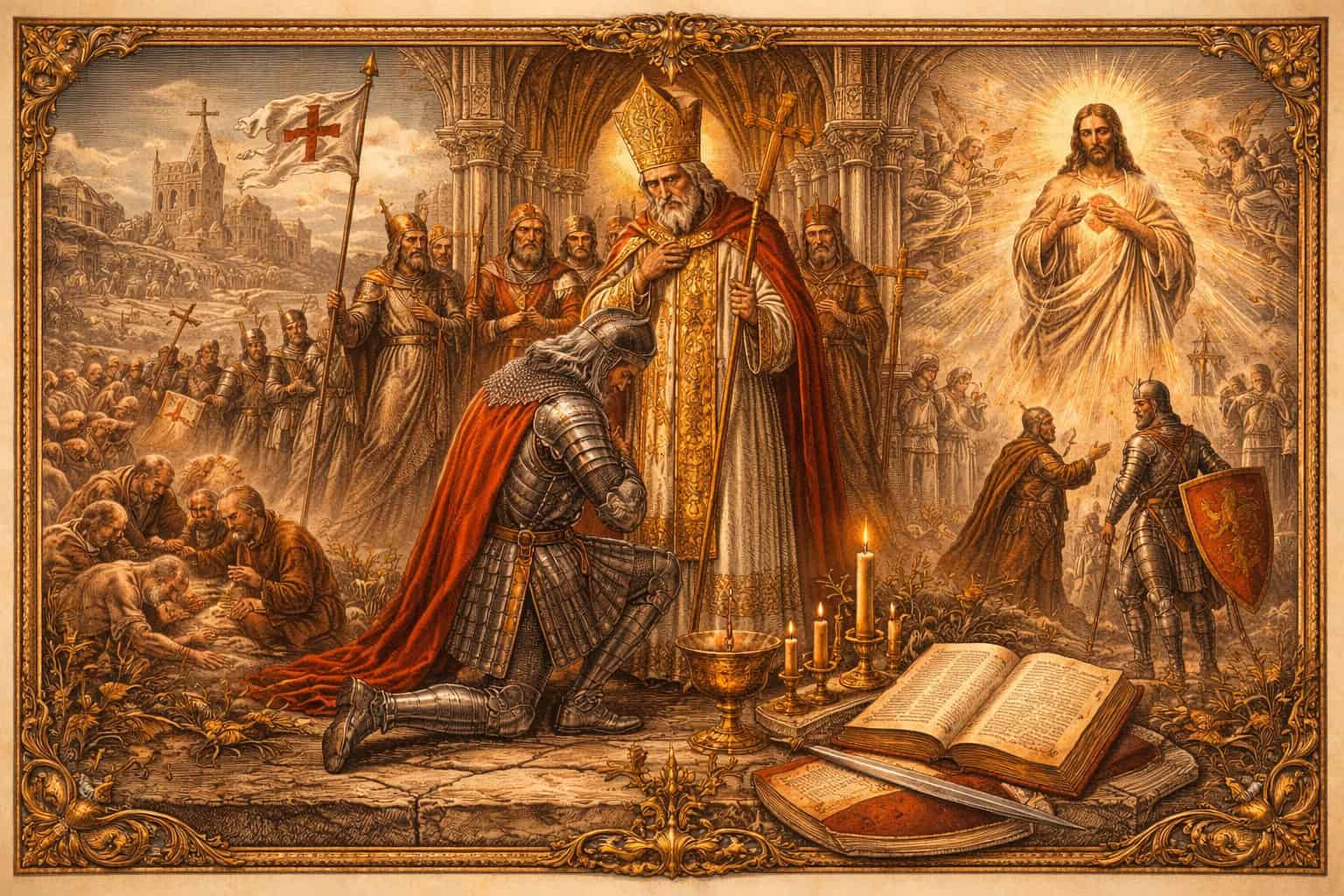
Knightly ceremonies reflected this influence. Some induction rituals resembled religious rites, involving prayer, fasting, and vigils before a candidate was formally dubbed a knight.
The ideal knight therefore combined three identities:
- Warrior
- Nobleman
- Christian
This fusion gave chivalry moral weight beyond simple battlefield conduct.
Literature and the Rise of the Chivalric Image
Medieval literature played a decisive role in popularizing chivalric ideals. Epic poems, romances, and courtly tales celebrated heroic knights whose courage was matched by refinement and loyalty.
One of the earliest examples is The Song of Roland, which portrays the knight Roland as the embodiment of feudal devotion and martial honor.
Later works emphasized courtly love, encouraging knights to demonstrate courtesy, restraint, and admiration toward noblewomen. While often stylized and symbolic, these stories influenced aristocratic culture and helped define the image of the “ideal knight.”
Troubadours and poets further elevated chivalry by transforming real warfare into narratives of honor and virtue.
Historical Texts on Chivalry
Several medieval writers attempted to define knighthood more clearly, transforming chivalry from an unwritten tradition into a subject of serious reflection and instruction.
Geoffroi de Charny, a 14th-century French knight, argued that true nobility derived from courage, discipline, and unwavering commitment to duty. His writings emphasized that honor was earned through action rather than inherited through status alone.
Ramon Llull’s Book of the Order of Chivalry portrayed the knight as a protector of society whose responsibilities extended beyond warfare to include moral leadership and the defense of Christian values.
Another influential work, Ordene de Chevalerie, explored the spiritual symbolism of knighthood and highlighted its connection to religious virtue.
Together, these texts demonstrate that chivalry was both a lived tradition and an intellectual ideal, actively examined and debated by medieval thinkers.
The Core Principles of Chivalry
Though no universal code existed, historians often summarize chivalric expectations into recurring themes:
- Believe in and defend the Christian faith
- Serve one’s lord with loyalty
- Protect the vulnerable
- Act with courage in the face of danger
- Keep promises and speak truthfully
- Show generosity and fairness
- Pursue justice
- Respect honorable opponents
- Avoid unnecessary cruelty
- Preserve personal honor
These principles reflected the medieval desire to discipline a powerful warrior class while preserving its prestige.

Ideal vs. Reality
The contrast between chivalric ideals and medieval warfare could be stark.
Raids, sieges, and political conflicts often resulted in widespread destruction. Knights sometimes pursued wealth, land, or influence with little regard for ethical restraint.
Yet ideals matter historically even when imperfectly followed. Chivalry influenced how medieval elites judged behavior, educated young nobles, and commemorated reputation.
A knight accused of dishonor risked lasting damage to his social standing.
The Spread of Chivalry Across Europe
Following the Norman expansion and the interconnected politics of medieval kingdoms, chivalric culture spread throughout Western Europe.
Tournaments showcased knightly skill while reinforcing aristocratic identity. Heraldry, ceremonial armor, and elaborate rituals further distinguished the knightly class.
By the Late Middle Ages, chivalry had become inseparable from noble culture, even as warfare began shifting toward professional armies and new military technologies.
The Decline of Traditional Chivalry
Several long-term developments gradually weakened the traditional military dominance of knights, reshaping warfare across late medieval Europe.
Key factors included:
- The rise of infantry forces capable of countering mounted warriors
- Advancements in weaponry, including longbows and early firearms
- The growth of centralized monarchies that relied less on feudal levies
- The emergence of professional soldiers trained for organized warfare
By the 15th century, heavily armored cavalry no longer dominated battlefields in the same way, signaling a major transition in military strategy.
However, the cultural prestige of chivalry endured. Renaissance writers and later historians continued to portray the medieval knight as a lasting symbol of discipline, honor, and heroic conduct.
The Legacy of the Code of Chivalry
Today, chivalry survives less as a military concept and more as a cultural metaphor for integrity, courage, and respectful conduct.
Expressions such as “a knight in shining armor” reflect the lasting romantic image created by medieval literature.
While modern society differs greatly from feudal Europe, the idea that strength should be guided by ethics remains one of the most enduring contributions of chivalric tradition.
❓ Code of Chivalry – Frequently Asked Questions
Did all medieval knights follow the Code of Chivalry?
No. Chivalry represented an ideal rather than a universal reality. While many knights aspired to these standards, warfare and political ambition often conflicted with ethical expectations.
Was the Code of Chivalry a written law?
There was no single official code. Instead, chivalric principles appeared across literary works, knightly manuals, and religious teachings.
How did religion influence chivalry?
Christian ideals helped shape knightly behavior, encouraging the defense of the Church and the protection of vulnerable populations.
When did chivalry decline?
Traditional chivalry weakened in the late medieval period as professional armies and new weapons reduced the military dominance of mounted knights.
Why is chivalry still remembered today?
Chivalry continues to symbolize integrity, courage, and honorable conduct, largely due to its powerful portrayal in medieval literature and later historical writing.
📜 Glossary of Chivalry Terms
A moral and social code associated with medieval knighthood emphasizing honor, loyalty, and courage.
The hierarchical system that structured medieval society through obligations between lords and vassals.
A literary and cultural tradition celebrating noble devotion and refined conduct toward women.
The ceremonial act through which a squire was formally made a knight.
A staged combat event where knights demonstrated skill and reinforced aristocratic prestige.
An epic medieval poem portraying heroic knighthood and feudal loyalty.