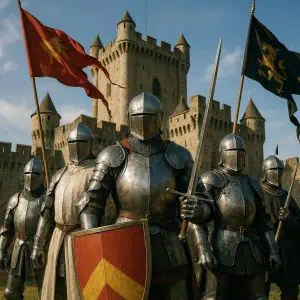
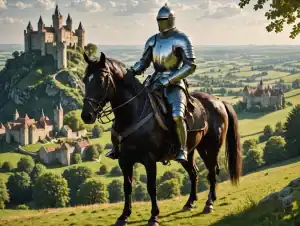
Warhorses, especially the famed destrier, were essential to a medieval knight’s effectiveness in battle. Bred for strength, agility, and endurance, these steeds were trained for combat from a young age. A knight’s horse was a prized possession, often more valuable than his weapons, and played a vital role in both warfare and ceremonial events. The bond between knight and warhorse was one of mutual trust, forged through constant training and shared experience on the battlefield.

A medieval knight generally possessed several horses which were used for different purposes. For instance, some horses were reserved for travelling purposes while others accompanied the medieval knight to the battlefield.
The Medieval knight’s warhorse could be seen accompanied by his squire writing new tales of chivalry and bravery.

Medieval Knight Breed of Horse
Various breeds of horses were used by medieval knights. The best-known of these breeds was called a Destrier which accompanied a medieval knight to battlefields and various tournaments.

It was also known as the “Great Horse” as it was the most important depiction of a medieval knight’s warhorse. For general travelling purposes, other breeds such as Palfrey and Ambler would accompany the medieval knight.
Training – Destrier War Horse
Special attention was paid to the training of a medieval knight’s warhorse. Since two of the most important components of the life of a medieval knight on a warhorse were battlefield and individual combat at tournaments, the warhorse was specifically trained for these purposes.

The warhorse was also trained to trample the bodies of the fallen enemies on the battleground in addition to being trained for biting and kicking when commanded.
William The Conqueror – War Horse
A Medieval knight and his warhorse went into battle multiple times in his life since wars were common during medieval times. The medieval warhorse that was most commonly used was called a Destrier.
It was the sturdiest and most active of all horses and therefore was preferred on the battleground.
This warhorse was brought to England by William the Conqueror after the famous Norman Conquest of England in 1066.

Knights Warhorse in Battle
A Medieval knight on a warhorse was one of the most essential elements of a medieval battlefield. Training of the knight’s warhorse was specifically carried out to accomplish different tasks during the battle.
In the event of a battle, for instance, the horse was trained to trample the bodies of enemies on the battlefield and even bite and kick when ordered by his owner.

Since a medieval knight on the battlefield had his armour and shield with him, the warhorses needed to be massive with a lot of stamina to bear the burden of the weight of his master, his armour and weaponry and needed to be able to understand and carry out his commands, only years of intensive training of a warhorse could accomplish this.

Warhorse Armour – Barding
The image of a medieval knight on a warhorse was particularly significant in that special Armour was used for the horse.

The armour of the horse was made of steel and leather and was called “barding”.

The body parts of the horse that was generally armoured were the neck, head, and chest. Additionally, the rear of the horse was covered with a padded cloth made of leather.

Knights Warhorse Summary
Special types of horse breeds were used for a medieval knight on a horse. These breeds have generally become extinct although some of them such as Clydesdales and Quarter horses have been reproduced in recent times.
The horse, before accompanying his master to the battlefield, was highly decorated and in addition to barding, medieval warhorses were covered in a special kind of ornamented cloth called a trapper.

Frequently Asked Questions about Knights’ Warhorses
What was a Destrier?
The Destrier was the most prized medieval warhorse, known for its strength, agility, and training for battle. It was the preferred mount of knights during tournaments and warfare.
Were all knights able to afford a Destrier?
No. Destriers were extremely expensive, and only the wealthiest knights or nobles could afford them. Many knights relied on more affordable horses like coursers or rounceys.
What other types of horses did knights use?
Knights also used coursers for fast movement, rounceys as everyday riding horses, and palfreys for travel and ceremonial occasions.
How were warhorses trained for battle?
Warhorses were specially trained to remain calm in chaotic battlefields, charge enemies, and respond quickly to a knight’s commands, even when surrounded by noise and danger.
Did warhorses wear armor?
Yes. In major battles and tournaments, valuable warhorses were often equipped with barding—protective armor made of leather, chainmail, or even plate steel.
Were medieval warhorses large like modern draft horses?
No. Contrary to popular belief, medieval warhorses were not giant draft animals but rather strong, muscular horses, typically around 15–16 hands high, built for agility as well as power.
What role did horses play in tournaments?
In tournaments, knights displayed their skills in jousting and melee combat while mounted on Destriers or coursers, making the horse an essential part of their performance and prestige.