Medieval musicians played a vital role in the cultural life of the Middle Ages, providing entertainment, religious devotion, and storytelling in a largely oral society. They performed in royal courts, towns, villages, and religious institutions, helping to preserve history, spread news, and reinforce cultural values.
These musicians ranged from wandering minstrels and troubadours, who travelled widely singing tales of love, chivalry, and heroism, to clerical musicians who performed sacred music in monasteries and cathedrals. Using instruments such as the lute, harp, flute, and drum, medieval musicians brought music to people from all levels of society.
What were medieval musicians?
Medieval musicians were performers who provided music for churches, royal courts, towns, and festivals. They preserved stories, spread news, and entertained society using instruments such as lutes, harps, flutes, and drums.
🎵 Timeline of Medieval Music (c. 500–1500)
Early Middle Ages (c. 500–1000)
Religious music dominated medieval life. Monasteries preserved sacred chant traditions, most notably Gregorian chant, which was monophonic and sung in Latin. Music was primarily used for worship, prayer, and liturgy.
10th–11th Centuries
Early forms of musical notation developed, allowing melodies to be recorded more accurately. Instruments such as the harp, flute, and organistrum became more common in both religious and secular settings.
High Middle Ages (c. 1100–1300)
Secular music flourished with the rise of troubadours, trouvères, and minstrels. Themes of courtly love, chivalry, and heroic deeds became popular, while polyphony (multiple vocal lines) emerged in church music.
13th–14th Centuries
Advances in rhythmic notation allowed for more complex compositions. Famous collections such as the Cantigas de Santa Maria combined sacred themes with sophisticated musical forms. Musicians slowly gained greater social acceptance.
Late Middle Ages (c. 1350–1500)
Music became increasingly refined, bridging the medieval and Renaissance worlds. Composers like Guillaume de Machaut developed elaborate secular and sacred works. The formation of musicians’ guilds raised professional status and stability.
Transition to the Renaissance
Medieval musical traditions laid the foundation for Renaissance music, influencing harmony, notation, and performance practices that would dominate Europe in the 15th and 16th centuries.
Medieval Musical Instruments
There was a wide variety of musical instruments in medieval times, generally divided into string, woodwind, and percussion instruments. Music was often played alongside singing, especially in secular performances.
Common medieval instruments included the lute, harp, rebec, gittern, timbrel, cymbals, and adufe. One important early instrument was the organistrum, a large stringed instrument in which the strings were vibrated by a rotating wheel, making it an ancestor of the hurdy-gurdy.
Another notable instrument was the bladder pipe, which consisted of a reed attached to an animal bladder. The musician blew air into the bladder through a mouthpiece, producing sound through holes in the reed. Some versions used two parallel pipes. This instrument is frequently depicted in illustrations from the Cantigas de Santa Maria, a famous 13th-century collection of sacred songs composed for the court of King Alfonso X “El Sabio” of Castile.
🎵 Click to Reveal: Medieval Musicians
Who were medieval musicians?
Medieval musicians were performers who entertained royal courts, churches, towns, and villages. They played a vital role in preserving stories, spreading news, and providing music in a largely oral society.
What instruments did they use?
Common instruments included the lute, harp, rebec, gittern, flute, drum, and organistrum. Some instruments were introduced through Islamic and Eastern influences.
What themes did medieval music explore?
Popular themes included courtly love, chivalry, heroic legends, religion, and royal praise. Northern traditions often celebrated heroes, while southern Europe focused on love and poetry.
How did the Church view musicians?
The Church often condemned musicians for physical performances such as dancing and acrobatics. Over time, however, sacred music became central to worship, and clerical musicians gained respect.
Who were troubadours and minstrels?
Troubadours and trouvères were poet-musicians, while minstrels performed ballads and epics. Jongleurs assisted performers, and waits served towns as official musicians and watchmen.
Did musicians form guilds?
Yes. By the 14th and 15th centuries, musicians formed guilds in cities such as Paris and London, raising their status and protecting professional standards.
Themes in Medieval Music
Medieval musicians used a wide range of themes in their songs and compositions. Many themes were inherited from ancient traditions and adapted to medieval values.
Common themes included:
- Heroic legends and epic tales
- Courtly love and romance
- Chivalry and knighthood
- Religious devotion and theology
- Praise of kings and noble patrons
In northern Europe, bards and skalds often celebrated heroes, warriors, and legendary figures, while musicians in southern Europe focused more heavily on love poetry and the accomplishments of knights.
Musicians employed by royal courts frequently composed songs praising kings, dynasties, and royal traditions. From the high medieval period onward, theological and spiritual themes became increasingly prominent in both sacred and secular music.
Medieval Musicians and the Church
The relationship between medieval musicians and the Church was complex and changed over time. While sacred music was central to Christian worship, some secular performers were criticised by Church authorities, particularly when performances involved excessive physical movement, acrobatics, or theatrical gestures.
Certain clerics viewed such behaviour as distracting or morally questionable. As a result, some wandering musicians were regarded with suspicion and occupied a low social status, lacking legal protection and relying on patronage or public generosity.
However, it is important to note that the Church did not universally condemn musicians. Over time, Church thinkers began to distinguish between improper performance and music that was spiritually uplifting. By the middle medieval period, greater emphasis was placed on musical skill, religious meaning, and intellectual value, rather than physical display.
The Decline of Physical Performance in Music
The Church played a significant role in shaping medieval musical culture. Thinkers such as Peter Cantor argued that musicians who avoided excessive physical performance and focused on useful, moral, or spiritual music were not sinful.
Later theologians, including Thomas Aquinas, influenced by the works of Aristotle, argued that music had a legitimate and even necessary role in society. This helped improve attitudes toward musicians, particularly those who served religious or educational purposes.
Eastern Influence on Medieval Music
One of the most important influences on medieval music during the middle medieval period came from increased contact with the Islamic world, particularly during the Crusades.
Through these encounters, Europeans were introduced to:
- New musical instruments
- Advanced musical theory
- Refined poetic traditions
This cultural exchange inspired innovation among medieval musicians and contributed to the growing popularity of troubadours, trouvères, and minstrels. Music gradually became a more respected profession, especially within noble and urban settings.
Types of Medieval Musicians
There were several distinct kinds of medieval musicians, each with different roles:
- Troubadours – travelling poets and musicians, mainly from southern France, known for songs of courtly love
- Trouvères – northern French musicians, often attached to noble courts
- Minstrels – performers of ballads, epics, and legendary tales
- Jongleurs – entertainers who assisted troubadours and minstrels, sometimes combining music with performance
- Waits – town-employed musicians who originally acted as watchmen, using music to signal danger or time
Over time, the Waits evolved into respected civic musicians, performing at ceremonies and official events, especially in England.
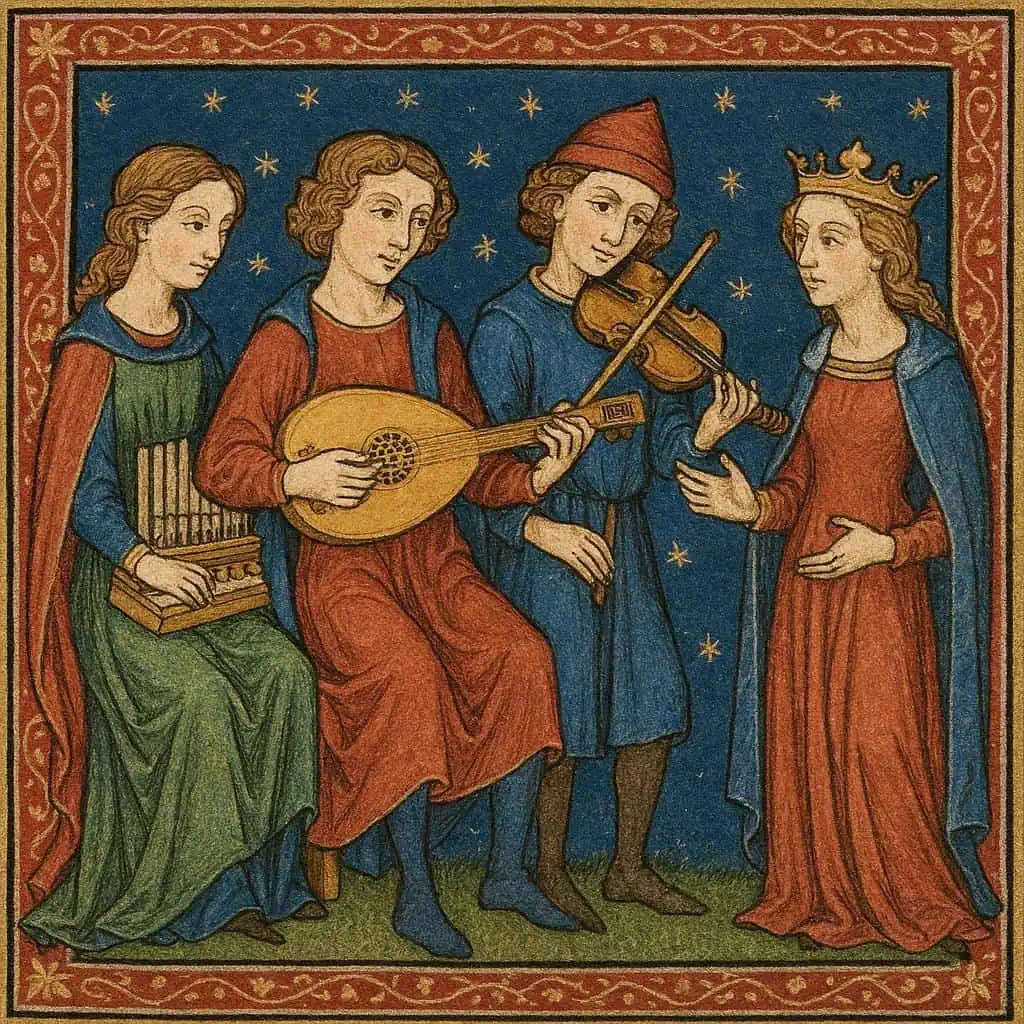
Medieval Musicians and Guilds
By the late medieval period, attitudes toward musicians improved significantly. Musicians were increasingly allowed to perform in churches, and their skills were recognised as valuable.
The formation of musicians’ guilds, including one in France in 1321 and another in England in 1469, marked a turning point. These guilds helped regulate training, protect members, and raise the social status of musicians within medieval society.
Famous Medieval Musicians
Several medieval musicians gained lasting recognition, including Guillaume de Machaut of France, John Hanboys of England, Maestro Piero of Italy, Mönch von Salzburg of Germany, and Martinus Fabri of Holland.
These figures belonged mainly to the high and late medieval periods, when musical traditions were becoming more sophisticated and widely accepted. Italian musicians, in particular, were often regarded as leaders in musical innovation.
The traditions established by medieval musicians directly influenced Renaissance and early modern music, ensuring their lasting legacy in European cultural history.
❓ Medieval Musicians – Frequently Asked Questions
Who were medieval musicians?
Medieval musicians were performers and composers who provided music for churches, courts, towns, and festivals during the Middle Ages.
What instruments did medieval musicians use?
Common instruments included the lute, harp, rebec, flute, drum, gittern, organistrum, and bladder pipe.
Were medieval musicians respected?
Their status varied. Church musicians were respected, while wandering minstrels often had low social standing, especially in early periods.
Did the Church allow music?
Yes. Sacred music was central to worship, though some secular performances were criticised for excessive physical display.
What were troubadours and minstrels?
Troubadours composed and sang courtly love poetry, while minstrels performed ballads, epics, and popular entertainment.
Did medieval music influence later periods?
Yes. Medieval music laid foundations for Renaissance harmony, notation, and Western musical traditions.
Were musicians organised into guilds?
By the late Middle Ages, musicians formed guilds in places like France and England, improving their legal and social status.
🎵 Medieval Musicians Knowledge Quiz
📘 Medieval Music Glossary
Troubadour – A medieval poet-musician who composed songs of courtly love, mainly in southern France.
Minstrel – A professional performer who entertained with music, storytelling, and epic poems.
Gregorian Chant – Monophonic sacred music sung in Latin as part of Christian worship.
Organistrum – An early stringed instrument played by turning a wheel to vibrate the strings.
Jongleur – An entertainer who assisted musicians, often combining music with performance.
Waits – Town-employed musicians who acted as watchmen and ceremonial performers.
Cantigas de Santa Maria – A 13th-century collection of sacred songs commissioned by Alfonso X of Castile.