
Medieval Times
Medieval Times
Pope Joan is one of the most intriguing and controversial figures in medieval history. According to legend, she was a woman who disguised herself as a man and rose through the ranks of the Catholic Church, eventually becoming Pope. Her story has been passed down for centuries, blending myth, folklore, and religious controversy.
Although there is no verified historical record of her papacy, the legend of Pope Joan has persisted, fueling debate among historians, theologians, and skeptics alike. Many believe her tale was fabricated to serve as a moral lesson or to critique the Church’s hierarchy. Others argue that records may have been deliberately erased to cover up her existence.The earliest mentions of a female Pope date back to the 13th century.
This initial mention was picked up by other writers and the legend propagated over the centuries. By the late Middle Ages, many Europeans firmly believed that Pope Joan was an actual figure. However, subsequent investigations by the Catholic and Protestant scholars revealed that Pope Joan couldn’t have been a real person.

The earliest mention of the female Pope Joan was found in the works of a Dominican chronicler. Although the work itself dates to the 13th century, the chronicler claims that the female Pope reigned much earlier in 1099. In this first mention of the female Pope, the chronicler says that she was able to mount a horse when she gave birth to a child.
It was then that other people discovered her true identity. The chronicler says that the female Pope was then dragged behind a horse and stoned to death. The account also claims that this led to the establishment of the ‘fast of the female Pope.’
A number of variations of the legend exist. As opposed to the first account which is rather limited, subsequent accounts embellish more details regarding the life of Pope Joan. In one of these legends, Pope Joan was led to the city of Athens in the clothes of a man by her lover.
In the city, Joan learned arts and attained knowledge so that she soon had no equal in the city.
Her exceptional knowledge eventually led her to be elected as the Pope. As per this variation of the legend, Pope Joan gave birth during one of the processions of the Church. The place where she gave birth came to be known as the ‘shunned street.’ Legend had it that she remained the Pope for two years and seven months.
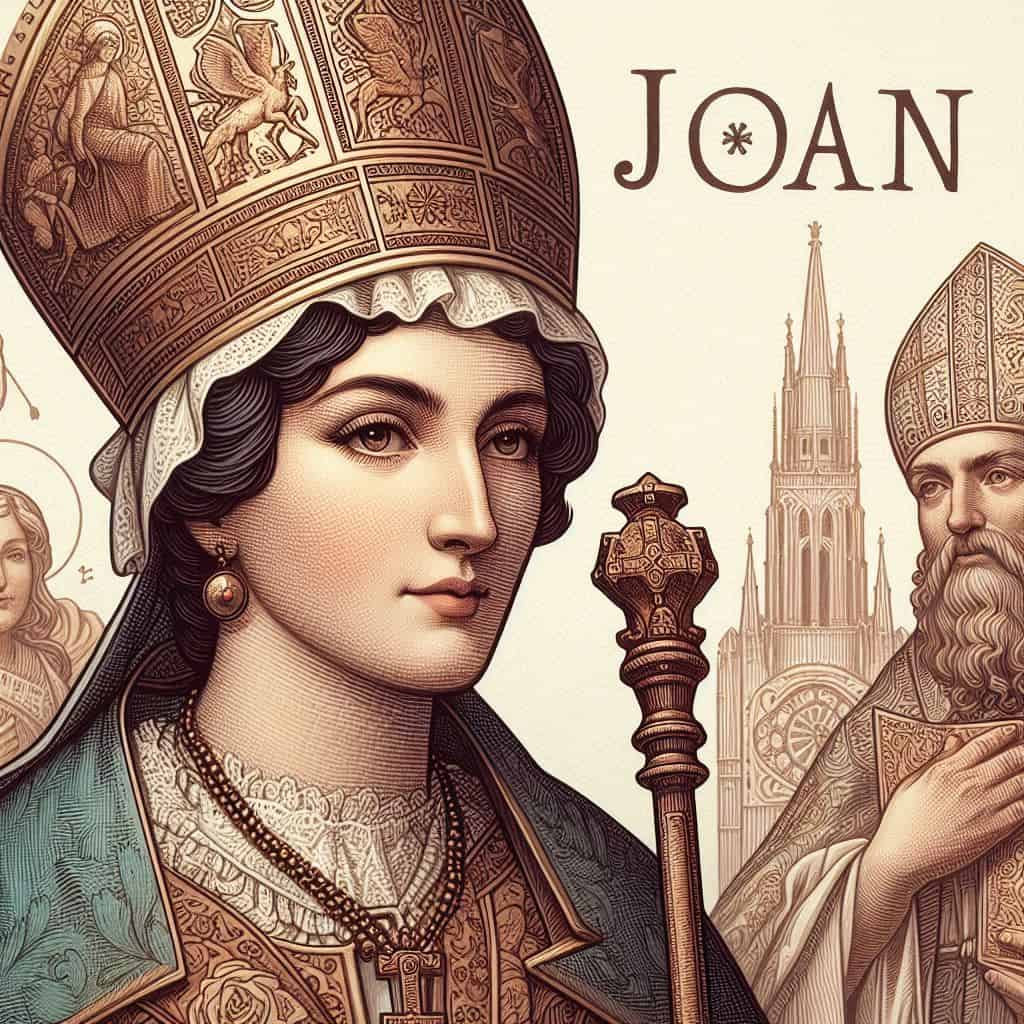
In some accounts, it is claimed that Pope Joan was put to death after it was discovered that she was a woman. Other accounts reveal that she died of childbirth. Yet other accounts reveal that Pope Joan was actually imprisoned after her identity was revealed. She continued to be in prison until her son grew up, became a Bishop, and had her entombed in a cathedral.
Some chroniclers also painted a vivid picture of the travails that visited different parts of Europe once the Pope was discovered to be a woman. As per one of these accounts, blood rained from the skies for several days after the discovery. Large locusts with teeth also appeared in France and caused diseases and pestilence among the people.
Some of the legends surrounding Pope Joan also state that after Joan was discovered, the Church mandated a method to confirm that the incumbent Pope was a man. To do this, a special chair was devised with a hole in it. This was known as the dung chair. To ascertain that the Pope was a man, the Pope would be asked to sit down on a chair. A cardinal would then check the Pope’s body and make sure he was a man in an elaborate ceremony.
During the Reformation, attempts began to critically analyze the history of the Church. During this time, some scholars set their focus on the story of Pope Joan. Critical analysis of several scholars revealed that Pope Joan was not an actual figure in ecclesiastical history. Instead, her story had largely been invented by various medieval chroniclers.