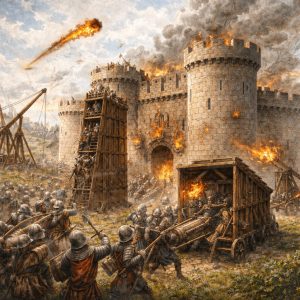
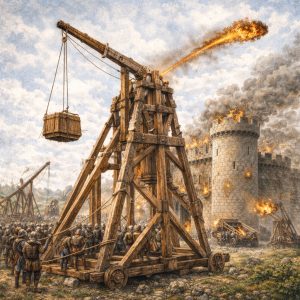
The Warwolf siege weapon, often described in modern sources as the Warwolf trebuchet, was the most powerful and intimidating siege engine of the Middle Ages, commissioned by King Edward I of England during his campaign to subdue Scotland. Built for the siege of Stirling Castle in 1304, the Warwolf represented the peak of medieval military engineering, capable of launching enormous stone projectiles with overwhelming force. More than a weapon, the Warwolf siege weapon served as a symbol of royal power and psychological warfare, securing its place as one of the most legendary siege engines in medieval English and European military history.

While many siege engines relied on numbers, this single war machine demonstrated the power of calculated engineering and psychological warfare. The name Warwolf became legendary not only for its destructive capability but also for the dramatic moment when the Scottish garrison attempted to surrender—only to be forced to endure the full wrath of the Warwolf as Edward insisted on testing his new siege engine. The story of the Warwolf captures the brutal intensity of medieval warfare, where technology and intimidation worked hand in hand.

Warwolf Size and Engineering Mastery
The few extant mentions of the Warwolf trebuchet from the medieval times cast light on its sheer size. According to such sources, Edward ordered five master carpenters and 49 other labourers to work on the trebuchet. These workers continued constructing the Warwolf for 3 months, making it the largest known trebuchet. Other medieval sources mention that when the trebuchet was disassembled, its pieces had to be carried in 30 wagons.
According to modern estimates, the trebuchet would have risen to a height of 300 to 400 feet. It could effectively raid stones at a wall 200 yards away, hurled at a speed of 120 miles per hour.

Warwolf in Action: Siege Use and Impact
In 1304, King Edward of England laid siege to the Stirling Castle as part of the English response to Scottish Wars of Independence. At this time, the English had up to 13 siege engines with them.
However, the Scots holding the castle refused to surrender. Edward then ordered the construction of the trebuchet and the work on it commenced within sight of the castle walls.
Witnessing the construction of such a mammoth trebuchet, the Scots tried to surrender to Edward but Edward sent back a part of the Scottish garrison into the castle so that he could still test his trebuchet’s prowess.
When used against the Stirling castle, the trebuchet destroyed the gatehouse and was as formidable in its use as its size. Given its size, it could toss stones of up to 300 pounds in weight which, when thrown against the Stirling Castle, effectively demolished the parts of the curtain wall where they hit.
Medieval Chronicles and Mentions of the Warwolf
Very few medieval mentions of the Warwolf trebuchet exist, even though it was a technological marvel of its time. The extant mentions of the trebuchet come directly from the documents from King Edward’s court. These document detail the payments made to workers for the construction of the trebuchet.
According to them, Edward ordered the payment of 10 shillings to the workers and the overall construction of the trebuchet itself cost upwards of 40 pounds.
Another mention of the trebuchet mentions another worker being paid for guarding the material used to construct the trebuchet. Apart from these, no detailed mentions of the trebuchet exist nor are any remains of it extant today.
What was the Warwolf trebuchet?
The Warwolf was a massive medieval trebuchet built by the English during the siege of Stirling Castle in 1304. It was designed to launch heavy projectiles to break down castle defenses.
How big was the Warwolf trebuchet?
The Warwolf was one of the largest trebuchets ever constructed, capable of hurling stones weighing over 300 pounds across great distances.
Who ordered the construction of the Warwolf?
King Edward I of England commissioned the Warwolf to help force the Scottish defenders of Stirling Castle to surrender.
What made the Warwolf famous in medieval history?
The Warwolf is famous not only for its size and power but also for the story that Edward I insisted on testing it even after the Scots attempted to surrender.
How did the Warwolf influence medieval siege warfare?
The Warwolf demonstrated the effectiveness of large counterweight trebuchets, combining engineering skill with psychological warfare to break enemy morale.