The First Crusade (1096–1099) was a Christian military expedition launched after Pope Urban II’s call at the Council of Clermont in 1095. Its goal was to support Eastern Christians and capture Jerusalem. Led by European nobles rather than kings, crusader armies fought through Anatolia and Syria, capturing Antioch before taking Jerusalem in 1099. The crusade resulted in the creation of several Crusader States and had lasting political, religious, and cultural consequences for Europe and the Middle East.
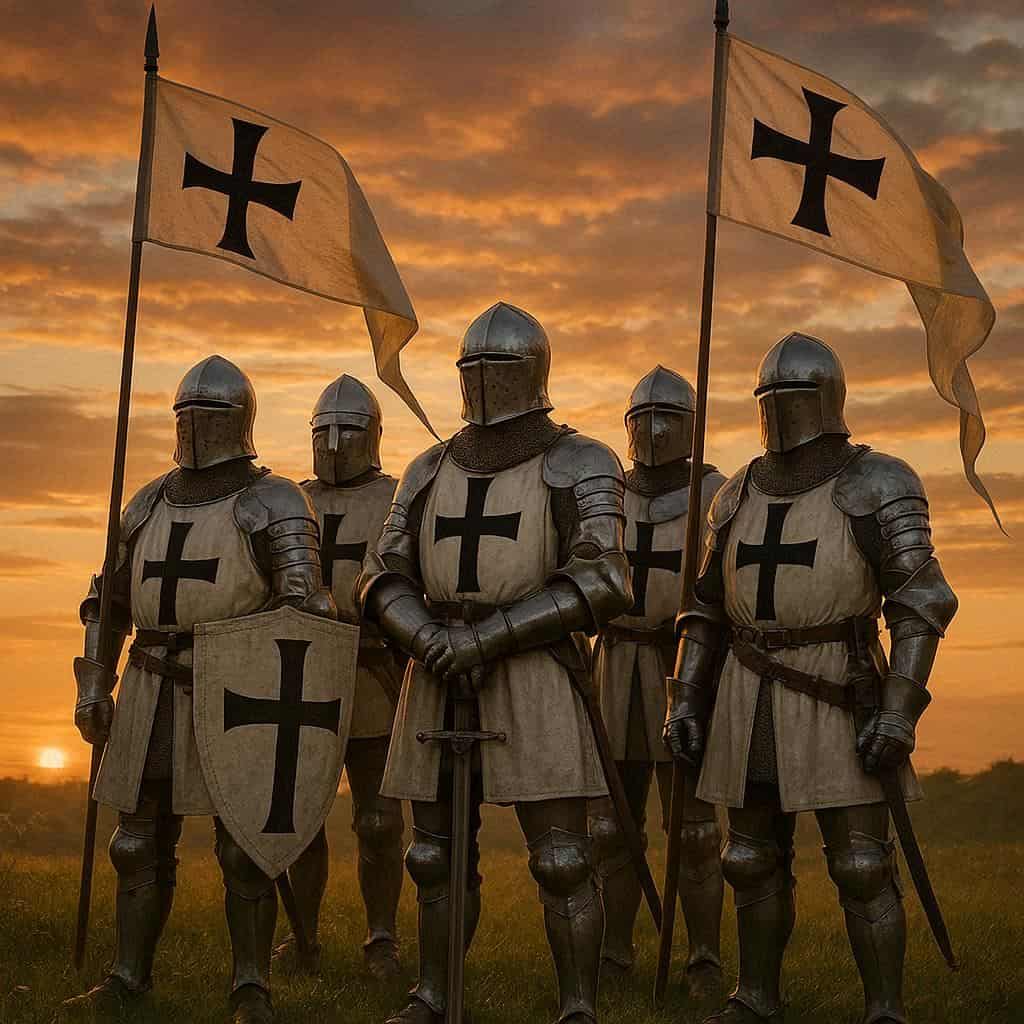
First Crusade Timeline
- 1095 – Pope Urban II calls for a crusade at the Council of Clermont
- 1096 – Crusading armies depart Western Europe
- 1097 – Crusaders capture Nicaea and cross Anatolia
- 1098 – Siege and capture of Antioch
- 1099 – Crusaders capture Jerusalem
- 1099–1100 – Establishment of the Crusader States
Background and Causes
By the late 11th century, much of the eastern Mediterranean, including Jerusalem, was under Muslim rule. Christian pilgrims had generally been allowed access to holy sites, but changing political conditions—particularly conflicts involving Seljuk Turkish expansion—created instability in the region.
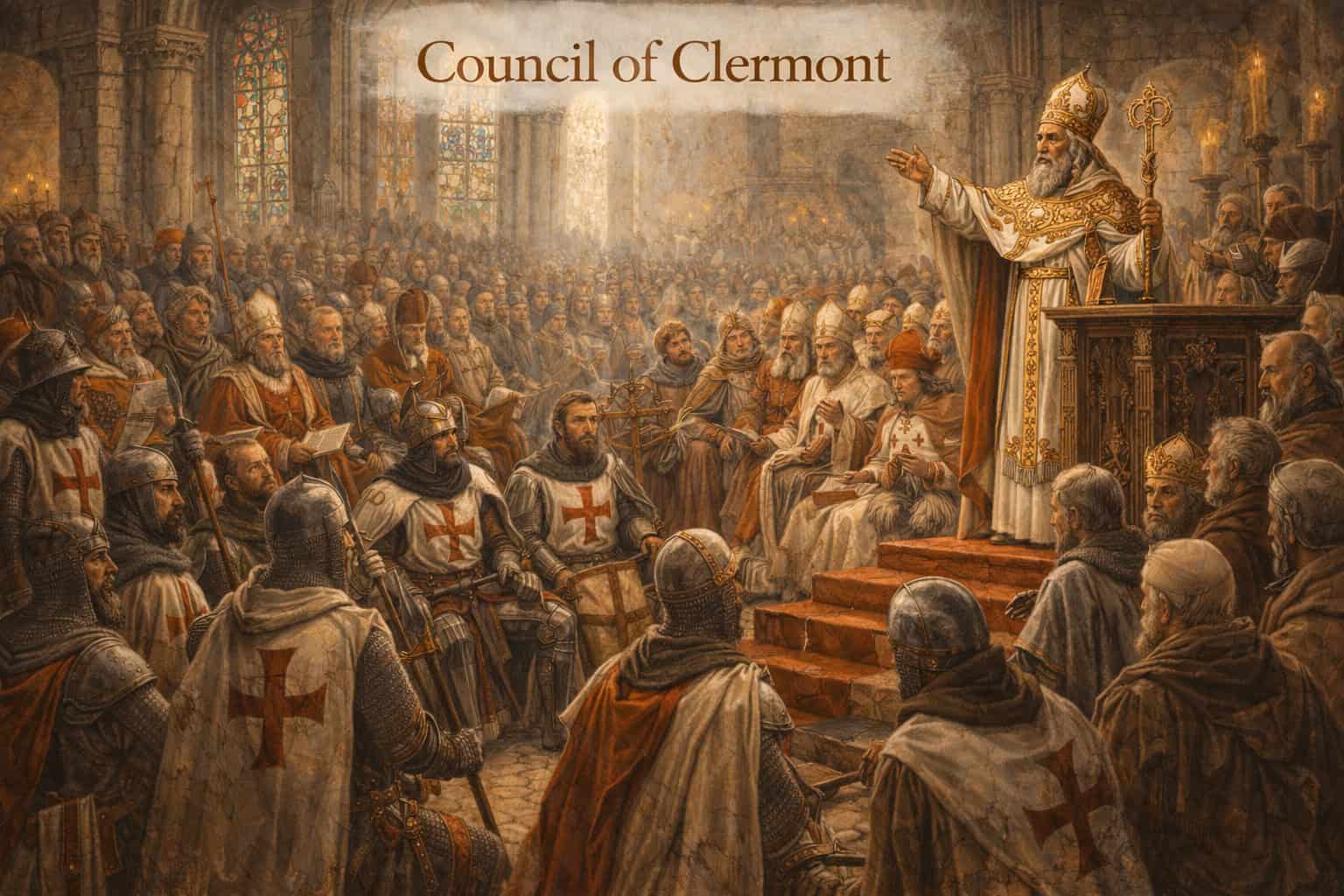
In 1095, representatives of the Byzantine Empire appealed to the papacy for military assistance. In response, Pope Urban II addressed the Council of Clermont, urging Western Christians to aid Eastern Christians and reclaim Jerusalem. Participants were promised spiritual rewards, including remission of sins, a powerful incentive in medieval society.
The Journey to the East
The First Crusade was not a single army but a series of expeditions. Early, poorly organized groups—often referred to as the “People’s Crusade”—suffered heavy losses before reaching the eastern Mediterranean.
The main crusading forces, led by nobles rather than kings, departed in 1096. Prominent leaders included Bohemond of Taranto, Godfrey of Bouillon, and Raymond IV of Toulouse. A papal representative, Adhemar of Le Puy, served as spiritual leader.

Major Campaigns and Battles
Siege of Nicaea and Anatolia
In 1097, crusader forces captured Nicaea with Byzantine assistance. They then crossed Anatolia, facing severe shortages of food, water, and supplies.
Siege of Antioch (1097–1098)
The prolonged siege of Antioch tested the crusaders’ endurance. After capturing the city, they were themselves besieged by Muslim relief forces. Contemporary sources describe famine, disease, and internal tensions. The eventual victory strengthened crusader resolve but came at a high human cost.

The Capture of Jerusalem (1099)
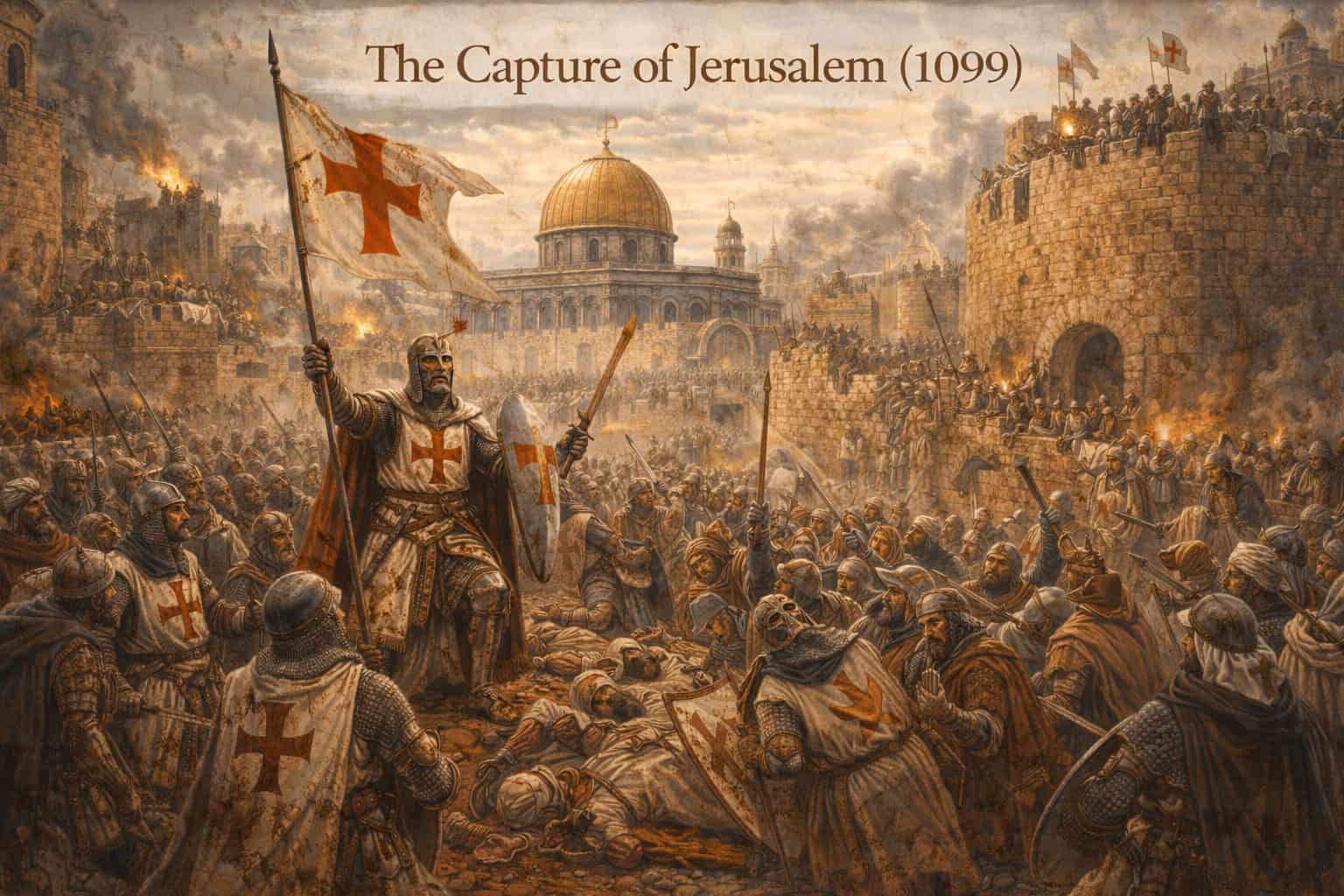
In June 1099, crusader armies reached Jerusalem, then under Fatimid control. After a short but intense siege, the city fell in July 1099.
Contemporary Christian and Muslim chroniclers describe widespread killings following the capture. Modern historians note that casualty figures vary widely and that medieval accounts often exaggerated numbers for rhetorical effect. What is clear is that the sack of Jerusalem was a brutal episode that left a lasting legacy of trauma and resentment.
Crusader States and Aftermath
Following the conquest, the crusaders established several Latin Christian states, including the Kingdom of Jerusalem, the County of Tripoli, and the Principality of Antioch.
These states relied heavily on continued support from Europe and constant military defense. Although they survived for generations, they remained vulnerable and contested, setting the stage for later crusades and prolonged conflict with surrounding Muslim powers.
Historical Significance
The First Crusade was unique among crusading expeditions for its success in achieving its primary objective. It transformed medieval warfare, intensified religious divisions, and reshaped political structures in both Europe and the Near East.
Modern historians emphasize that the crusade should be understood not as a single-minded religious war, but as a complex movement driven by faith, social pressures, political ambition, and economic opportunity.
First Crusade FAQ
What caused the First Crusade?
The First Crusade was launched after Pope Urban II called for military aid at the Council of Clermont in 1095. The campaign was motivated by a mix of religious devotion, concern for Christian pilgrims, political pressures, and appeals from the Byzantine Empire for help against Seljuk Turkish expansion.
Who led the First Crusade?
The First Crusade was led by prominent nobles rather than kings. Key leaders included Godfrey of Bouillon, Bohemond of Taranto, Raymond of Toulouse, and Baldwin of Boulogne. The expedition also involved thousands of knights, soldiers, and non-combatants from across Europe.
What happened when Jerusalem was captured in 1099?
After a short siege, crusader forces captured Jerusalem in July 1099. Contemporary Christian and Muslim sources describe widespread killings following the city’s fall. Modern historians note that casualty figures vary and are often exaggerated, but agree that the sack of Jerusalem was a violent and traumatic event.
Why was the First Crusade significant?
The First Crusade was significant because it resulted in the establishment of crusader states in the eastern Mediterranean and reshaped relations between Christian and Muslim societies. It marked the beginning of nearly two centuries of crusading activity and had lasting political, religious, and cultural consequences.