Throughout the Middle Ages, armies developed an array of powerful castle siege weapons designed to defeat even the strongest stone fortifications. As medieval castles grew higher, thicker, and more complex, attackers responded with increasingly advanced medieval siege weapons capable of smashing gates, breaching walls, and striking defenders from a distance.
These siege weapons ranged from simple yet devastating tools such as the battering ram, to highly engineered machines like the trebuchet, ballista, and mangonel. Each weapon served a specific role in medieval siege warfare, whether it was delivering crushing force, launching projectiles over walls, or allowing soldiers to assault battlements directly. Together, these weapons highlight both the ingenuity and brutality of warfare during this period.
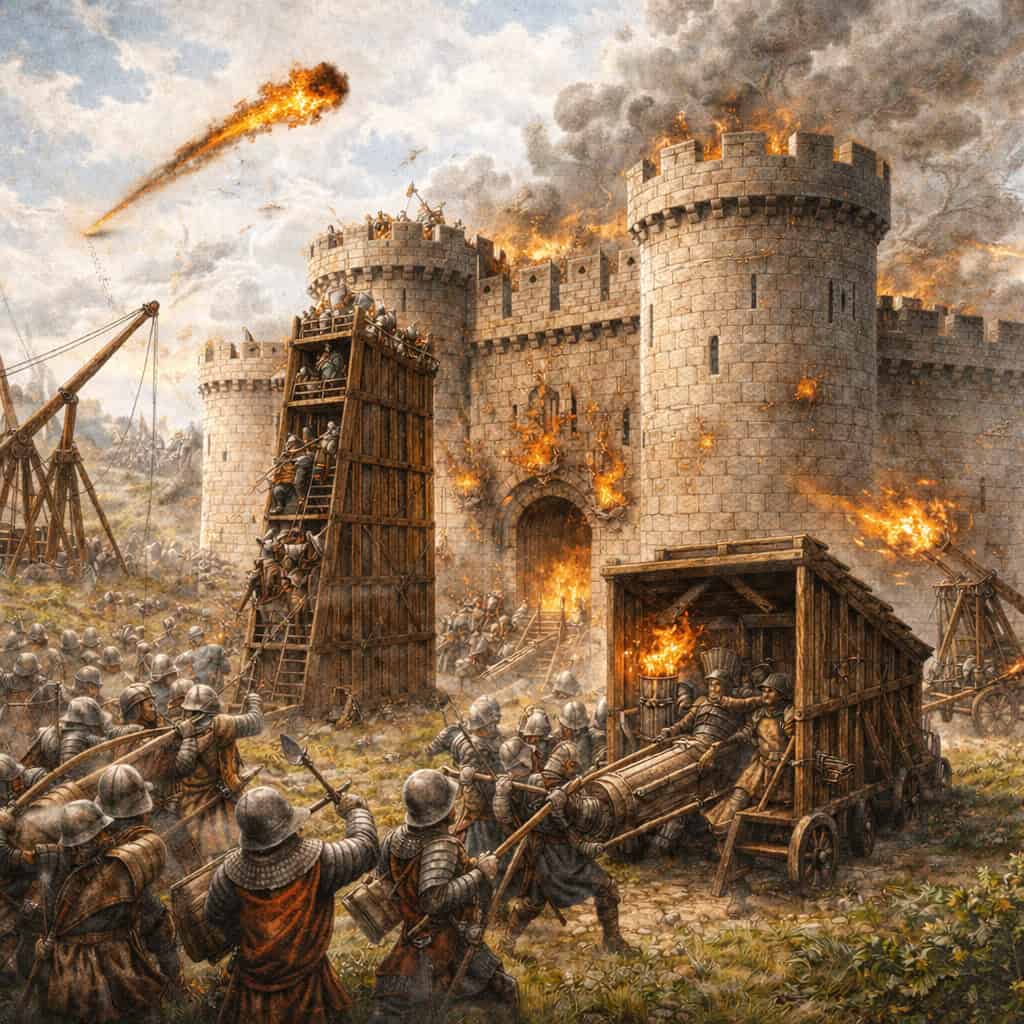
Is a Trebuchet a Catapult?
Understanding how a trebuchet fits into the broader category of catapult siege weapons helps clarify medieval siege technology.
Catapult (General Term)
A catapult is a general classification for mechanical siege weapons designed to launch projectiles using stored energy.
- Includes mangonels, onagers, and trebuchets
- Uses tension, torsion, or counterweights
- Designed for bombardment and disruption
Trebuchet (Specific Type)
A trebuchet is a specific type of catapult that uses a counterweight or manpower to generate far greater force and range.
- Most powerful medieval siege weapon
- Highly effective against stone walls
- Used in major historical sieges
In short, all trebuchets are catapults, but not all catapults are trebuchets.
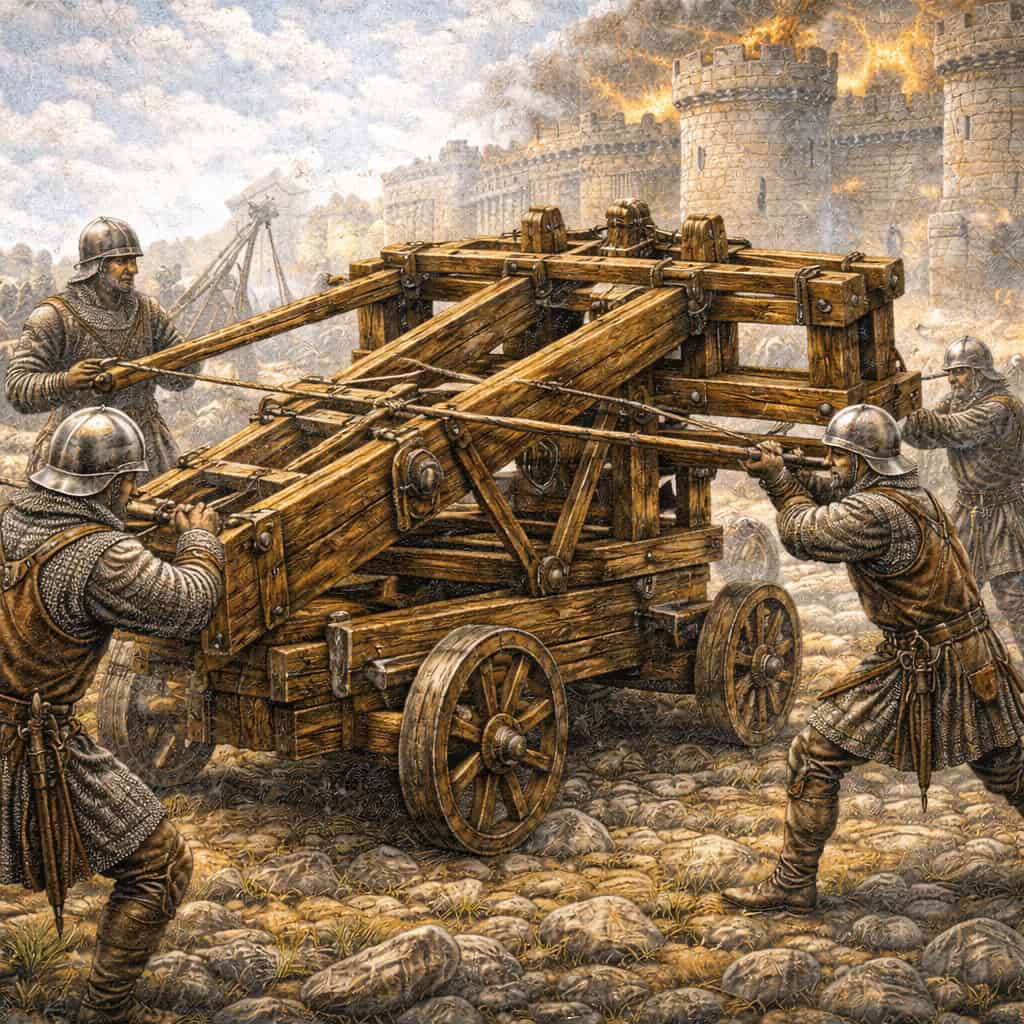
Ballista – Medieval Artillery Weapon
The ballista was one of the most precise medieval siege weapons, resembling a giant crossbow mounted on a wooden frame. Powered by twisted cords that stored torsion energy, the ballista could launch heavy bolts, darts, or iron-tipped projectiles with great force and accuracy.
Key characteristics of the ballista siege weapon include:
- High accuracy compared to stone-throwing machines
- Ability to target soldiers on walls and towers
- Effectiveness against wooden structures and light fortifications
Although the ballista originated in the ancient world, it remained in use throughout the Middle Ages, particularly during prolonged sieges where precision fire was required.
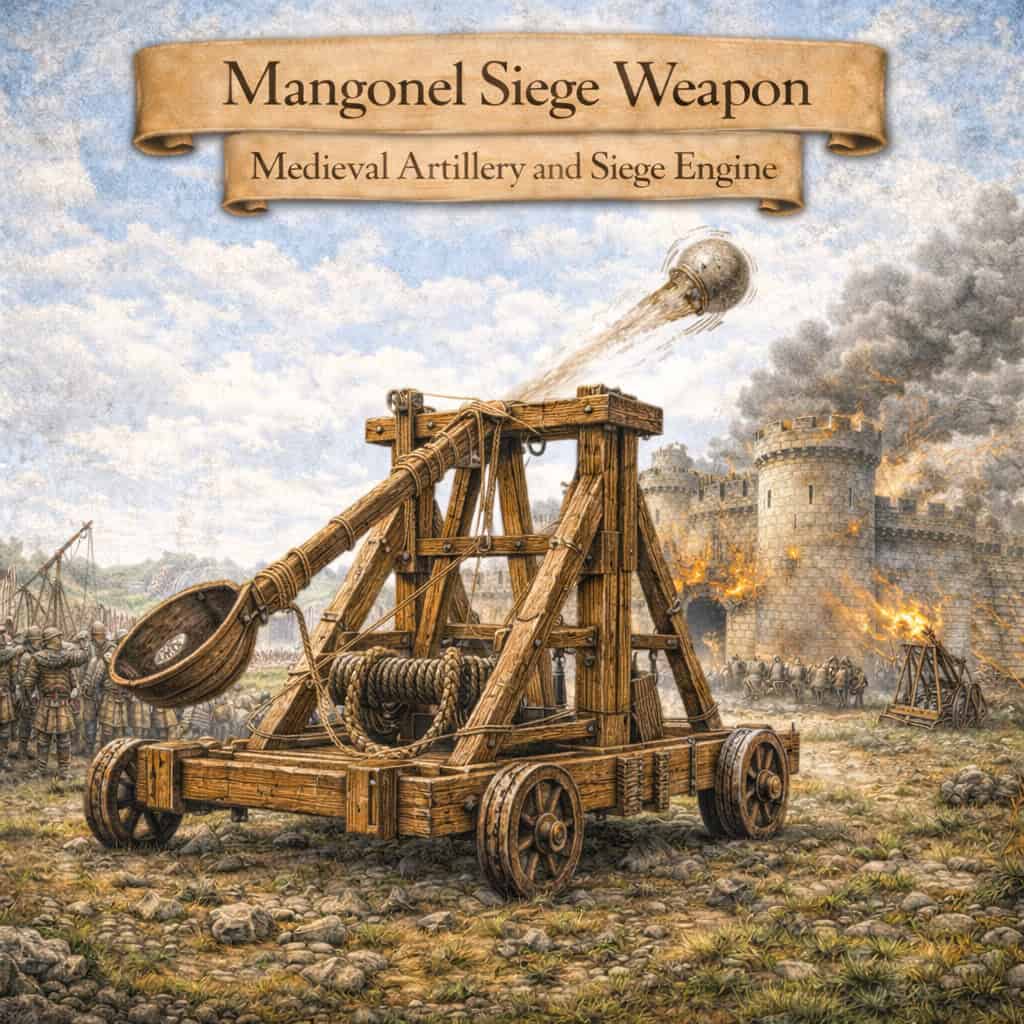
Mangonel – Stone-Throwing Catapult
The mangonel was a popular type of catapult siege weapon used to hurl heavy stones and debris toward castle walls. It operated using a swinging arm and sling or bucket, releasing its projectile in a high arc.
The mangonel siege weapon was valued because:
- It was simpler to build than more complex machines
- It could launch large projectiles over defensive walls
- It caused structural damage and disrupted defenders
While less accurate than a ballista, the mangonel was effective for bombardment. Its design evolved from earlier Roman machines such as the onager, though medieval versions became larger and more powerful as castles expanded across Europe.
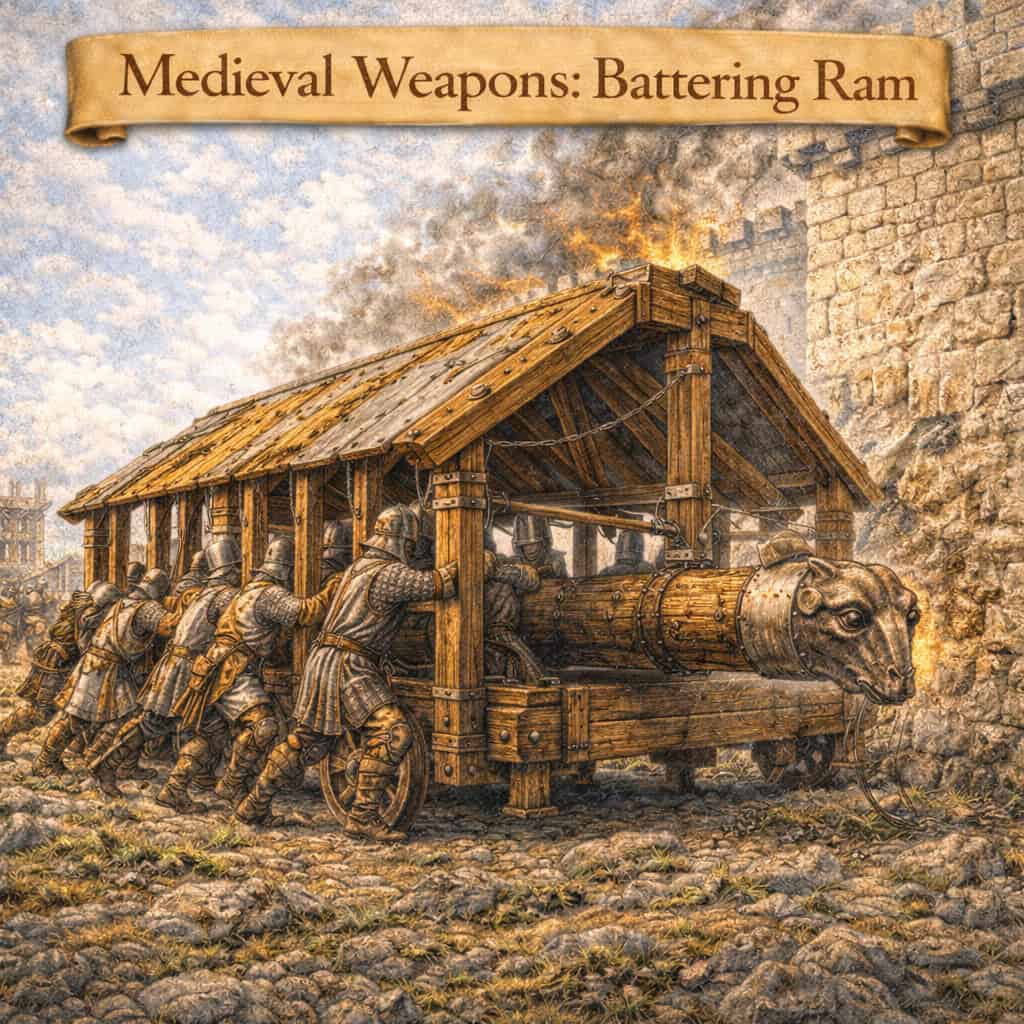
Battering Ram – Gate-Breaking Siege Weapon
Among the most direct castle siege weapons was the battering ram. Constructed from a heavy wooden beam, battering rams were used to repeatedly strike castle gates or weakened sections of walls until they collapsed.
Common features of medieval battering rams included:
- Reinforced iron or bronze heads
- Suspension frames to increase impact force
- Protective wooden roofs to shield attackers from missiles
These protective coverings allowed soldiers to approach gates under fire, though castle moats and drawbridges often proved highly effective defenses against battering ram attacks.
Trebuchet – Heavy Projectile Siege Weapon
The trebuchet was the most powerful of all medieval siege weapons. Unlike simpler catapults, trebuchets used either human power or a massive counterweight to launch projectiles over great distances.
Trebuchets were primarily used to:
- Smash outer castle walls and gatehouses
- Demoralize defenders through constant bombardment
- Launch extremely heavy stones with devastating force
The most advanced form, the counterweight trebuchet, could hurl projectiles weighing hundreds of pounds. The most famous example was Warwolf, built in 1304 during the siege of Stirling Castle on the orders of King Edward I of England.
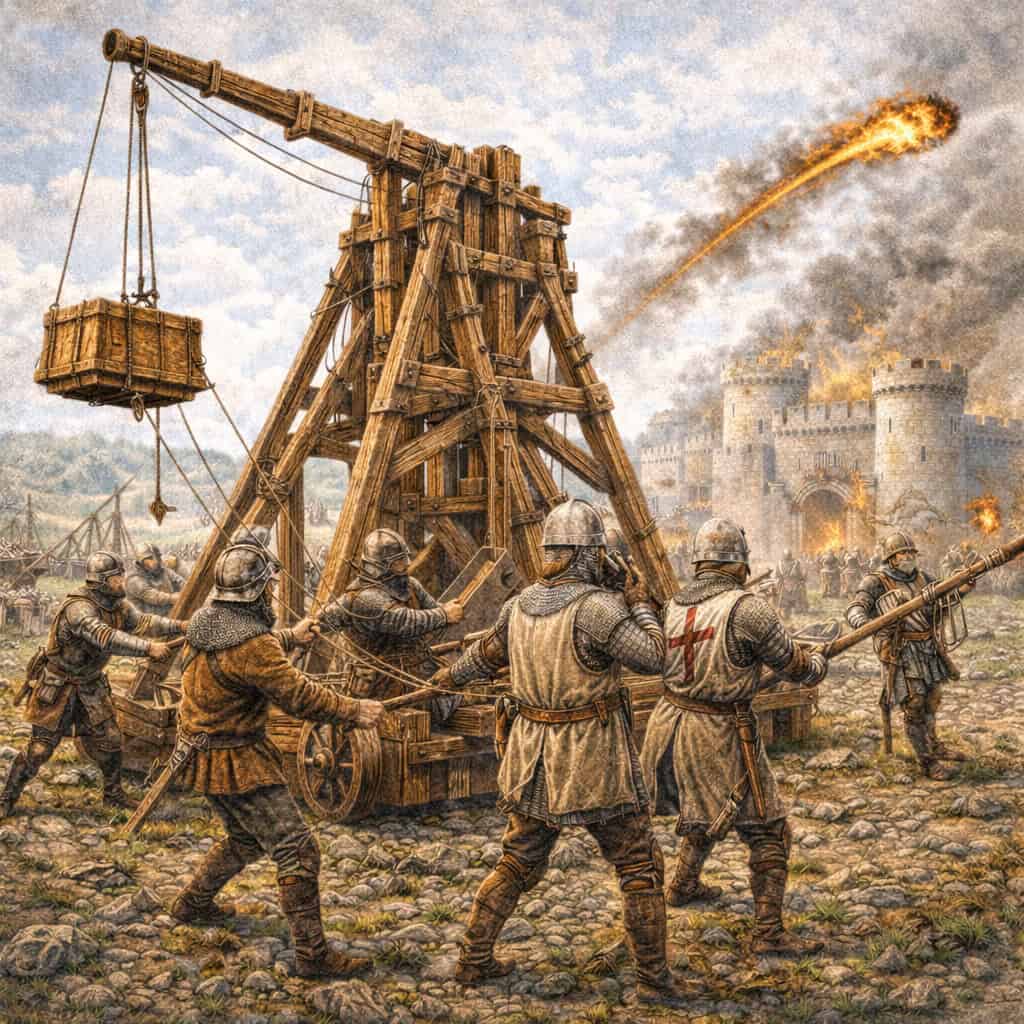
Catapults in Medieval Siege Warfare
Catapults were among the most feared siege weapons of the Middle Ages, designed to deliver destruction, disruption, and psychological pressure during prolonged sieges.
Medieval Catapult Siege Weapons
The term catapult siege weapon broadly refers to machines that hurled projectiles using mechanical force. During medieval sieges, catapults were used not only to damage fortifications but also to weaken defenders’ morale.
- Large stones to break walls and towers
- Burning materials to ignite fires within castles
- Decomposing matter to spread fear and disease
The most powerful medieval catapults were the mangonel and the trebuchet, both central to extended siege campaigns.
Onager – Roman Predecessor
The onager was an earlier Roman siege weapon that influenced later medieval catapult designs. It used a torsion-powered arm to launch stones and other heavy projectiles.
Although the onager predated the Middle Ages, its mechanical principles helped shape the development of medieval stone-throwing machines, particularly the mangonel.
Medieval engineers refined these earlier concepts to create larger, more powerful weapons suited to attacking stone castles.
Castle Siege Tower
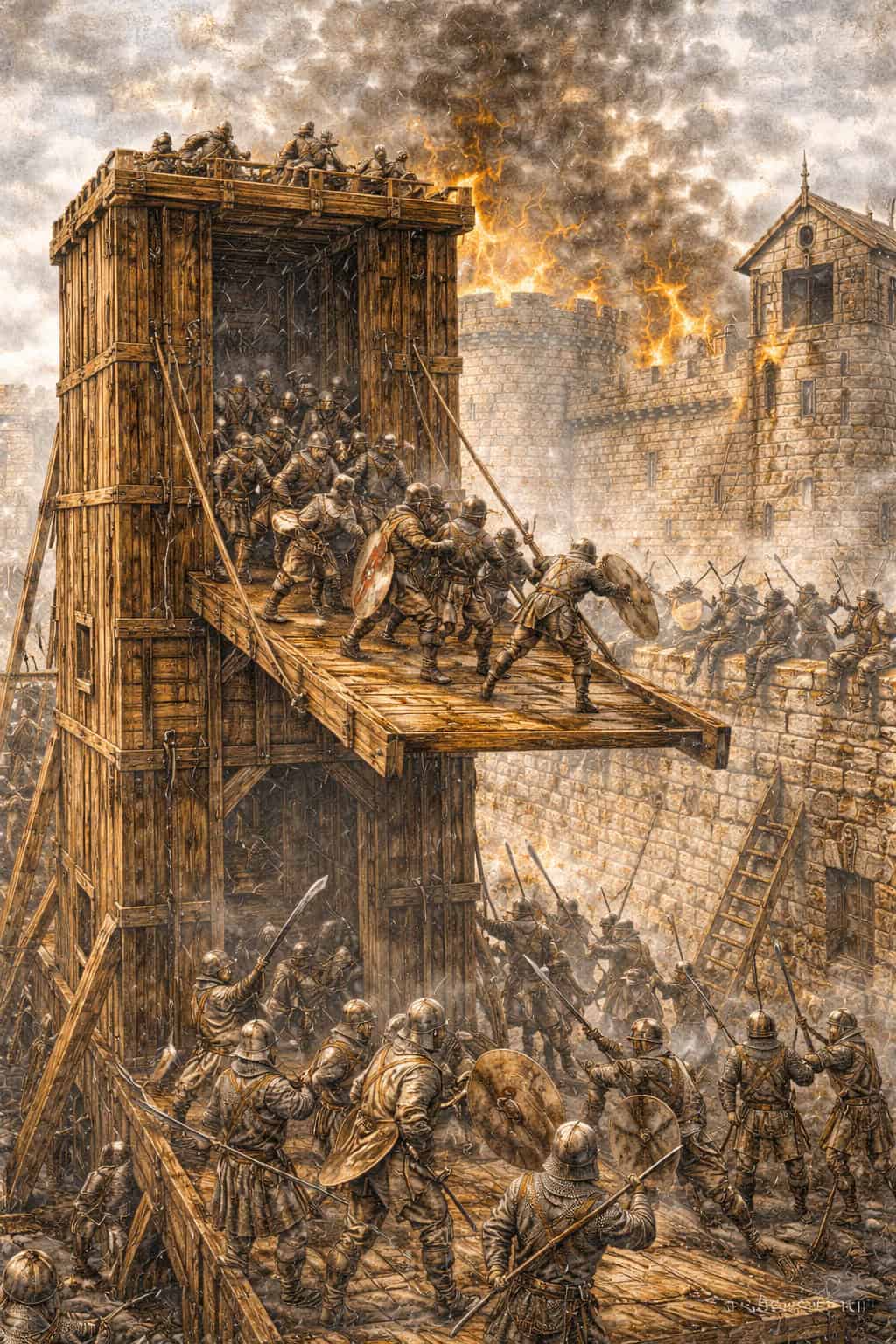
The siege tower was a tall wooden structure designed to allow attacking soldiers to reach the height of a castle’s walls. These towers were often mounted on wheels and pushed toward fortifications under covering fire.
Castle siege towers provided:
- Protected access to battlements
- Elevated platforms for archers
- A way to bypass walls without breaching them
As with battering rams, moats and drawbridges were effective defenses, often preventing siege towers from reaching the walls.
Castle Siege Weapons Summary
Castle siege weapons were essential to medieval warfare. Without them, conquering a well-defended castle was nearly impossible. Over time, attackers refined these weapons as castles became more numerous and heavily fortified.
Although many siege weapons had ancient origins, their use became far more widespread during the Middle Ages due to the rise of stone castles across Europe. These medieval siege weapons remain powerful symbols of the technological ingenuity and harsh realities of medieval warfare.
Frequently Asked Questions About Castle Siege Weapons
These answers explain how medieval siege weapons were used, how they differed, and why they were so effective during castle warfare.
What were castle siege weapons used for?
Castle siege weapons were used to break through fortified defenses, destroy gates and walls, target defenders on battlements, and weaken morale during long sieges. Without them, capturing a stone castle was extremely difficult.
What was the most powerful medieval siege weapon?
The trebuchet was the most powerful medieval siege weapon. Counterweight trebuchets could hurl massive stones capable of collapsing walls and gatehouses from a great distance.
What is the difference between a catapult and a trebuchet?
A catapult is a broad term for projectile-throwing machines. A trebuchet is a specific type of catapult that uses a counterweight or human power to generate far greater force and accuracy.
Were siege weapons used before the Middle Ages?
Yes. Many siege weapons originated in the ancient world. Devices such as the ballista and onager were developed by Roman engineers and later adapted and improved during medieval times.
What projectiles were launched during medieval sieges?
Medieval siege weapons launched heavy stones, burning materials, debris, and sometimes decaying matter. These projectiles caused physical damage and were also intended to spread fear and disease among defenders.
How did castles defend against siege weapons?
Castles relied on thick stone walls, moats, drawbridges, angled towers, and elevated battlements. These defenses were designed to absorb impact, block access, and make siege weapons less effective.
Test Your Knowledge: Castle Siege Weapons
Glossary of Medieval Siege Weapon Terms
Key terms and definitions related to medieval siege weapons, castle warfare, and siege tactics.
Ballista
A precision siege weapon resembling a giant crossbow, used to fire heavy bolts or darts at defenders, gates, and wooden structures.
Catapult
A general term for mechanical devices that launched projectiles using stored energy. Catapults were central to medieval siege warfare.
Mangonel
A type of catapult siege weapon that used a swinging arm and sling to hurl stones and debris over castle walls.
Trebuchet
The most powerful medieval siege engine, using a counterweight or manpower to throw massive projectiles capable of breaking stone walls.
Onager
An ancient Roman siege weapon that influenced medieval catapult designs, using torsion power to fling stones.
Battering Ram
A heavy wooden beam used to smash castle gates or weakened walls during a siege, often protected by a covered frame.
Siege Tower
A tall, mobile wooden structure that allowed attackers to reach castle battlements while remaining protected from missile fire.
Siege Warfare
A form of warfare focused on surrounding and attacking fortified positions, often involving prolonged assaults using siege weapons.
Fortifications
Defensive structures such as walls, towers, gates, and moats designed to protect castles from siege attacks.