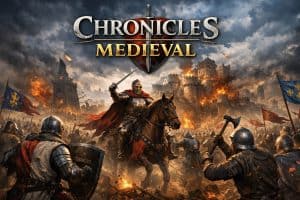
The medieval gaming genre continues to grow, but few upcoming sandbox RPGs have generated as much early curiosity as Chronicles: Medieval. Designed as a large-scale sandbox RPG set in a dynamic version of medieval Europe, the game aims to give players unprecedented freedom to forge their own path — whether through warfare, diplomacy, trade, or political influence.
While the title is still approaching its Early Access release, enough details have emerged to paint a clear picture of what players can expect. From massive battlefield encounters to deep kingdom management systems, Chronicles Medieval appears positioned to appeal to fans of strategy-heavy role-playing games.
This guide breaks down everything we know about Chronicles Medieval so far, along with realistic expectations based on developer statements and current genre trends.
⚔️ What Is Chronicles Medieval?
Chronicles Medieval (officially titled Chronicles: Medieval) is an upcoming sandbox RPG centered on player freedom within a dynamic medieval world. Rather than forcing a scripted path, the game encourages you to forge your own legacy through warfare, diplomacy, trade, and political strategy.
Designed to combine large-scale battles with long-term leadership systems, the experience focuses on meaningful decision-making. Your choices are expected to shape the world around you — creating a reactive environment where no two playthroughs unfold the same way.
Sandbox Medieval RPG
Build power, command armies, and expand your realm.
Choose diplomacy, economic growth, warfare — or all three.
Emergent gameplay ensures every campaign feels unique.
Setting and World Design
Chronicles Medieval takes place in a fictionalized interpretation of 14th-century Europe — a period marked by political instability, territorial conflicts, and shifting alliances.
Players should expect a world shaped by:
- Regional power struggles
- Noble families competing for control
- War-driven economies
- Social hierarchies
- Unpredictable crises
Rather than functioning as a static map, the environment is designed to evolve over time. Wars may redraw borders, trade routes can shift, and leadership changes could alter the balance of power.
This type of dynamic world-building is becoming a defining feature of modern sandbox RPGs because it encourages long-term engagement rather than short campaign bursts.
🎮 Gameplay Overview
At its core, Chronicles Medieval revolves around player freedom. You begin with limited resources and influence, gradually expanding your reach through calculated decisions. How that expansion unfolds is entirely flexible — allowing you to shape your leadership style and long-term strategy.
Whether you prefer conquest, diplomacy, or economic dominance, the game is designed to support multiple paths to power.
⚔️ Military Dominance
Raise armies, lay siege to fortified strongholds, and capture territory to expand your growing empire.
🤝 Political Influence
Form alliances, negotiate treaties, and strategically manipulate rival factions to secure your position.
💰 Economic Power
Control vital trade routes, build wealth, and finance military campaigns that fuel expansion.
👑 Hybrid Leadership
Balance diplomacy with strategic warfare to create a resilient and adaptable kingdom.
This layered design suggests the game is targeting players who enjoy both fast-paced action and long-term strategic planning.
Get the full breakdown of the Chronicles Medieval release date, Early Access expectations, trailer, gameplay highlights, and the latest confirmed updates.
Read: Chronicles Medieval Release Date, Gameplay, Trailer & News (2026)Large-Scale Battles
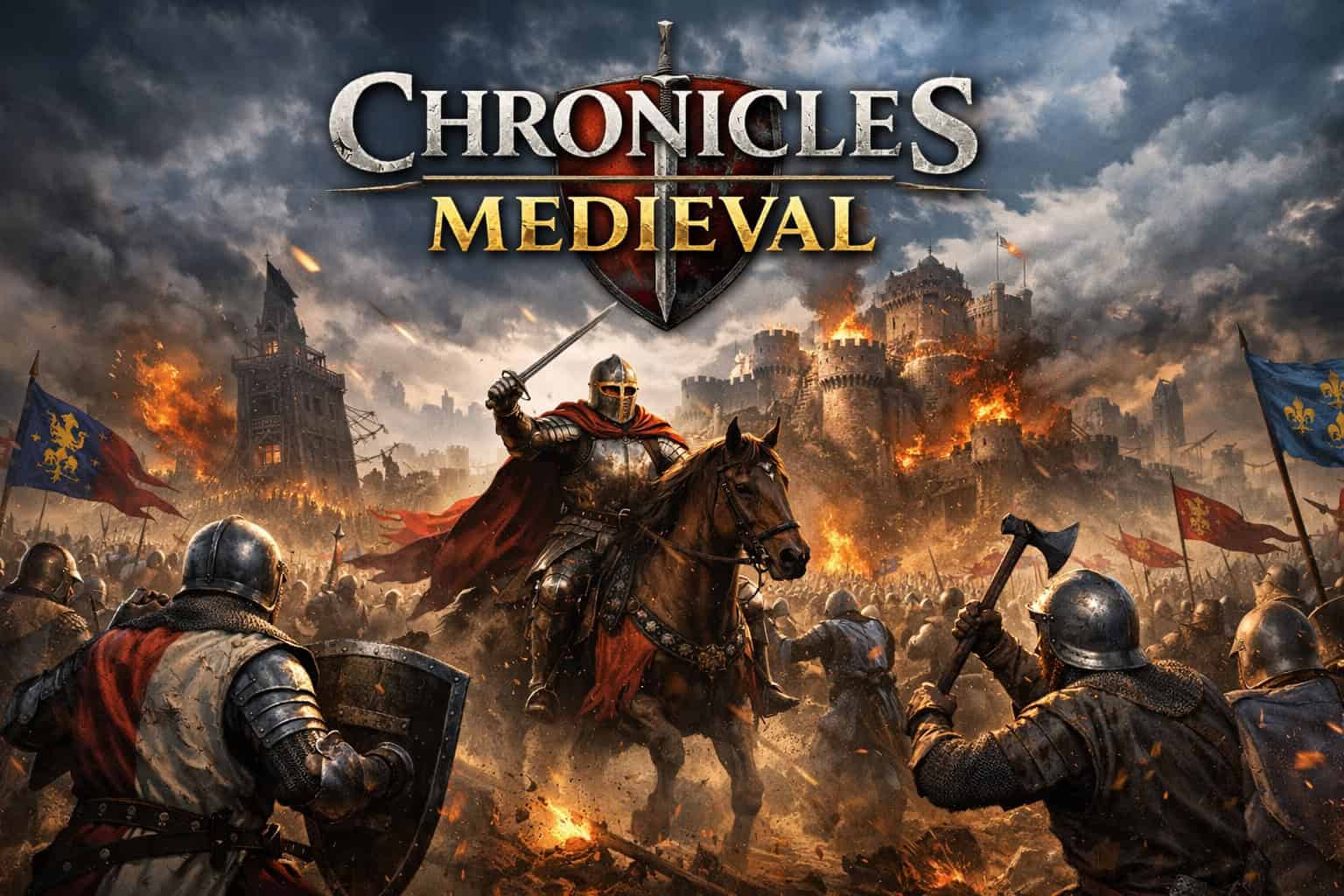
One of the most anticipated elements is the promise of massive battlefield encounters.
These engagements are expected to emphasize:
- Tactical positioning
- Unit composition
- Terrain advantages
- Timing and morale
Instead of chaotic combat, the focus appears to lean toward strategic command — rewarding preparation as much as raw aggression.
Large-scale warfare is often a technical challenge for developers, but when executed well, it becomes a major differentiator within the genre.
For players who enjoy commanding forces rather than fighting alone, this feature could become one of the game’s strongest draws.
Kingdom Building and Power Expansion
Beyond combat, Chronicles Medieval places heavy emphasis on leadership.
Territory control is likely only the beginning. Sustaining a growing domain requires careful management of resources, infrastructure, and relationships.
Players may need to consider:
- Food production
- Tax systems
- Defense planning
- Population stability
- Trade agreements
Poor governance can be just as dangerous as enemy armies.
This strategic layer transforms the experience from a simple RPG into something closer to a ruler simulation — appealing to players who enjoy long-term planning.
🌍 A Living Sandbox
Modern sandbox games succeed when the world feels reactive rather than scripted, and Chronicles Medieval appears to be built around that philosophy. Instead of guiding players down a fixed narrative path, the game is expected to create a dynamic environment where decisions shape the balance of power.
Developer messaging suggests that player actions will carry meaningful consequences, encouraging careful planning while still rewarding bold ambition.
⚔️ Aggressive Expansion
Growing too quickly could provoke defensive coalitions and trigger large-scale conflicts.
🤝 Neglected Diplomacy
Ignoring alliances and negotiations may leave your faction politically isolated.
🛡️ Weak Defenses
Poor fortifications could invite opportunistic rivals looking to seize territory.
This kind of responsiveness creates organic tension without relying on artificial story beats. It also encourages experimentation — allowing players to attempt daring strategies and watch how the world reacts.
Early Access Strategy
Chronicles Medieval is expected to launch first in Early Access, a model increasingly used for complex simulation games.
Early Access typically allows developers to:
- Gather real player feedback
- Adjust balance
- Expand features
- Improve performance
For players, it offers the chance to shape the game’s evolution.
However, expectations should remain realistic. Early Access builds often lack full feature sets at launch and improve gradually.
Players who prefer polished, complete experiences may choose to wait for the full release, while genre enthusiasts often enjoy watching the project mature.
Technology and Visual Direction
The game is being developed using modern engine technology, signaling a strong emphasis on immersion.
Visual goals appear to include:
- Detailed armor and weaponry
- Atmospheric lighting
- Expansive landscapes
- Dense battle scenes
In medieval settings especially, environmental detail plays a huge role in believability. Muddy fields, fortified castles, and crowded towns help anchor the player in the era.
If performance scales well alongside visual fidelity, the game could appeal to both simulation fans and players drawn to cinematic experiences.
🔧 Modding Potential
Support for modding tools has already been mentioned — a feature that often plays a major role in a game’s long-term success. When developers empower their communities to create new content, the result is typically a richer and more evolving experience.
Historically, strong modding communities have dramatically extended the lifespan of sandbox titles by introducing fresh gameplay opportunities and expanding what the base game offers.
Introduce original kingdoms, cultures, and power structures.
Unlock larger worlds and unexplored territories.
Rebalance mechanics or transform core systems entirely.
Enhance textures, lighting, and environmental detail.
Create unique campaigns and player-driven narratives.
For sandbox games especially, modding often becomes part of the core ecosystem rather than a niche feature. Titles that embrace community creativity frequently maintain active player bases for years — making this a promising sign for the future of Chronicles Medieval.
How Chronicles Medieval Could Stand Out
The medieval genre is competitive, so differentiation matters.
Several factors could help the game carve out space:
Scale – Large battles and territory control create a sense of grandeur.
Player Freedom – Nonlinear progression appeals to sandbox enthusiasts.
Strategic Depth – Governance and diplomacy add complexity.
Replayability – Emergent gameplay encourages multiple runs.
If these systems integrate smoothly, the result could be a highly engaging leadership simulator rather than just another combat-focused RPG.
What We Still Don’t Know
Despite growing interest, some major details remain unclear:
- Exact Early Access release date
- Full faction list
- Multiplayer scope
- Endgame structure
- Modding depth at launch
These unknowns are typical for pre-release sandbox games and will likely become clearer as development progresses.
For now, cautious optimism is the most reasonable stance.
👀 Who Should Be Watching This Game?
Chronicles Medieval is shaping up to be a strong contender for players who enjoy depth, freedom, and long-term strategic growth.
Players who enjoy layered, strategy-heavy gameplay.
Those drawn to ruling kingdoms and managing growing empires.
Gamers who prefer open-ended progression over linear storytelling.
Anyone fascinated by castles, armies, and large-scale battles.
Players who value agency and emergent gameplay.
Fans of sandbox design — particularly those who prioritize player choice — may find this title especially compelling.
Final Thoughts
Chronicles Medieval is shaping up to be an ambitious entry into the medieval sandbox RPG space. Its focus on player-driven outcomes, territorial expansion, and strategic governance suggests a game built for depth rather than quick completion.
Much will depend on execution — especially battle performance, AI behavior, and long-term world reactivity — but the foundation appears promising.
As more information emerges and Early Access approaches, the game is positioned to attract increasing attention from strategy and RPG communities alike.
For now, it stands as one of the more intriguing upcoming titles for players eager to command armies, influence politics, and build a legacy in a shifting medieval world.