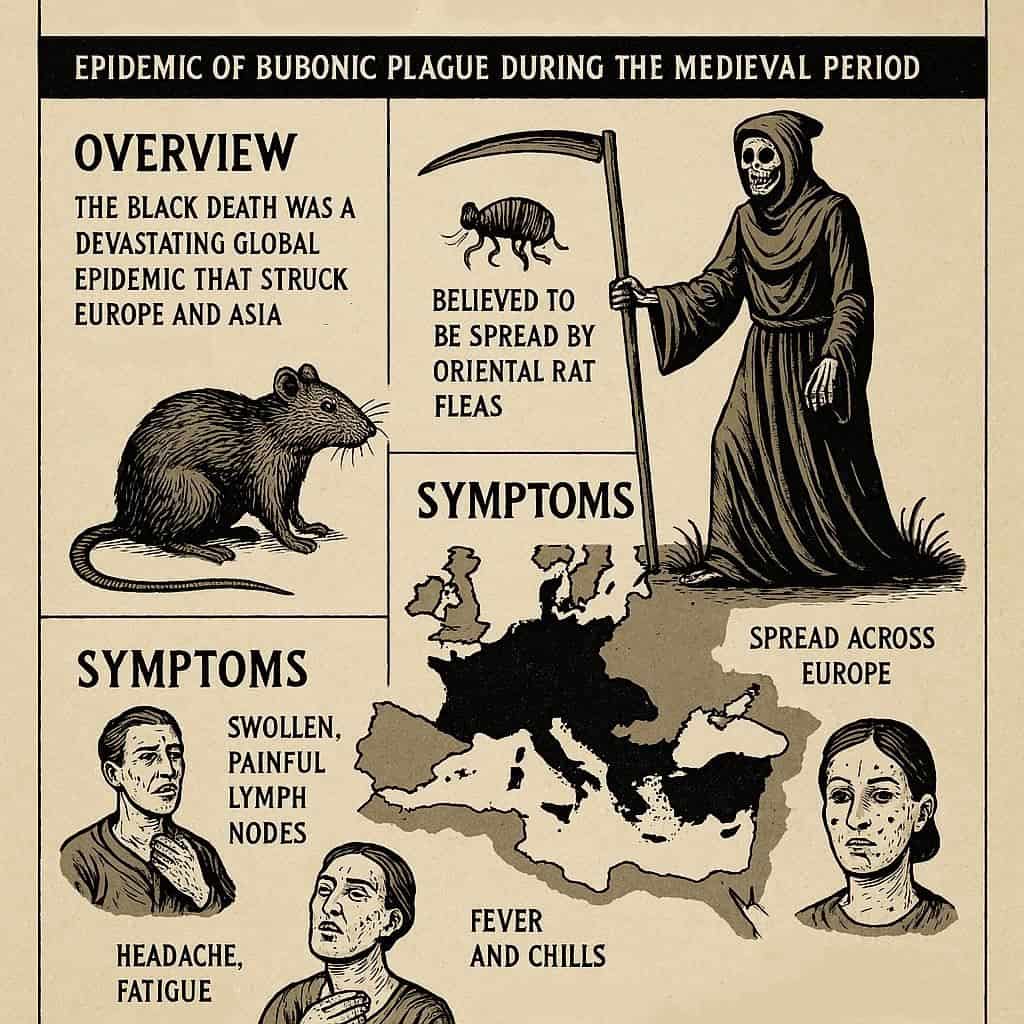
The Black Death, also known as the Bubonic Plague, the Great Plague, or simply The Plague, was one of the most catastrophic pandemics in human history. Emerging in the mid-14th century, it swept relentlessly across Europe, Asia, and North Africa, killing tens of millions of people and wiping out entire communities within months. The plague did not discriminate — peasants, merchants, and nobles alike fell victim to the terrifying disease that seemed to strike without warning. Beyond the staggering loss of life.
The Black Death transformed medieval society, altering economies, religious beliefs, art, and medicine in ways that would shape the course of European history for centuries. Its legacy remains one of both tragedy and transformation, marking the end of the old medieval world and paving the way for profound social and cultural change.
Origins and Spread
The Black Death is believed to have originated in Central Asia, spreading along trade routes before reaching Europe in 1347. The pandemic spread quickly due to:
- Fleas carried by rats, which acted as vectors for the Yersinia pestis bacterium
- Overcrowded medieval towns and cities with poor sanitation
- Close contact between humans in bustling markets, ports, and trade centers
Some of the major European outbreaks occurred between 1347 and 1353, killing an estimated 25–60% of the population in affected regions.
The Black Death wiped out an estimated 30–60% of Europe’s population between 1347 and 1353 — making it one of the deadliest pandemics in recorded history.
Symptoms of the Black Death
The Bubonic Plague was infamous for its horrific symptoms, which often appeared rapidly after infection:
- Swollen lymph nodes (buboes), usually in the armpits, groin, or neck
- High fever, chills, and fatigue
- Skin discoloration, often turning black or purple in extremities
- Vomiting and severe pain
Many victims died within a few days of infection, making it a terrifying and nearly unstoppable force in medieval Europe.
Social and Economic Impact
The Black Death fundamentally changed medieval society. Key effects included:
- Severe depopulation, leading to labor shortages
- Weakening of the feudal system, as surviving peasants demanded better wages and conditions
- Economic disruption, with towns and cities struggling to function
- Growth of new farming techniques and land reforestation due to abandoned lands
- Boost to medicine and public health awareness, although effective cures were unknown

Cultural and Religious Effects
The pandemic influenced religion, art, and daily life:
- Many turned to the Church for guidance, leading to a rise in pious movements and sometimes persecution of minorities, such as Jews
- Art and literature reflected the omnipresence of death, with macabre themes and morality tales
- Plague doctors became infamous figures, attempting remedies with little scientific understanding
Medieval people believed the plague spread through “bad air” or miasma — leading to the creation of the famous plague doctor beak mask filled with herbs and flowers.
Legacy of the Black Death
Despite its devastation, the Black Death led to long-term societal changes:
- It contributed to the decline of feudalism and the rise of more modern economic structures
- Stimulated developments in public health, sanitation, and urban planning
- Accelerated social mobility, as survivors could demand better lives
- Paved the way for the Renaissance, as labor shortages created opportunities for education, innovation, and cultural growth
Key Takeaways
- Origin: Central Asia, spreading along trade routes
- Cause: Yersinia pestis bacterium, carried by fleas on rats
- Peak Outbreaks: 1347–1353 in Europe
- Death Toll: Estimated 25–60% of European population
- Impact: Social, economic, cultural, and political transformation
The Black Death remains a defining moment in medieval history, shaping the course of European society for centuries. For deeper insights, explore our articles on Plague Doctors, how the plague spread, and the surprising effects of the Black Death.
The Black Death indirectly led to the collapse of the feudal system as surviving peasants demanded higher wages and better working conditions.
🧩 Frequently Asked Questions about the Black Death
What was the Black Death?
The Black Death was a devastating pandemic caused by the bacterium Yersinia pestis. It spread through fleas carried by rats and infected millions across Europe, Asia, and North Africa in the 14th century.
How did the plague spread so quickly?
The disease spread through flea bites, contact with infected individuals, and unsanitary living conditions. Overcrowded towns and poor hygiene made transmission rapid and deadly.
How did people try to protect themselves?
People used herbs, incense, and masks filled with aromatic materials. Some fled infected cities, while others turned to prayer and religious rituals for protection.
What were the main symptoms?
Symptoms included high fever, chills, vomiting, painful swellings called buboes in the groin or armpits, and blackened skin caused by internal bleeding.
Did the Black Death have any long-term effects?
Yes. The pandemic led to massive social and economic change, including labor shortages, peasant revolts, and the eventual decline of the feudal system.
🧩 Test Your Knowledge: The Black Death Quiz
📘 Glossary of Terms: The Black Death
This glossary explains some of the key terms and phrases used when studying or discussing the Black Death and its impact on medieval Europe.
- Buboes: Painful, swollen lumps that appeared on the body (often in the armpits, neck, or groin). These were a classic symptom of the Bubonic Plague.
- Yersinia pestis: The bacterium responsible for the Black Death. It was carried by fleas living on rats and transmitted to humans through bites.
- Plague Doctor: A physician hired to treat plague victims. Known for wearing long black cloaks and distinctive beak-shaped masks filled with herbs to filter “bad air.”
- Miasma: A medieval medical theory suggesting that diseases like the plague were spread through poisonous or foul-smelling air.
- Feudal System: The dominant social and economic structure of medieval Europe, where peasants worked the land for lords in exchange for protection. The Black Death greatly weakened this system.
- Peasants’ Revolt: A major uprising in England in 1381, partly fueled by labor shortages and social changes following the plague.
- Quarantine: A public health measure first used during the plague, involving the isolation of ships or people for 40 days to prevent disease spread.
- Pandemic: A disease outbreak that spreads across countries or continents — the Black Death is one of history’s most devastating examples.
- Bubonic Plague: The most common form of the plague caused by Yersinia pestis, characterized by buboes, fever, and high mortality.