Education in the Middle Ages—often called medieval education—was far more complex and influential than most people realize. While only a small portion of society could read or write, the foundations of modern European learning were built during this period. From monastic schools teaching Latin and scripture to the rise of the first medieval universities in Paris, Bologna, and Oxford, education shaped both faith and society. Even peasants and craftsmen absorbed knowledge through apprenticeships and church instruction. In this article, we uncover 10 surprising facts about medieval education, exploring how learning evolved from sacred monasteries to bustling urban lecture halls and why its influence still echoes in the classroom today.

“Medieval education was a tapestry of diversity, reflecting the interconnectedness of cultures and ideas. It was a time when learning transcended borders, with exchanges between East and West leading to remarkable advancements in science, mathematics, and philosophy.”
Professor Robert Hughes, Medieval Studies Scholar.
While we often associate this period with a lack of knowledge and learning, a closer look reveals surprising facts about education that defy common misconceptions.
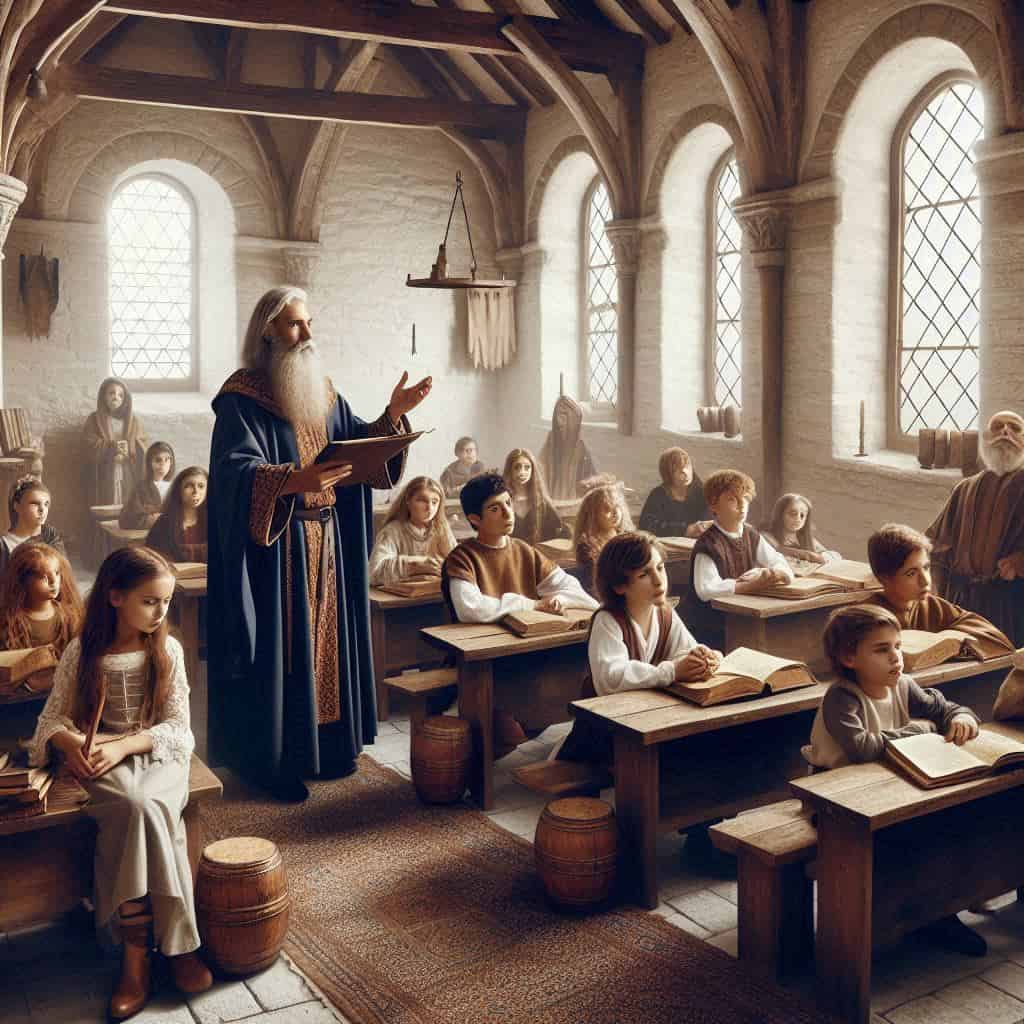
Let’s explore ten intriguing aspects of medieval education that shed light on the intellectual pursuits and innovations of this fascinating era.
1. Limited Access to Education
Education in the Middle Ages was largely reserved for the elite, such as nobles, clergy, and wealthy merchants. Monastic and cathedral schools were the primary centers of learning, with education closely tied to the church and religious institutions.
2. Early Learning through Apprenticeship
For many children in the Middle Ages, education began through apprenticeships rather than formal schooling. Young boys and girls learned practical skills from a mentor or master craftsman, such as blacksmithing, weaving, or carpentry, to prepare them for a trade.
3. The Role of Monasteries
Monasteries played a crucial role in preserving knowledge during this period. Monks were responsible for copying and preserving ancient texts, including classical works from ancient Greece and Rome, ensuring the continuity of knowledge.
4. Trivium and Quadrivium
Medieval education was structured around the liberal arts, comprising the Trivium (grammar, rhetoric, and logic) and the Quadrivium (arithmetic, geometry, music, and astronomy). These subjects formed the foundation of higher education and were considered essential for cultivating a well-rounded mind.
5. The Growth of Universities
Towards the later Middle Ages, universities began to emerge as centers of higher education. The University of Bologna, founded in 1088, is recognized as the oldest continually operating university in the Western world. Other renowned medieval universities include Oxford, Paris, and Cambridge.
6. University Curriculum
Medieval university curricula were heavily influenced by the scholastic method, which sought to reconcile faith with reason and promote critical thinking. Theology was a dominant subject, but other disciplines like law, medicine, and philosophy were also taught.
7. Role of Women in Education
While limited, some opportunities for education did exist for women in the Middle Ages. Wealthy noblewomen could receive private tutoring, and certain convents offered rudimentary education for girls, focusing on religious instruction and basic literacy.
8. Use of Illuminated Manuscripts
Before the invention of the printing press, books were laboriously handwritten by scribes. Illuminated manuscripts, decorated with intricate illustrations and gold leaf, were highly valued for their aesthetic beauty and religious significance.
9. Oral Tradition and Storytelling
In rural areas, education often relied on oral tradition and storytelling. Skilled bards and troubadours would pass down history, folklore, and legends through captivating performances, ensuring the transmission of knowledge across generations.
10. The Impact of Crusades and Trade
The Crusades and expanding trade routes facilitated cultural exchange between Europe and the Middle East. This cross-cultural interaction brought new ideas, scientific knowledge, and scholarly works to medieval Europe, enriching the educational landscape.
“The Middle Ages may conjure images of darkness and ignorance, but beneath the surface lies a thriving world of knowledge and intellectual pursuits. From the monastic scriptoria preserving ancient texts to the emergence of universities, education in this era was an illuminating journey that shaped the course of Western civilization.”
Dr. Emily Turner, Historian and Author.
In conclusion, the Middle Ages was a period of diverse educational practices, with learning opportunities ranging from monastic schools to emerging universities.
While access to education was limited, the preservation of ancient texts and the pursuit of knowledge through diverse disciplines laid the groundwork for the intellectual advancements of subsequent centuries.
By exploring these surprising aspects of medieval education, we gain a deeper appreciation for the complexity and evolution of learning during this transformative era.
10 Surprising Things About Education in the Middle Ages | Great Books
“The Pursuit of Knowledge in the Early Islamic World” by Muzaffar Iqbal
This book explores the rich intellectual heritage of the Islamic world during the Middle Ages, shedding light on the contributions of scholars and the flourishing of learning in diverse fields.
“Birth of the West: Rome, Germany, France, Creation of Europe in the Tenth Century” by Paul Collins
Focusing on the transformative 10th century, this book delves into the emergence of medieval Europe, examining the development of educational institutions and the exchange of knowledge.
“The Civilization of the Middle Ages” by Norman F. Cantor
Providing a comprehensive overview of the medieval period, this book delves into the educational practices and intellectual achievements that shaped the era’s culture and society.
“The Knowledge of Childhood in the German Middle Ages, 1100-1350” by Albrecht Classen
This book offers a unique perspective on medieval education, exploring the role of childhood in learning and the transmission of knowledge during this period.
“Learning in a Visual Age: The Medieval Lesson” by Kathryn A. Smith
Focusing on visual culture and education in the Middle Ages, this book examines how images and illustrations were used as pedagogical tools to convey knowledge and information.
These books offer fascinating insights into the diverse facets of education during the medieval period, from the intellectual achievements of Islamic scholars to the emergence of universities and the use of visual aids for teaching. Each work contributes to a deeper understanding of the rich tapestry of learning and knowledge in this captivating era.
❓ Frequently Asked Questions About Medieval Education
1. What was medieval education like during the Middle Ages?
Medieval education focused mainly on religious learning. Monks and priests taught reading, writing, and Latin in monasteries and cathedral schools, preparing students for service in the Church.
2. Who could receive an education in medieval Europe?
Most formal education in the Middle Ages was limited to boys from wealthy or noble families. However, some girls received basic literacy lessons in convents, and apprentices learned trades through hands-on training.
3. What subjects were taught in medieval schools?
The core of medieval education was the “trivium” (grammar, rhetoric, logic) and the “quadrivium” (arithmetic, geometry, music, astronomy). These formed the foundation of medieval learning and classical studies.
4. When did universities first appear in medieval Europe?
The first medieval universities emerged in the 12th and 13th centuries—most famously in Bologna, Paris, and Oxford. They trained scholars in philosophy, law, medicine, and theology.
5. Was education only for the clergy in the Middle Ages?
While the clergy dominated formal learning, education slowly expanded to include laymen, merchants, and the upper classes. The rise of towns and universities opened new opportunities beyond the Church.
6. How did medieval education influence modern schools?
Medieval education introduced structured curriculums, degrees, and lecture-based teaching—concepts that became the foundation of today’s university system.
7. Could peasants receive any form of education?
Most peasants did not attend formal schools, but they learned practical skills through work, family, and church sermons. Some village priests taught basic prayers and literacy to those eager to learn.