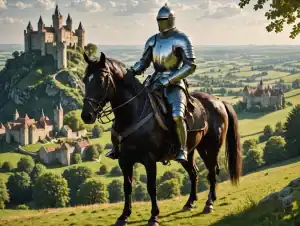
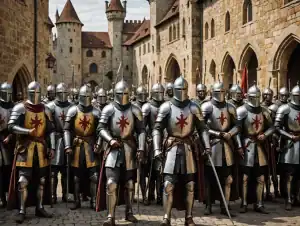
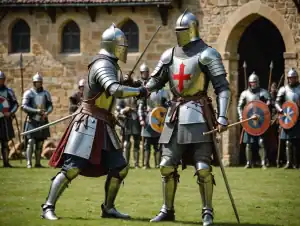
When we think of knights in the medieval period, we often picture armored men on horseback, wielding swords and lances. But history also reveals remarkable women warriors who defied societal norms. Although women were rarely officially knighted, several courageous women took on the responsibilities and duties of a medieval knight, demonstrating skill, bravery, and leadership in battle. Here are some of the most famous female knights whose stories continue to inspire today.

Joan of Arc Born 1412 – Executed on May 30, 1431
Joan of Arc, also known as Jeanne d’Arc, was a historical figure who lived during the 15th century in France and is widely recognized for her role as a military leader and symbol of French patriotism. Here are five interesting things about Joan of Arc:
Military Leadership
Joan of Arc is famous for her military leadership during the Hundred Years’ War between France and England. She claimed to have received divine guidance and led the French army to several key victories, including the lifting of the Siege of Orleans in 1429, which was a turning point in the war.

Religious Beliefs
Joan of Arc had a deep religious faith and claimed to have received visions from saints and angels, which she believed were divine messages from God. She believed that she had been chosen by God to help expel the English from France and restore the French dauphin, Charles VII, to the throne.

Unconventional Dress
Joan of Arc was known for her distinctive and unconventional attire. She wore men’s clothing, which was highly unusual for a woman of her time, and is often depicted in armor or military attire in historical accounts and artistic representations.
Trial and Execution
Joan of Arc’s military successes brought her both admiration and enemies. She was eventually captured by the English, accused of heresy, and put on trial. Despite her staunch defense, she was found guilty and burned at the stake in 1431 at the age of 19. Decades later, she was posthumously exonerated and declared a martyr and a saint by the Catholic Church.

Cultural and Historical Impact
Joan of Arc’s legacy has endured over the centuries, and she has become a symbol of French nationalism, courage, and faith. Her story has inspired numerous books, plays, movies, and works of art, and she is revered as a national heroine in France. She has also been a subject of historical study and debate, and her life and achievements continue to captivate people’s imaginations to this day.
Joan of Arc’s life and legacy are rich with historical significance and continue to be a source of fascination for people around the world. Her story is a testament to her courage, determination, and unwavering faith, making her one of the most intriguing figures in history.

Eleanor of Aquitaine – Born on c. 1122 (exact date of birth is uncertain) Died April 1, 1204
Another notable woman who took on the role of a knight was Eleanor of Aquitaine. Eleanor was the queen of both France and England during her lifetime, and was known for her political savvy and leadership skills. She was also a skilled horsewoman and jouster, and was reportedly able to hold her own in combat.

Eleanor of Aquitaine was a prominent figure in medieval European history and known for her influential role as a queen, mother, and diplomat. Here are five interesting things about Eleanor of Aquitaine:
Remarkable Political Influence
Eleanor of Aquitaine was a powerful political figure and known for her strong influence during her time. She was the queen consort of both France and England, as she was married to Louis VII of France and later Henry II of England. She played a significant role in the administration of her husband’s lands, as well as in the upbringing of her children who went on to become influential rulers, including Richard the Lionheart and King John of England.
Wealth and Territories
Eleanor of Aquitaine inherited the vast territories of Aquitaine in southwestern France, which made her one of the wealthiest and most powerful women of her time. Her lands were known for their rich resources, including wine production, and provided her with considerable economic and political power.

Active Role in Crusades
Eleanor of Aquitaine accompanied her husband, Louis VII of France, on the Second Crusade, making her the only queen of France to have gone on a crusade. She played an active role in the Crusade, rallying support for the cause and participating in military campaigns, which was highly unusual for a woman of her time.

Imprisonment and Rebellion
Eleanor of Aquitaine’s marriage to Henry II of England eventually soured, and she rebelled against him, supporting her sons in their attempts to overthrow their father. As a result, Henry II imprisoned her for nearly 16 years, making her one of the longest-serving prisoners in medieval Europe. She was released after Henry II’s death and played a role in the political affairs of her sons’ kingdoms.
Cultural Patronage
Eleanor of Aquitaine was known for her patronage of the arts and literature. She supported the development of troubadour poetry and courtly love culture, which flourished in her territories. She also encouraged the spread of Gothic architecture and artistic styles in her domains, leaving a lasting impact on the cultural and artistic landscape of medieval Europe.
“The rise of women knights in medieval Europe challenges the common perception of women’s passive roles in history, and highlights their agency and contributions to the world of chivalry.”
Dr. Sarah Adams, Medieval Gender Studies Researcher.
Eleanor of Aquitaine’s life and achievements were remarkable for her time and continue to be a subject of fascination for historians and scholars. Her political influence, wealth, and cultural patronage, as well as her personal struggles and achievements, make her a captivating figure in medieval European history.
Hua Milan – The Chinese Knight
There are also several accounts of women who disguised themselves as men in order to become knights. One such example is the story of Hua Mulan, a Chinese woman who disguised herself as a man and fought in the army for several years. While Mulan’s story is fictional, it is believed to be based on real accounts of women who took on similar roles.
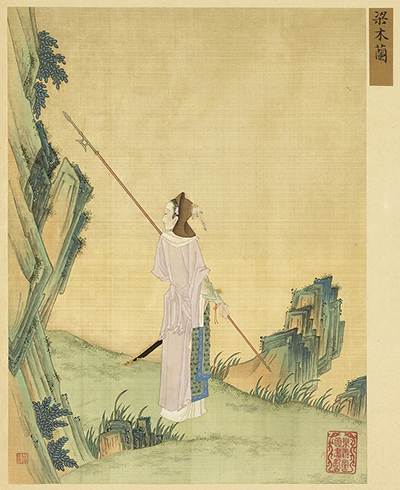
Hua Mulan is a legendary figure in Chinese history and folklore, known for her bravery, military prowess, and filial piety. Here are five interesting things about Hua Mulan:
Legendary Heroine
Hua Mulan is a legendary figure whose story has been passed down through Chinese folklore, poems, plays, and novels for centuries. According to the legend, Mulan disguised herself as a man and joined the army in place of her aging father to fight against invading forces, serving for 12 years without being discovered as a woman.
Gender Role Reversal
Hua Mulan’s story is notable for its gender role reversal, as she defied societal norms and expectations by cross-dressing and joining the army, which was traditionally a male domain. Her story has been celebrated as a symbol of gender equality, female empowerment, and the importance of filial piety in Chinese culture.
Medieval women knightswere often overlooked in historical records, but their stories reveal their remarkable courage and determination in breaking gender barriers.
Dr. Jessica Smith, Historian of Medieval Europe.
Courage and Military Prowess
Hua Mulan is depicted as a courageous and skilled warrior in the legends. She was known for her martial arts skills, archery, and tactical acumen, leading her fellow soldiers to victory in battles and earning the respect of her comrades and superiors.
Filial Piety
Hua Mulan’s story is often praised for her filial piety, a Confucian virtue that emphasizes the duty and respect of children towards their parents. In the legend, Mulan disguised herself as a man and joined the army to protect her father and fulfill her duty as a loyal daughter.
“The existence of women knights in medieval times challenges traditional notions of gender roles and sheds light on the diverse roles women played in warfare and society.”
Dr. Maria Alvarez, Medieval History Scholar.
Cultural Impact
Hua Mulan’s story has had a significant cultural impact and has been retold in various forms of art and media, including films, TV shows, books, and songs. The legend of Hua Mulan has become a beloved symbol of courage, loyalty, and sacrifice in Chinese culture, and she is often regarded as a legendary heroine and a role model for women.
Hua Mulan’s legendary story has captivated people’s imaginations for centuries and continues to be celebrated as a symbol of courage, gender equality, and filial piety. Her tale has inspired numerous adaptations and interpretations, making her a beloved figure in Chinese history and folklore.
“The stories of women knights in medieval history demonstrate their exceptional martial skills and their tenacity in navigating a male-dominated world.”
Dr. Anne Thompson, Medieval Studies Professor.
Other Women Knights
In addition to these notable examples, there are also several lesser-known accounts of women who took on the role of a knight. For example, the 13th century French chronicler Jean de Joinville wrote about a woman named Jeanne who fought alongside her husband in the Crusades. He described her as being “strong and hardy, and able to bear the weight of arms as well as any man.”
Despite these examples, the idea of women becoming knights was not widely accepted in medieval society. Women were expected to be wives and mothers, and were not allowed to participate in activities that were traditionally seen as masculine, such as warfare and combat. But the existence of these female knights shows that there were always exceptions to the rule.
The story of women knights in the medieval period is a fascinating and often overlooked part of history. It is a reminder that even in societies where gender roles were strictly defined, there were always individuals who pushed the boundaries and defied expectations. By acknowledging the existence of these women knights, we can gain a deeper understanding of the complexities of medieval society and the ways in which people navigated its rigid social norms.
Frequently Asked Questions About Female Knights
Were women officially allowed to become knights?
No, women were rarely officially knighted, but some defied societal norms and took on the responsibilities of knights.
Who is one of the most famous female knights?
Joan of Arc is the most famous example, leading troops during the Hundred Years’ War and later canonized as a saint.
Did female knights participate in battles?
Yes, exceptional women sometimes fought alongside men, defending territories or leading troops in combat.
What kind of training did female knights undergo?
Training often included combat skills, horsemanship, and strategy, similar to male knights of the time.
Were female knights recognized by their peers?
Recognition was limited, but those who demonstrated bravery and leadership were respected and sometimes celebrated in historical records.
Did religion influence female knights?
Many female knights were deeply religious, often seeking divine guidance before battles or missions.
Were there female knights outside Europe?
Women warriors existed in other cultures, but formal knighthood was primarily a European tradition.
Did female knights hold land or titles?
Some were granted lands or noble titles for their service, though it was far less common than for male knights.
What legacy did female knights leave behind?
They inspired future generations of women, showing that courage, skill, and honor were not limited by gender.
Were female knights involved in tournaments?
Participation in tournaments was rare, but some took part in ceremonial or combat demonstrations to showcase their skills.