Medieval Spain was one of the most complex and dynamic regions in medieval Europe, shaped by centuries of political fragmentation, religious diversity, and cultural exchange. From the collapse of Roman rule to the fall of Granada in 1492, the Iberian Peninsula experienced profound transformations that continue to influence Spanish history and identity today.
⚔️ Click-to-Reveal: Medieval Spain Facts
The Islamic Conquest of 711
In 711 CE, Muslim forces from North Africa crossed into the Iberian Peninsula, defeating the Visigothic kingdom and establishing Islamic rule over much of Spain, later known as Al-Andalus.
What Was Al-Andalus?
Al-Andalus was the Arabic name for Muslim-ruled Iberia, which evolved from an emirate to a caliphate and later fragmented into taifa kingdoms known for learning and trade.
The Reconquista Explained
The Reconquista was a long, uneven process (8th–15th centuries) in which Christian kingdoms gradually expanded southward through warfare, treaties, and alliances.
Three Religions in Medieval Spain
Christians, Muslims, and Jews lived throughout medieval Spain, contributing to urban life, scholarship, and commerce, though religious minorities faced legal inequality.
Castles and Frontier Warfare
Thousands of castles were built along shifting frontier zones during the Middle Ages. The kingdom of Castile derives its name from this dense network of fortifications.
The Fall of Granada (1492)
The conquest of Granada by Ferdinand of Aragon and Isabella of Castile ended Muslim political rule in Iberia and marked the symbolic close of medieval Spain.
Political Landscape of Medieval Spain
Between the 5th and 15th centuries, medieval Spain was divided among multiple rival kingdoms and territories. Following the fall of the Western Roman Empire, the Visigothic Kingdom emerged as the dominant power, ruling much of Iberia until the early 8th century.
In 711 CE, Muslim forces from North Africa crossed into Iberia, defeating the Visigoths and establishing Al-Andalus, an Islamic polity that would dominate large portions of the peninsula for centuries. Meanwhile, Christian resistance survived in the mountainous north, giving rise to the kingdoms of Asturias, León, Castile, Navarre, Aragon, and Portugal.
These kingdoms frequently engaged in warfare, alliances, and dynastic marriages, creating a constantly shifting political map throughout the Middle Ages.

The Reconquista: Conflict and Coexistence
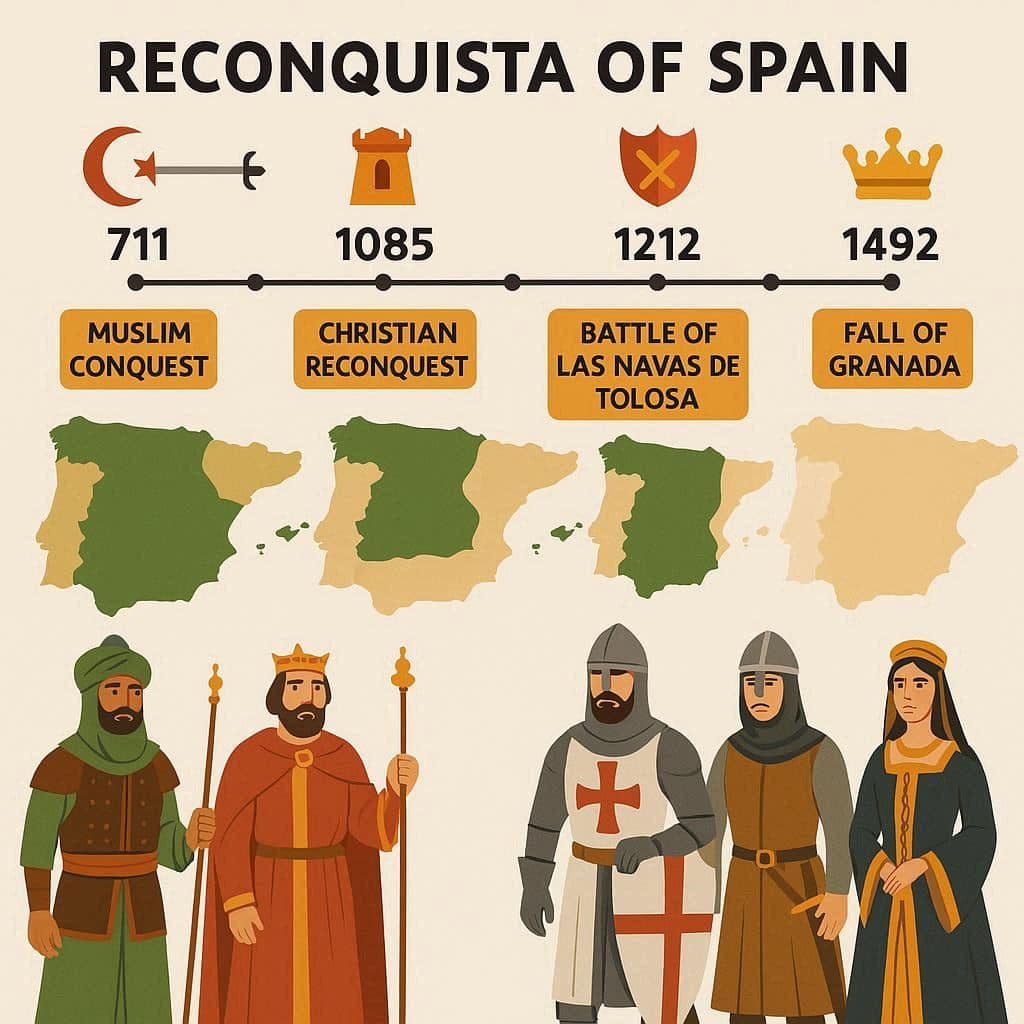
The Reconquista refers to the long and uneven process by which Christian kingdoms expanded southward at the expense of Muslim-controlled territories. Traditionally dated from 711 to 1492, the Reconquista was not a continuous war but rather a series of military campaigns, truces, alliances, and periods of coexistence.
Christians, Muslims, and Jews often lived side by side, especially in urban centers. This coexistence—sometimes referred to as convivencia—allowed for cultural exchange in science, philosophy, architecture, and agriculture, even as religious tensions and violence persisted.
The Reconquista concluded with the capture of Granada by King Ferdinand of Aragon and Queen Isabella of Castile in 1492, marking the end of Muslim political rule in Iberia.
Religion and Society in Medieval Spain
Religion played a central role in medieval Spanish life. In both Christian and Muslim territories, faith shaped law, governance, and social hierarchy.
- Christians lived under Islamic rule as Mozarabs, often allowed limited religious freedom in exchange for taxes.
- Muslims living in Christian lands (Mudéjars) retained their customs but faced legal restrictions.
- Jews formed vibrant communities in both realms, contributing significantly to commerce, medicine, and scholarship.
Despite periods of tolerance, religious minorities were legally subordinate. Following 1492, forced conversions and expulsions dramatically altered Spain’s demographic and cultural landscape.
Feudalism and Governance
Feudalism in medieval Spain developed unevenly and differed significantly from the classic French feudal model. In the Christian kingdoms of Iberia, political relationships were shaped by land grants, military service, and personal loyalty, while royal authority often remained stronger than elsewhere in medieval Europe.
Some historians identify elements of proto-feudalism during the Visigothic period, though this interpretation remains debated. By contrast, Muslim-controlled regions followed entirely different systems of governance, relying on Islamic law, centralized administration, and structured taxation rather than feudal vassalage.
Cities, Castles, and Military Life
Medieval Spanish cities were crucial centers of power, trade, and culture. Cities such as Córdoba, Toledo, Barcelona, León, and Granada flourished as administrative and economic hubs.
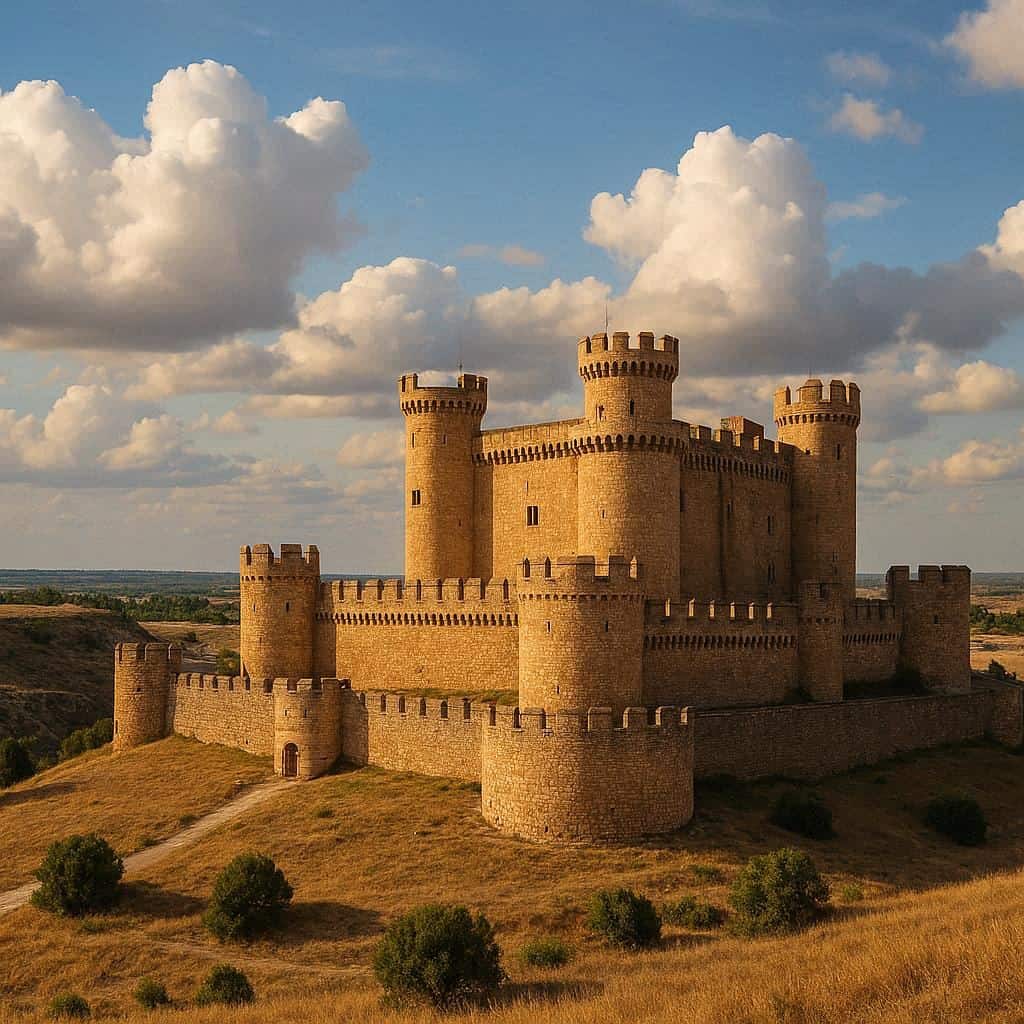
Spain is particularly famous for its medieval castles, with over 1,000 fortifications recorded across the peninsula. Many were built along shifting frontier zones during the Reconquista. The region of Castile—meaning “land of castles”—derives its name from this dense network of fortresses.
Knighthood and Chivalry
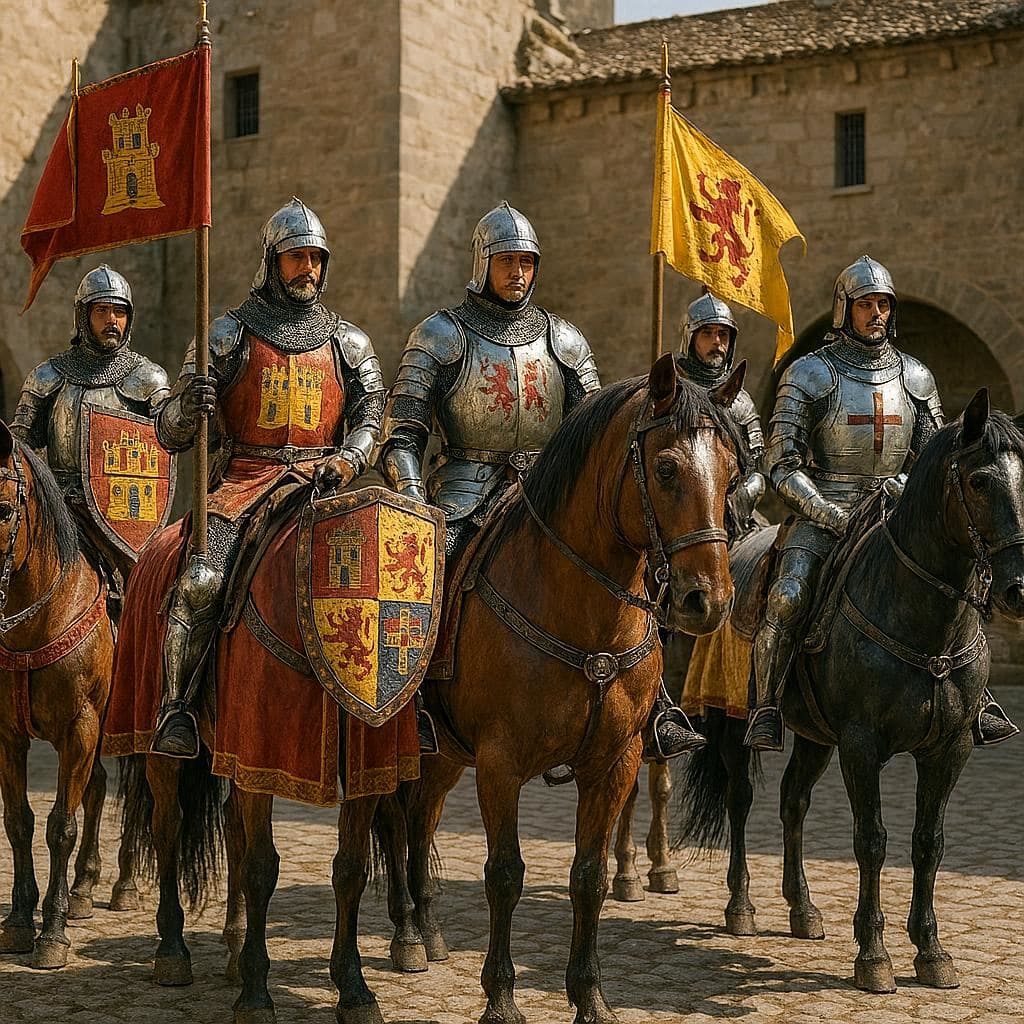
Spanish knighthood developed under the influence of both indigenous traditions and broader European chivalric culture. From the 10th century onward, Frankish and Iberian knights protected pilgrims traveling to Santiago de Compostela, introducing chivalric ideals.
Military orders such as the Order of Santiago, Order of Calatrava, and Order of Alcántara played vital roles in frontier warfare. Spanish chivalry, however, often blended loyalty to the crown with papal authority, creating unique tensions.
One of the most famous figures of medieval Spain, El Cid (Rodrigo Díaz de Vivar), exemplifies this complexity, serving both Christian and Muslim rulers during his lifetime.
Daily Life, Clothing, and Social Classes
Daily life in medieval Spain varied widely by region, religion, and social class. Most people lived in rural villages and worked as peasants, while urban populations included artisans, merchants, scholars, and religious officials.
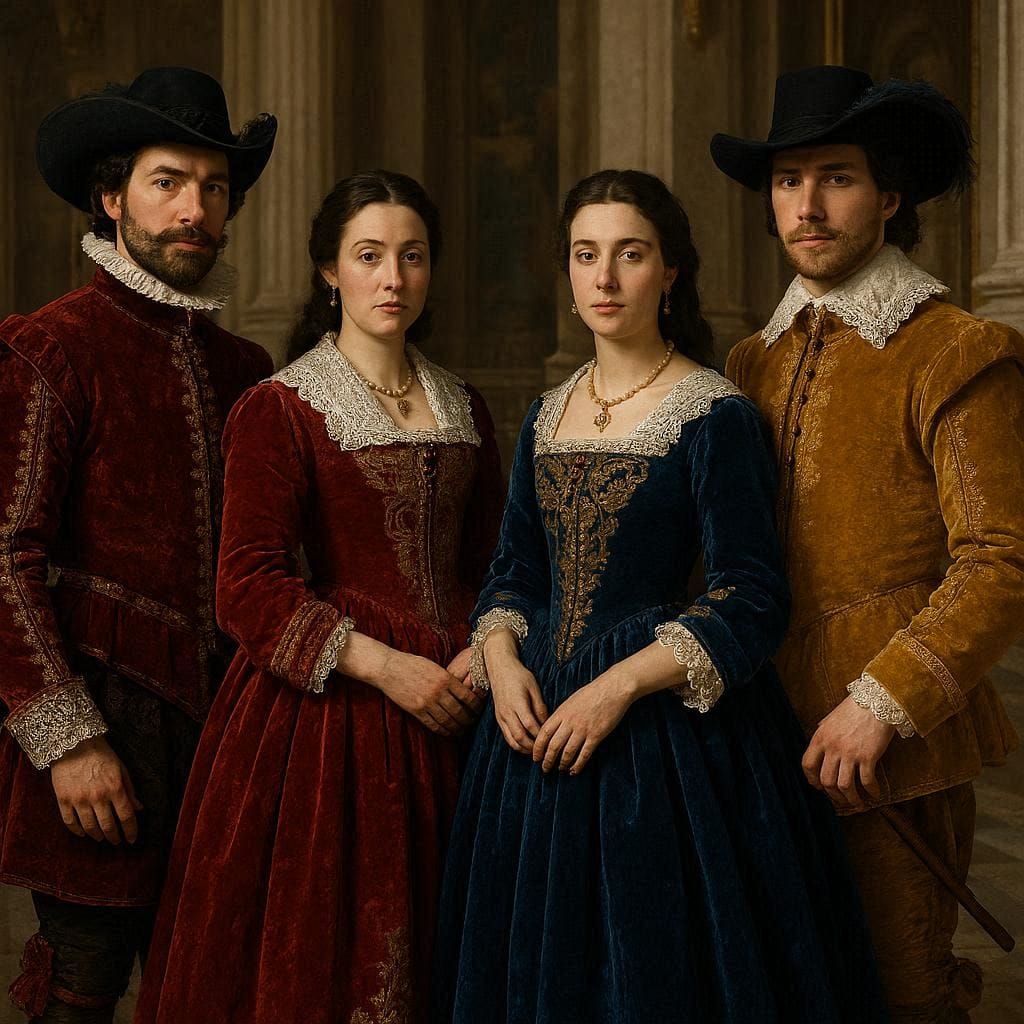
Medieval clothing reflected social hierarchy:
- Nobility wore fine fabrics, dyes, and tailored garments.
- Peasants typically wore simple tunics and cloaks.
- Muslim dress often featured loose garments suited to climate and cultural norms.
🎶 Music, Art, and Learning
Medieval Spanish culture was enriched by a remarkable blend of musical, artistic, and intellectual traditions. Early Christian music included Visigothic chant, which was later replaced by Roman liturgy but survived in limited forms such as the Mozarabic Rite.
Under Islamic rule, Al-Andalus became one of the greatest centres of learning in medieval Europe. Scholars preserved and expanded classical knowledge in mathematics, astronomy, medicine, and philosophy.
Famous translation centres, particularly in cities such as Toledo, played a crucial role in transmitting ancient Greek and Arabic scholarship to the wider European world, helping to lay foundations for later medieval and Renaissance learning.
Food and Agriculture
Muslim influence on Spanish cuisine was profound. Islamic agricultural innovations introduced crops such as rice, citrus fruits, sugarcane, eggplant, and pomegranates, along with advanced irrigation systems.
These techniques transformed Iberian agriculture and spread into Christian territories, shaping what would later become Mediterranean cuisine.
The End of Medieval Spain
The fall of Granada in 1492 marked the symbolic end of medieval Spain. The unification of Castile and Aragon under Ferdinand and Isabella laid the foundation for the modern Spanish state.
In the years that followed, religious uniformity was enforced through the Spanish Inquisition, forced conversions, and expulsions of Jews and Muslims. Spain soon entered the early modern period, embarking on overseas expansion that would create a global empire.
Legacy of Medieval Spain
The legacy of medieval Spain lies in its extraordinary cultural synthesis, architectural achievements, and historical complexity. The interaction of Christian, Muslim, and Jewish civilizations produced a society unlike any other in medieval Europe—one whose influence continues to shape Spain and the wider world today.
📜 Feudalism in Medieval Spain – FAQs
Was medieval Spain fully feudal?
No. Feudalism in medieval Spain developed unevenly and never fully mirrored the French feudal model.
How did Spanish feudalism differ from France?
Spanish kings generally retained stronger royal authority, limiting the independence of nobles.
Did all regions of Spain follow feudalism?
No. Muslim-controlled regions operated under administrative systems based on Islamic law and taxation.
What role did land grants play?
Land grants rewarded military service and loyalty, especially during the Reconquista.
Was feudalism linked to warfare?
Yes. Feudal obligations were closely tied to military support and defense.
Did feudalism exist before the Middle Ages?
Some historians suggest proto-feudal elements during the Visigothic period, though this remains debated.
Who held the most power?
Unlike much of Europe, medieval Spanish kings often maintained centralized control.
🧠 Feudalism in Medieval Spain – Knowledge Quiz
📘 Glossary of Feudalism & Medieval Governance
Feudalism – A medieval system of governance based on land ownership, military service, and personal loyalty between lords and vassals.
Vassal – A noble who received land from a lord or king in exchange for loyalty and military service.
Fief – Land or property granted by a lord to a vassal as part of a feudal agreement.
Lord – A noble who controlled land and granted portions of it to vassals in return for service.
Manorial System – The economic structure of feudal society in which peasants worked a lord’s land in exchange for protection.
Reconquista – The centuries-long campaign by Christian kingdoms to reclaim Iberian territory from Muslim rule.
Proto-Feudalism – Early or partial forms of feudal relationships that existed before fully developed feudal systems.
Visigoths – A Germanic people who ruled much of Iberia before the Muslim conquest in the 8th century.
Islamic Law (Sharia) – The legal and administrative system governing Muslim-controlled regions of medieval Spain.
Royal Authority – The power exercised by a monarch, often stronger in medieval Spain than in other feudal societies.
📚 Academic References on Medieval Spain
An Overview of the Medieval Iberian Peninsula Culture
An analysis of the cultural dynamics in the Iberian Peninsula during the medieval period, focusing on the interplay of Christian, Muslim, and Jewish communities.
🔗 Read the full paper
An Overview of the Medieval Iberian Peninsula Culture
An analysis of the cultural dynamics in the Iberian Peninsula during the medieval period, focusing on the interplay of Christian, Muslim, and Jewish communities.
Access the thesisReligion and Politics in Medieval Spain
A comprehensive course outline discussing the religious and political landscape of medieval Spain, highlighting the coexistence and conflicts among different faiths.
🔗 View the course material