Medieval Germany was not a single unified nation but a vast and evolving region at the heart of Central Europe. Throughout the Middle Ages, the lands that would later form modern Germany were divided among powerful duchies, principalities, bishoprics, and free imperial cities.
For much of this period, these territories were loosely connected under the authority of the Holy Roman Empire, one of the most influential political structures in medieval Europe.
Rather than centralized rule, medieval Germany was defined by regional autonomy, shifting alliances, and the constant negotiation of power between emperors, nobles, and the Church. This political complexity helped shape European diplomacy, warfare, religion, and trade for centuries.
⚔️ Medieval Germany — Quick Overview
Medieval Germany stood at the political and cultural crossroads of Europe. Rather than a single kingdom, it was a vast network of territories united under the Holy Roman Empire, where emperors, princes, bishops, and free cities competed for influence. This decentralized structure shaped warfare, trade, religion, and governance across Central Europe for centuries.
- Imperial Core: The German lands formed the backbone of the Holy Roman Empire.
- Decentralized Rule: Power was shared between emperors and regional princes.
- Feudal Society: Knights, nobles, clergy, and peasants operated within a rigid hierarchy.
- Castle Landscape: Fortifications symbolized authority and controlled strategic territories.
- Growing Cities: Trade centers gained independence and boosted economic expansion.
- Enduring Influence: Medieval German politics helped shape the future of Central Europe.
Understanding medieval Germany reveals how a fragmented region became one of the most influential forces in European medieval history.
📜 Timeline of Medieval Germany
The history of medieval Germany evolved through powerful dynasties, imperial coronations, and shifting territorial control. This timeline highlights the major political transformations that shaped the German lands during the Middle Ages.
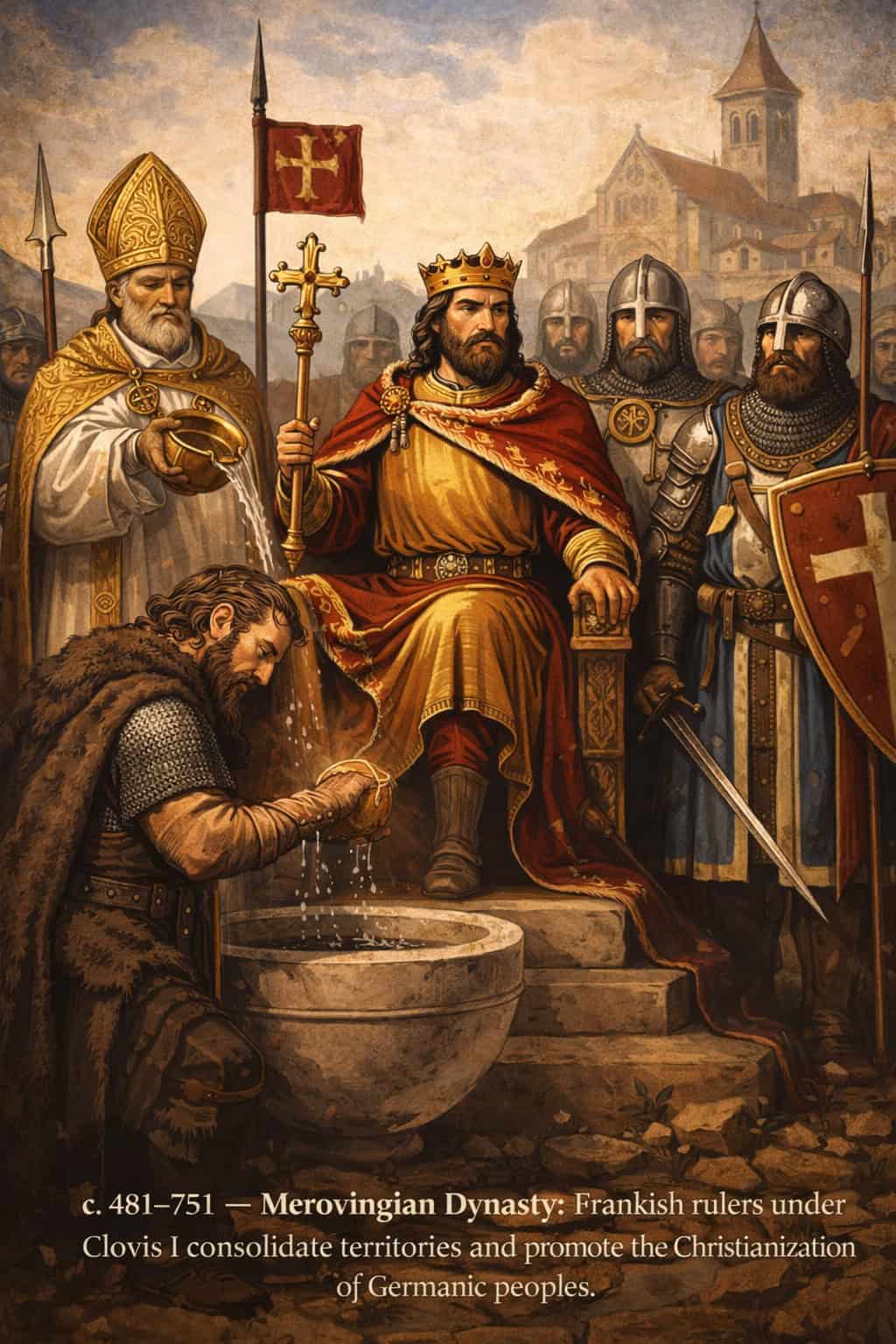
- c. 481–751 — Merovingian Dynasty: Frankish rulers under Clovis I consolidate territories and promote the Christianization of Germanic peoples.
- 751–840 — Carolingian Empire: Charlemagne unites much of Western and Central Europe and is crowned Emperor in 800, ushering in a period of political strength and cultural revival.
- 843 — Treaty of Verdun: The Carolingian Empire is divided, and the East Frankish Kingdom emerges as the political foundation of future Germany.
- 962 — Birth of the Holy Roman Empire: Otto I is crowned emperor, establishing a powerful yet decentralized empire that dominates Central European politics.
- 11th–13th Centuries — Imperial Expansion: German rulers extend influence across Europe while cities grow and trade networks expand.
- 13th–14th Centuries — Rise of Powerful Princes: Regional leaders gain authority, reinforcing the empire’s fragmented structure.
- 15th Century — Transition Toward Early Modern Europe: Economic growth, stronger cities, and shifting military technology begin reshaping the medieval German world.
Rather than forming a centralized kingdom, medieval Germany developed as a network of semi-independent states — a defining characteristic that influenced European political history for centuries.
🏰 The Political Foundations of Medieval Germany
The origins of medieval Germany can be traced to the Germanic tribes that settled across Central Europe after the decline of the Western Roman Empire. Over centuries, these tribal lands were absorbed into larger political entities that shaped the structure, identity, and governance of the medieval German world.
-
Merovingian Dynasty (c. 481–751)
Founded by Clovis I, the Merovingians ruled much of Western and Central Europe. Their reign encouraged the early Christianization of the Franks and established administrative systems later expanded by subsequent rulers. -
Carolingian Empire (c. 751–840)
The rise of the Carolingian dynasty, especially under Charlemagne, brought political consolidation and cultural revival known as the Carolingian Renaissance. When Charlemagne was crowned Emperor of the Romans in 800, his empire covered large portions of modern Germany. -
East Frankish Kingdom (843–10th Century)
Following the Treaty of Verdun, the eastern territories evolved into the East Frankish Kingdom — widely regarded as the political predecessor of Germany. This era saw the emergence of a distinct German identity shaped by governance, language, and regional leadership. -
Holy Roman Empire (962–1806)
Established with the coronation of Otto I, the empire was not a centralized state but a federation of semi-independent territories including duchies, ecclesiastical states, free imperial cities, and noble domains. It played a decisive role in medieval politics, church–state relations, and military campaigns such as the Crusades.
These successive political structures transformed a landscape of tribal territories into one of Europe’s most influential medieval regions.
Feudalism in Medieval Germany
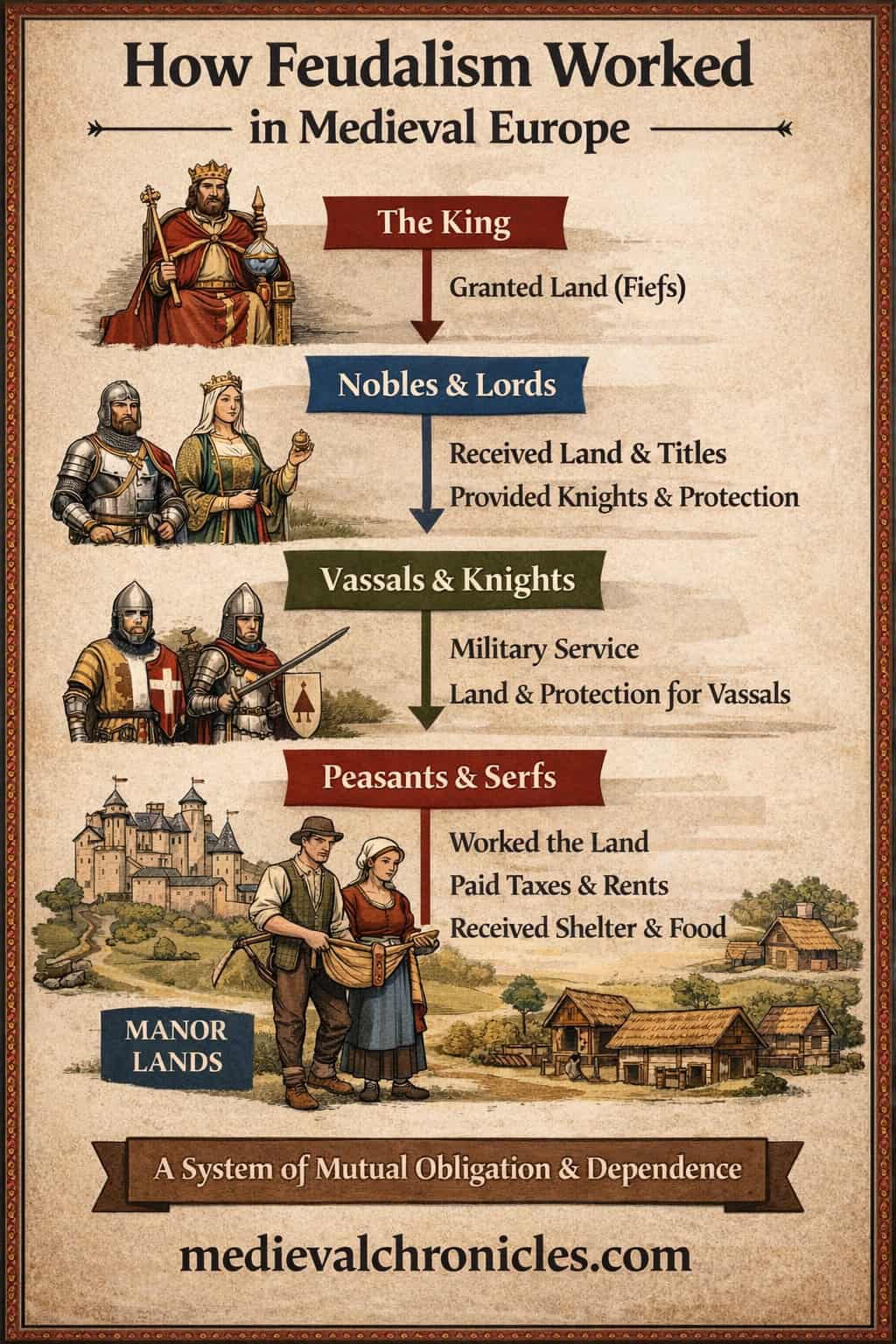
Like much of Europe, medieval German society operated within a feudal framework that structured land ownership, military service, and social hierarchy.
At the top stood the king or emperor, followed by powerful dukes and princes who controlled large territories. These rulers granted land to loyal nobles in exchange for military support and political allegiance.
Below them were:
- Knights, who served as mounted warriors
- Peasants, who farmed the land
- Serfs, who were bound to estates
This system ensured stability but also reinforced rigid social divisions that shaped everyday life.
Germanic Peoples and Cultural Identity
The population of medieval Germany was far from uniform. It consisted of numerous Germanic groups, including the Goths and Vandals, whose migrations influenced the broader European landscape.
Germanic peoples spread across the continent, interacting with neighboring cultures and contributing to the formation of emerging kingdoms.
Meanwhile, Scandinavian Norse communities established themselves in northern regions such as Sweden, Norway, and Iceland, expanding trade networks and cultural exchange.
Castles and Power
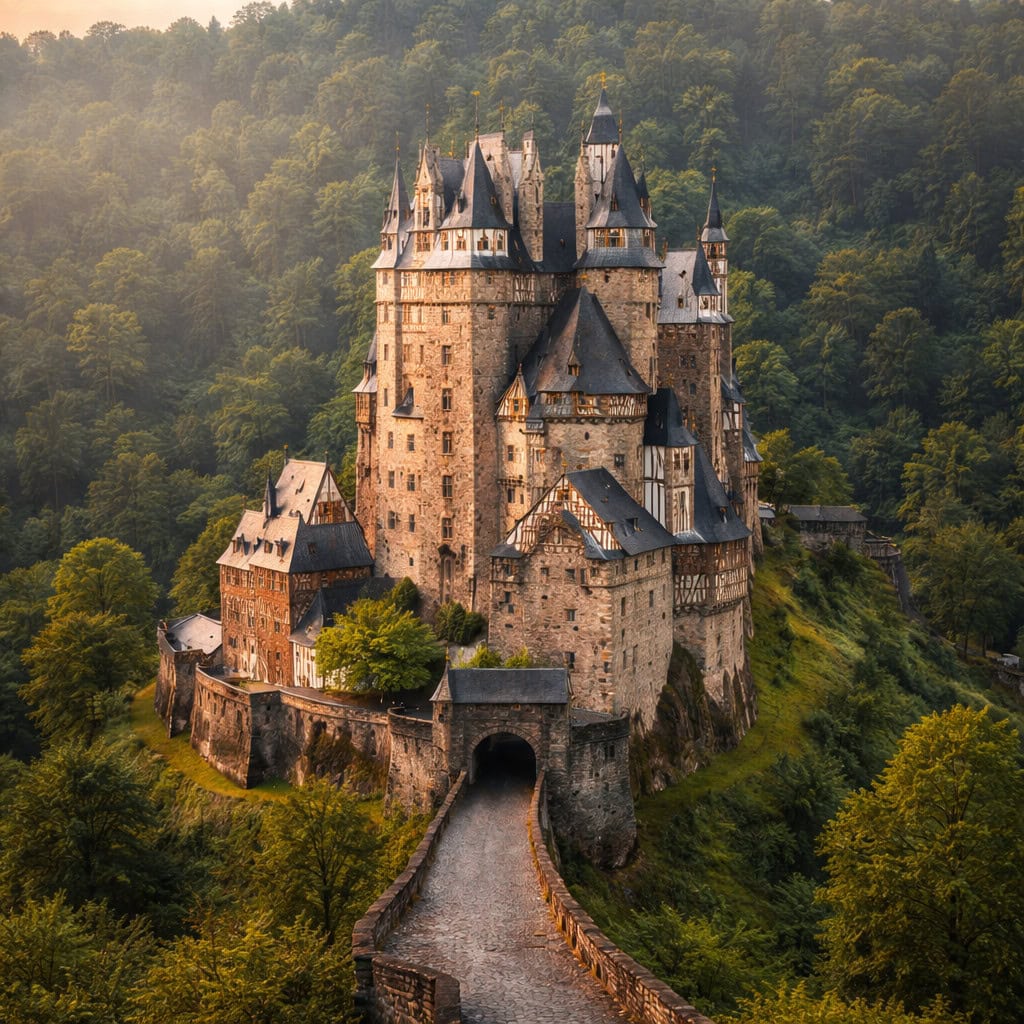
Castles became one of the most recognizable symbols of medieval Germany.
Constructed by lords and princes, these fortified structures served multiple purposes:
- Defensive strongholds
- Administrative centers
- Residences for the nobility
- Visible symbols of authority
Frequent conflicts between rival rulers increased the importance of castles, encouraging continual innovation in military architecture.
German castle-building traditions helped influence fortification styles across Europe.
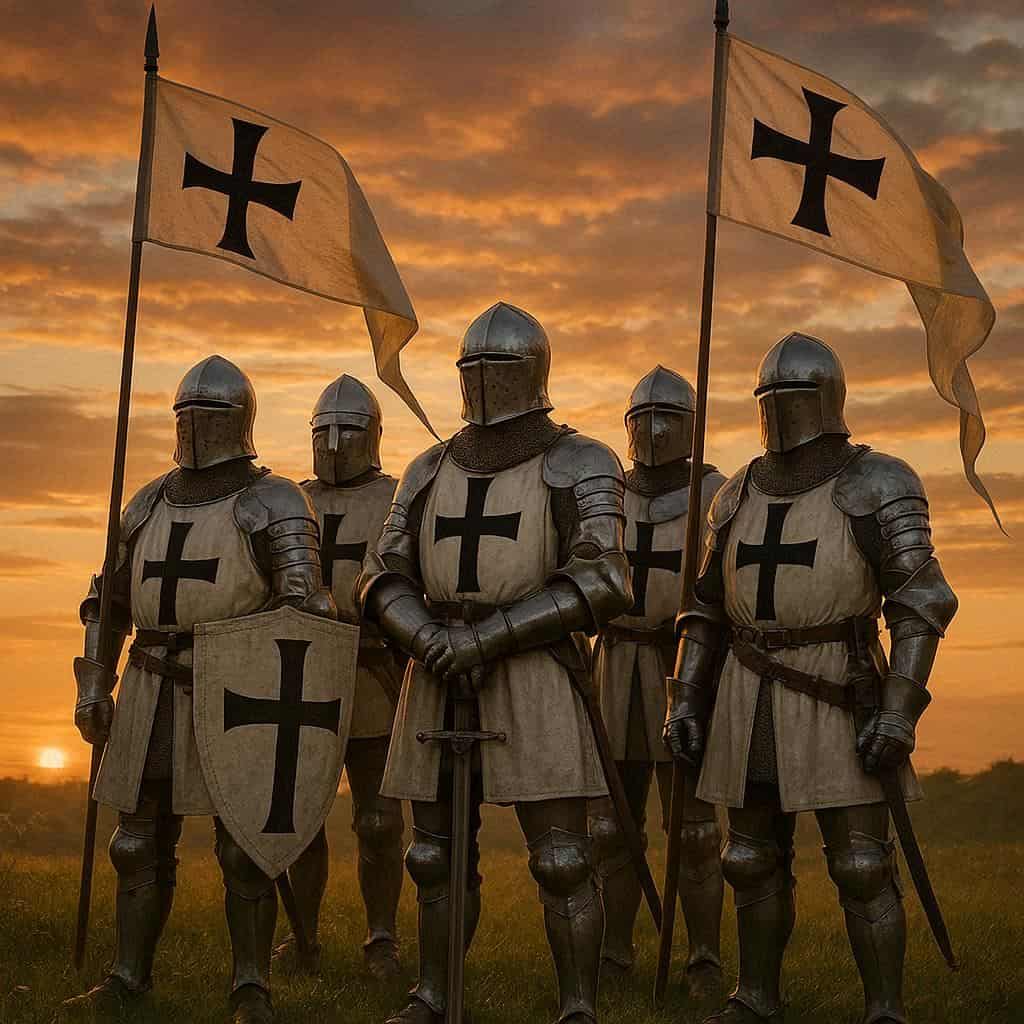
Knights and Military Orders
The tradition of German knighthood dates back to the reign of Charlemagne, who relied on mounted warriors drawn from the aristocracy.
Over time, knighthood became closely associated with noble status and martial honor.
One of the most influential military organizations was the Teutonic Order, founded in the late 12th century. The order played a major role in expanding Christianity into parts of Eastern Europe, particularly Prussia and the Baltic regions.
The Rise of Towns and Cities
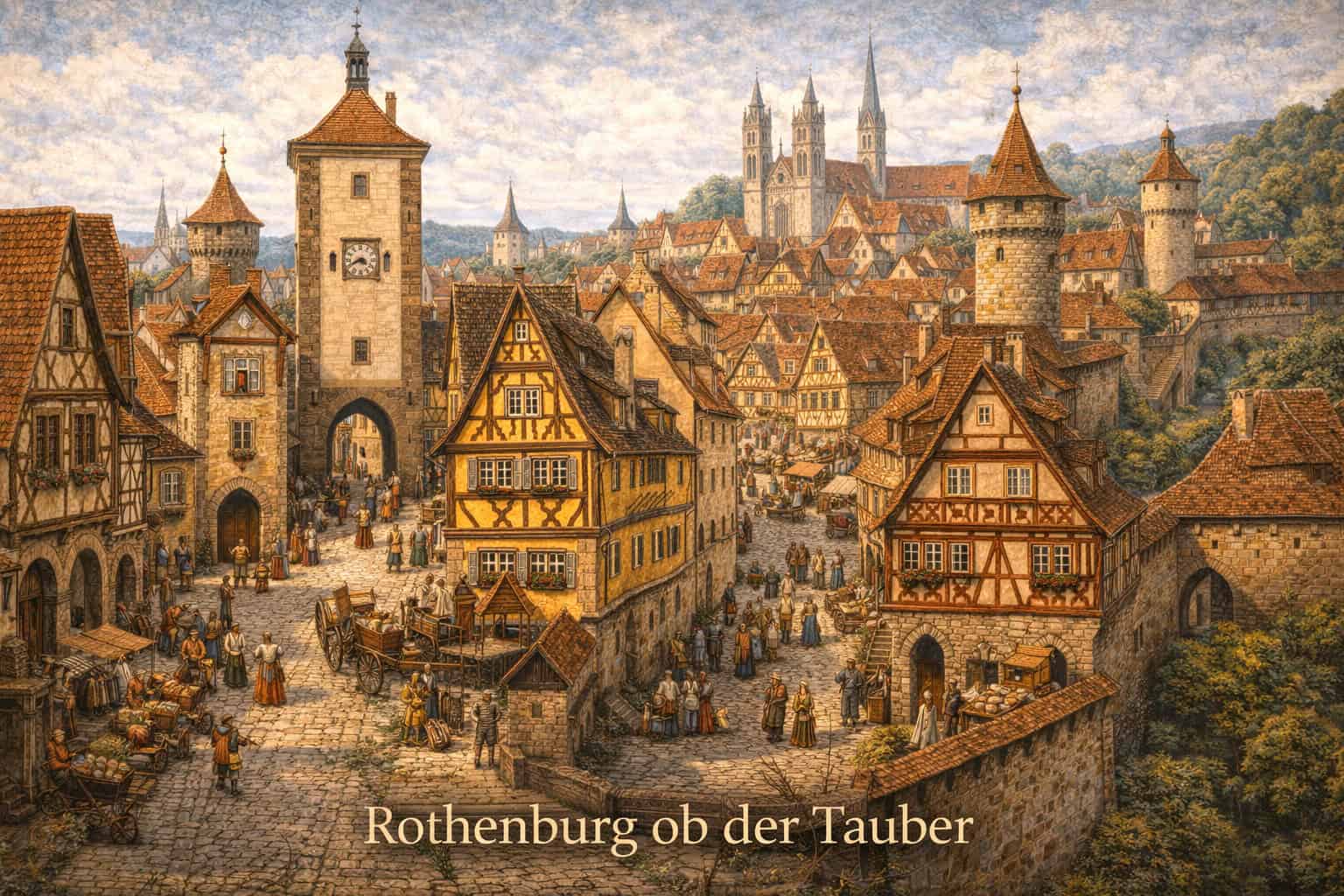
Beginning around the 10th century, towns and cities expanded across German lands.
Many settlements developed near:
- Castles
- Trade routes
- Religious centers
- Imperial strongholds
Urban communities often received municipal rights, allowing them to govern locally, regulate trade, and administer justice.
Some cities answered directly to the emperor, granting them greater autonomy and making them thriving centers of commerce.
Kings and Emperors
Several rulers left lasting marks on medieval Germany.
Charlemagne unified vast territories and established a political framework that influenced European governance for generations.
Later, Otto I strengthened royal authority and secured the imperial crown, firmly positioning Germany at the center of European power.
Subsequent emperors continued to balance authority with the independence of regional rulers — a defining characteristic of the medieval German political system.

Music and Intellectual Life
Medieval Germany cultivated a rich musical tradition.
One of the most notable forms was Minnesang, a lyrical style performed by Minnesingers that celebrated themes of courtly love. These performances often took place in noble courts and reflected aristocratic culture.
Another tradition, Geisslerlieder, emerged during periods of crisis such as warfare and the Black Death. These penitential songs were sung by wandering religious groups seeking spiritual redemption.
🍞 Food and Daily Living in Medieval Germany
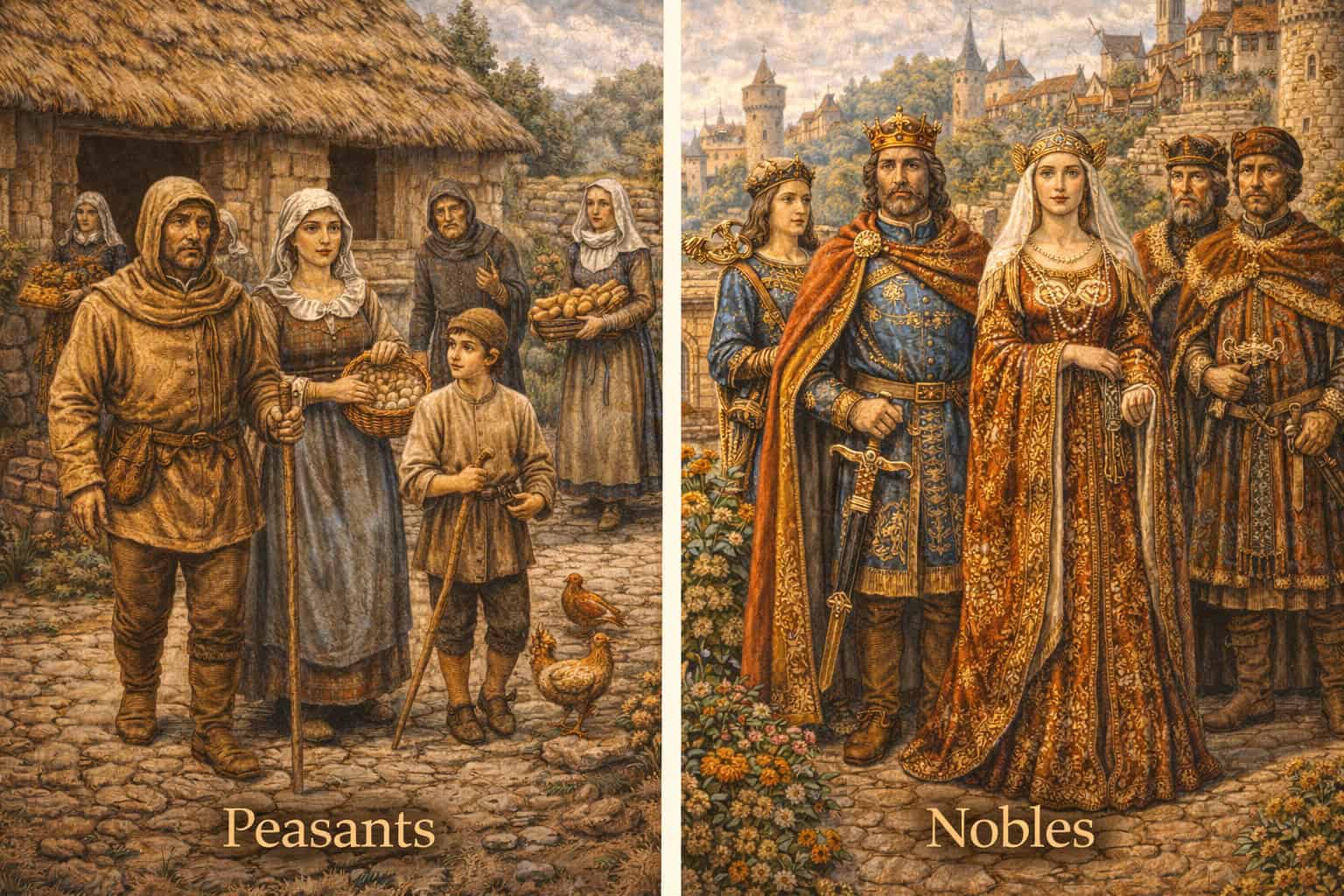
Diet in medieval Germany varied dramatically according to social class. While the nobility enjoyed diverse and richly prepared meals, peasants relied on practical, sustaining foods that reflected the realities of agricultural life.
Noble Diet
Wealthy households had access to a broad selection of foods, many of which symbolized status and privilege.
- Game meats such as deer and boar
- Fish for both everyday meals and religious fasting days
- Fruits and vegetables from cultivated estates
- Bread and pastries made from finer grains
- Wine, commonly served at noble tables
Spices like pepper and ginger were highly prized, and meats were often prepared as pies or sausages to enhance flavor and preservation.
Peasant Diet
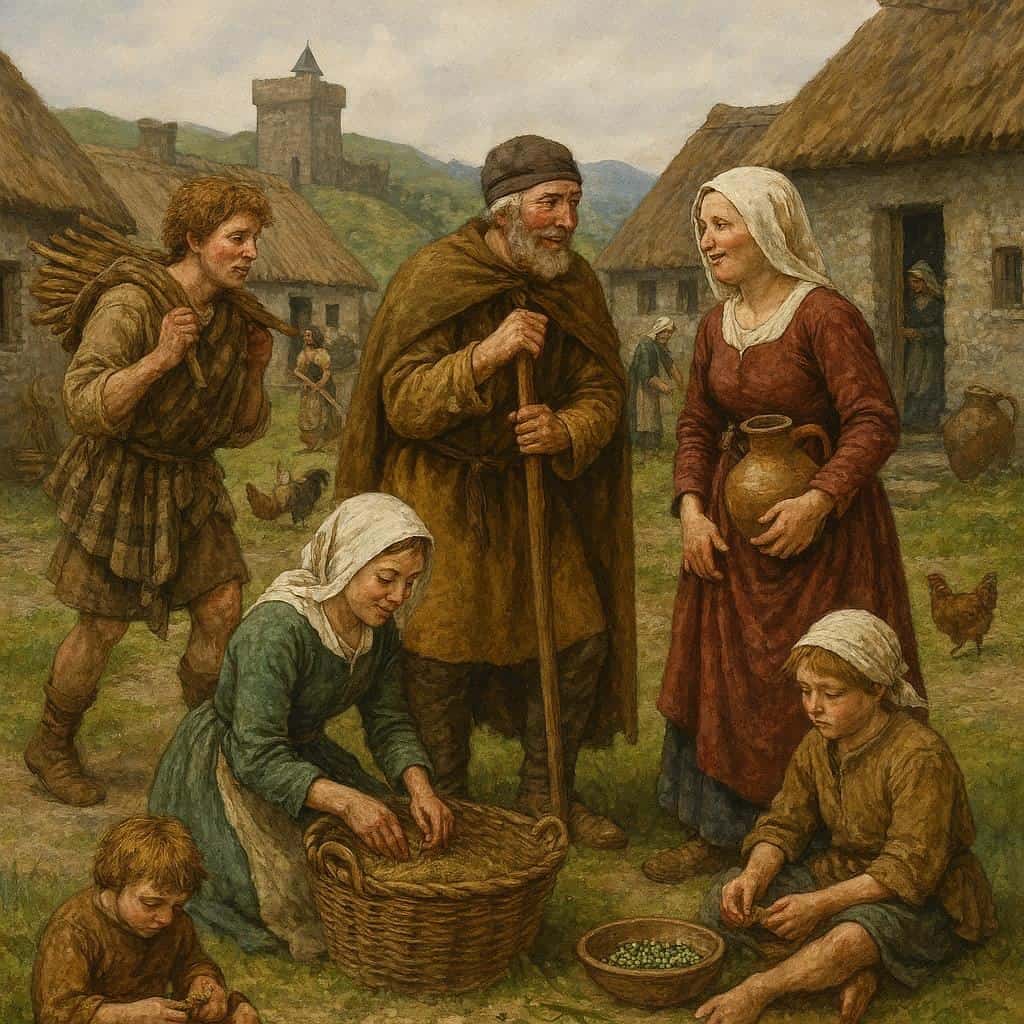
Rural communities depended on affordable, filling foods that could be grown locally and prepared with minimal resources.
- Porridge made from grains
- Bread, often coarse and dark
- Beans and lentils as key protein sources
- Vegetables harvested from small plots
Despite social contrasts, agriculture remained the backbone of the medieval economy, sustaining both elite households and village life.
Clothing and Appearance
Clothing reflected both status and practicality.
Men commonly wore long tunics, linen undergarments, and cloaks, while women dressed in full-length chemises layered with outer garments.
Materials and decoration often indicated wealth, with finer fabrics reserved for the nobility.
Peasants and Labor
Many peasants were technically free and could hold land, though economic realities required them to cultivate it personally.
Land was often granted by nobles or the Church in exchange for rent or labor.
Slavery also existed in parts of medieval Germany, particularly among large landowners who used enslaved individuals for agricultural work and domestic service.
Legacy of Medieval Germany
Medieval Germany emerged from a network of tribal territories into a politically significant region that influenced the direction of European history.
Although never fully unified during the Middle Ages, its rulers, cities, and religious institutions contributed to:
- Castle architecture
- Imperial governance
- Trade expansion
- Christian missionary activity
- Cultural exchange
The decentralized structure that defined medieval Germany helped shape the broader political traditions of Central Europe.
Conclusion
Medieval Germany was a region of immense diversity, political complexity, and cultural development. From the rise of the Holy Roman Empire to the growth of autonomous cities and powerful noble families, it stood at the crossroads of European transformation.
Its legacy can still be seen in historic towns, fortified castles, and enduring cultural traditions — reminders of a medieval world that helped shape modern Europe.
❓ Medieval Germany — Frequently Asked Questions
Medieval Germany was a politically complex region shaped by powerful dynasties, feudal structures, and the enduring influence of the Holy Roman Empire. These frequently asked questions clarify how the region developed and why it became central to European history.
What was Medieval Germany?
Medieval Germany refers to the territories in Central Europe that later formed modern Germany during the Middle Ages (c. 5th–15th centuries). The region evolved through major political entities such as the Frankish Empire, the East Frankish Kingdom, and ultimately the Holy Roman Empire.
Was Germany a unified country in the Middle Ages?
No. Medieval Germany was a collection of duchies, principalities, free imperial cities, and church territories. Although many were nominally under the emperor, local rulers often exercised significant independence.
Which empires shaped medieval German history?
Key political powers included the Merovingian Dynasty, the Carolingian Empire, the East Frankish Kingdom, and the Holy Roman Empire. Each contributed to the administrative, cultural, and political foundations of the German world.
Who were the most influential rulers?
Important figures include Charlemagne, who expanded Frankish rule across much of Europe, and Otto I, whose coronation in 962 formally established the Holy Roman Empire. Later emperors continued shaping regional power structures for centuries.
What role did the Holy Roman Empire play?
The Holy Roman Empire acted as the primary political framework for medieval Germany. While decentralized, it coordinated imperial authority, influenced church–state relations, and played a major role in European diplomacy and warfare.
What was daily life like in medieval German lands?
Life varied by social class. Peasants cultivated land and supported the rural economy, nobles governed territories and maintained armies, and the Church shaped education, culture, and spiritual life. Growing towns gradually expanded trade and economic opportunity.
📘 Medieval Germany — Key Terms Glossary
Understanding medieval Germany requires familiarity with the political, social, and religious institutions that shaped the region. This glossary highlights essential terms that defined governance, society, and daily life throughout the German Middle Ages.
- Holy Roman Empire: A vast political entity established in 962 under Otto I, consisting of semi-independent territories across Central Europe rather than a single unified state.
- Feudalism: A hierarchical system in which land was granted in exchange for loyalty and military service, structuring medieval German society from emperors down to peasants.
- Duchy: A territory ruled by a duke. Many duchies operated with considerable autonomy despite belonging to the empire.
- Frankish Empire: The powerful realm ruled by the Franks, especially under Charlemagne, that laid the political groundwork for later German states.
- East Frankish Kingdom: The eastern portion of the Carolingian Empire formed after the Treaty of Verdun (843), widely regarded as the precursor to medieval Germany.
- Prince-Elector: One of the elite rulers granted the authority to elect the Holy Roman Emperor, demonstrating the decentralized nature of imperial power.
- Free Imperial City: A city directly subject to the emperor rather than a regional lord, often enjoying economic freedom and political privileges.
- Teutonic Knights: A German military and religious order that expanded Christianity into Eastern Europe and played a major role in regional warfare.
- Minnesang: A tradition of lyrical song performed by Minnesingers, typically centered on themes of courtly love within noble circles.
- Serf: An agricultural laborer bound to the land and obligated to serve a noble household, forming the backbone of the rural economy.
Together, these terms reveal how decentralized authority, feudal relationships, and imperial tradition defined the political landscape of medieval Germany.