Throughout the Middle Ages, mercenaries—soldiers who fought for payment rather than feudal obligation—played a pivotal and often controversial role in shaping European warfare. While paid soldiers had existed since antiquity, the 14th and 15th centuries witnessed the rise of large, organized mercenary companies whose influence extended across political, military, and even economic spheres. These companies offered trained, battle-hardened warriors to rulers and city-states, but they also introduced instability, shifting loyalties, and, at times, outright devastation.

Origins and Growth of Mercenary Companies
Although the article commonly cited the 14th century as their “beginning,” mercenaries had long been present in Europe. Earlier examples include:
- Brabançons in the 12th century
- Routiers active during the 13th century
- Norman adventurers serving foreign rulers in the 11th century
What did emerge in the 14th century was the large-scale, organized mercenary company, often composed of unemployed soldiers left adrift during lulls in conflicts such as the Hundred Years’ War. These companies:
- Operated as semi-professional military corporations
- Negotiated contracts (condotte in Italy)
- Offered specialized infantry, cavalry, or missile troops
- Served monarchs, nobles, city-republics, and sometimes the Church
These soldiers were typically paid:
- Monthly or seasonal wages
- Shares of plunder
- Bonuses for successful campaigns
Their services were contractual yet often temporary, lasting only as long as funding allowed.
📜 Click to Reveal a Quick Summary of Medieval Mercenary Companies
Mercenary companies were professional fighting forces that rose to prominence in the 14th and 15th centuries, especially in regions like Italy, France, and the Byzantine world. While soldiers-for-hire existed earlier, these **large organized companies** reshaped medieval warfare.
- The White Company – Elite English-led mercenaries under Sir John Hawkwood, famed for discipline and success in Italy.
- Companies of St. George – Italian-led forces such as the brigade of Alberico da Barbiano, promoting early professionalized warfare.
- The Catalan Company – Fierce Almogavars who served Byzantium, later carving out territories in Greece.
- Free Companies – Loosely organized bands active during the Hundred Years’ War, often resorting to pillage during peacetime.
- Swiss Mercenaries – Highly sought-after pikemen known for discipline and decisive battlefield shock tactics.
These companies provided rulers with professional, flexible armies but also introduced significant instability, shifting allegiances, and widespread destruction when unpaid or uncontrolled. Their influence marked the transition from feudal levies to **early state-based military systems**.
Major Mercenary Companies of the Medieval and Renaissance World
Below are historically grounded profiles of the most influential mercenary groups of the era.
1. The White Company
One of the most famous and successful mercenary companies of the 14th century, the White Company formed around 1360 and became renowned throughout Italy. Key facts include:
- Composed largely of English and Anglo-Gascon veterans of the Hundred Years’ War
- Commanded by the legendary Sir John Hawkwood, celebrated for innovation and discipline
- Fought for multiple Italian powers, including Florence, Pisa, and the Papal States
- Distinguished by strict discipline, longbow use, and strategic mobility
Hawkwood’s talents allowed the White Company to become:
- A decisive political force in Italy
- A model of professionalized warfare years before standing armies became common
- A symbol of both the effectiveness and dangers of hired military power
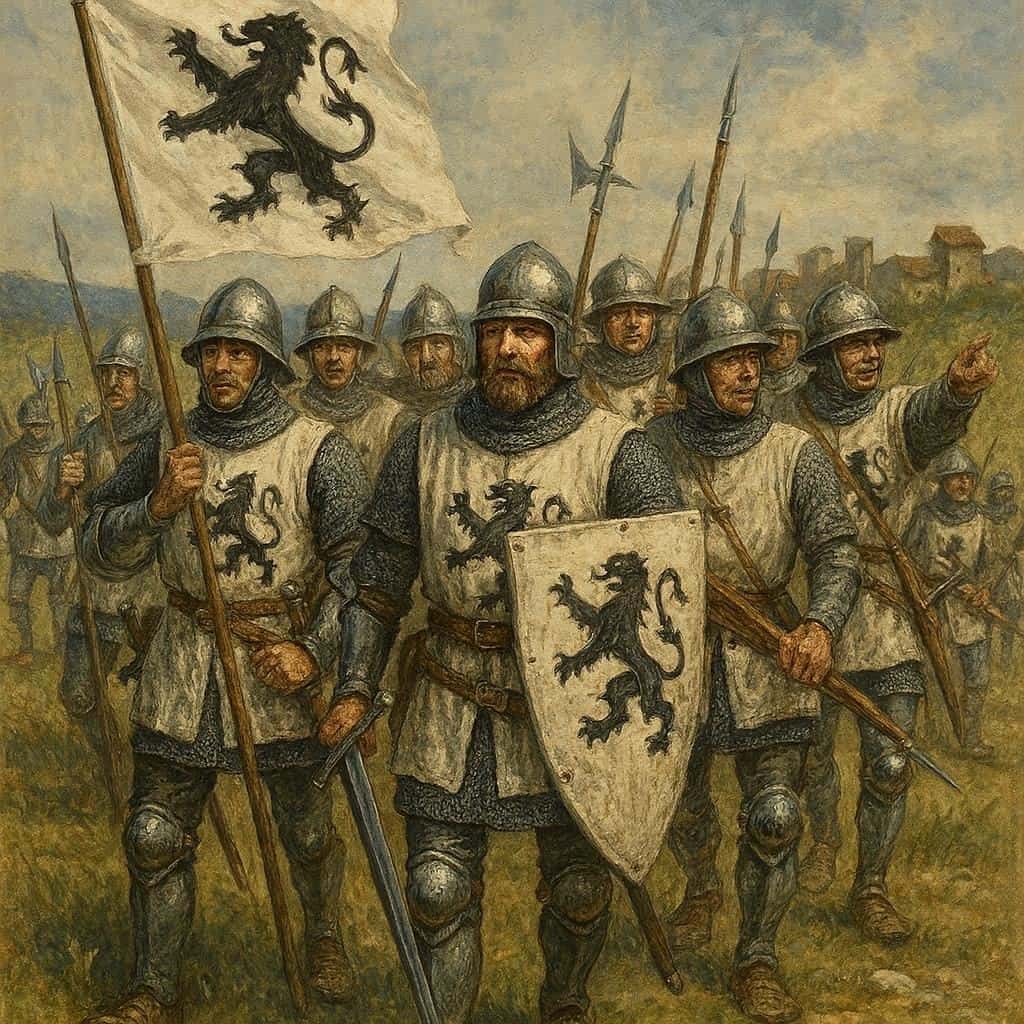
2. Companies of St. George (Compagnia di San Giorgio)
Several Italian companies used this name, the earliest founded in the 14th century. The most influential was created by Alberico da Barbiano in 1377. Important distinctions:
- Not originally founded by Francesco Sforza, though he later commanded companies of similar structure
- Primarily composed of Italian mercenaries, in contrast to earlier bands dominated by foreigners
- Emphasized loyalty to employers—Barbiano famously ordered his men not to pillage Italian civilians
These companies marked a shift toward Italian-led, semi-professional armies, shaping the future of Renaissance warfare.

3. The Catalan Company
The Catalan Company, formed of hardened Almogavars—light infantry from Catalonia and Aragon—was one of the most formidable mercenary forces of the early 14th century. Their history includes:
- Initially hired by the Byzantine Empire to combat Turkish incursions
- Quickly became notorious for their ferocity and independence
- Turned on their Byzantine employers after political conflict and the murder of their commander Roger de Flor
- Launched the infamous “Catalan Vengeance”, ravaging Thrace and Greece
- Eventually carved out control over the Duchy of Athens
Far from exemplifying loyalty, the Catalan Company became famous for autonomy, brutality, and opportunism.
💡 Did You Know? — The Catalan Company
The Catalan Company, formed of hardened Almogavars—elite light infantry from Catalonia and Aragon—was one of the most formidable and feared mercenary forces of the early 14th century. Their history includes:
- Serving the Byzantine Empire in its struggle against Turkish expansion.
- Developing a fierce reputation for mobility, shock attacks, and ruthless efficiency.
- Turning on their Byzantine employers after the murder of their leader, Roger de Flor.
- Launching the infamous “Catalan Vengeance”, devastating the Balkans and Greece.
- Eventually seizing power and ruling territories, including the Duchy of Athens.
4. Free Companies (Les Grandes Compagnies)
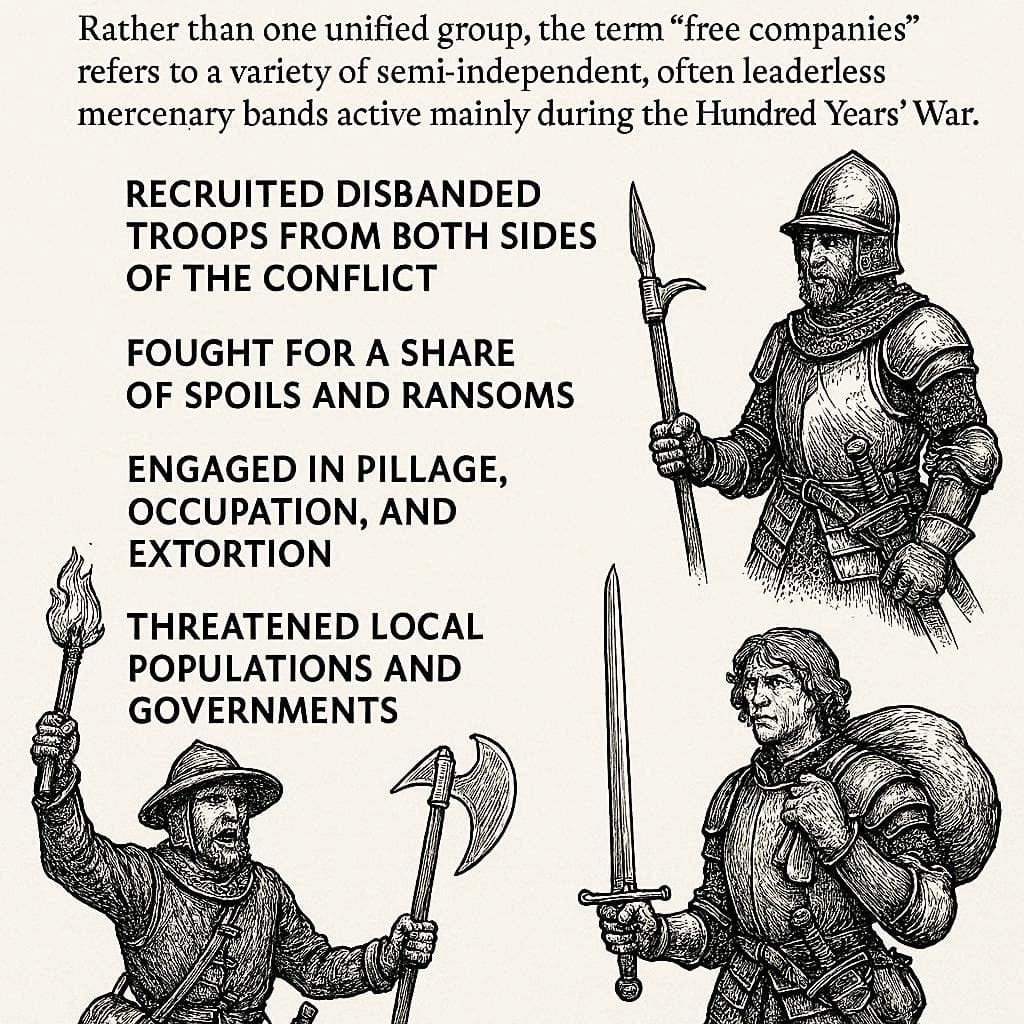
Rather than one unified group, the term “Free Companies” refers to a variety of semi-independent, often leaderless mercenary bands active mainly during the Hundred Years’ War. They:
- Operated without fixed allegiance, fighting for whoever paid
- Survived during peace by extortion, raiding, and pillage
- Included infamous organizations like the Tard-Venus and the Great Company
- Became so disruptive that rulers sometimes paid them simply to go elsewhere
These companies reflected the dangerous economic vacuum faced by unemployed soldiers in a continent torn by prolonged conflict.
5. Swiss Mercenaries
By the late 15th century, Swiss pikemen were among the most sought-after troops in Europe. Their characteristics included:
- Exceptional discipline, cohesion, and shock infantry tactics
- Organized recruitment through the Swiss cantons
- Contracts with major powers such as France, the Holy Roman Empire, and several Italian states
Swiss mercenaries played major roles in:
- The Burgundian Wars
- The Italian Wars
- The shaping of early modern infantry tactics
Though highly effective, their reputation for loyalty is overstated; their primary constraint was a refusal to fight fellow Swiss.

Impact of Mercenary Companies on Medieval Europe
Mercenary companies profoundly influenced the military and political environment of their time. Their impact can be summarized as follows:
Advantages
- Provided rulers with rapidly deployable professional armies
- Introduced or improved military innovations (e.g., pike squares, mobile infantry)
- Allowed smaller states to compete militarily with larger kingdoms
- Strengthened the emergence of state-controlled standing armies by setting professional standards
Disadvantages
- Could become uncontrollable during lapses in payment
- Engaged in widespread pillaging, especially Free Companies
- Often pursued self-interest, resulting in shifting alliances
- Contributed to political destabilization, especially in Italy during the Renaissance
Mercenaries were, in many ways, a double-edged sword. They offered expertise and flexibility but also undermined the ideals of knightly service, feudal loyalty, and territorial stability.

Mercenary companies were essential components of late medieval warfare. Whether serving as disciplined professionals like the White Company, opportunistic ravagers like the Free Companies, or elite infantry such as the Swiss mercenaries, these groups reshaped military practice across Europe. Their existence highlights a period of transformation, marked by declining feudal structures and the rise of contract-based warfare, professional soldiers, and early state militaries.
What made the Catalan Company so feared?
Were mercenary companies loyal to the rulers who hired them?
Did mercenaries replace traditional medieval armies?
Which mercenary company was the most successful?
Why did so many mercenary groups form in the 14th century?
🛡️ Medieval Mercenary Companies Quiz
📖 Glossary of Medieval Mercenary Terms
Almogavars
Light infantry from Catalonia and Aragon known for their ferocity, speed, and devastating shock attacks.
Condottiere
A professional mercenary captain in Renaissance Italy who commanded a contract-based army (a condotta).
Condotta
The legal contract under which Italian mercenary companies served employers such as city-states or nobles.
Free Companies
Independent bands of mercenaries active during the Hundred Years’ War, notorious for pillaging during peacetime.
Great Company
One of the largest 14th-century mercenary bands, composed of thousands of soldiers operating across Italy and France.
Pike Square
A disciplined infantry formation used by Swiss mercenaries, famous for its defensive and offensive power.
Routiers
Earlier medieval mercenary bands (12th–13th century) known for raiding and operating outside feudal structures.
Soldiers of Fortune
A general term for mercenaries who fought for payment rather than loyalty or feudal duty.
White Company
A famous English-led mercenary company under Sir John Hawkwood, known for discipline and effectiveness in Italy.
Catalan Company
A powerful mercenary force of Almogavars who served Byzantium before carving out territories in Greece.
📚 References & Further Reading
-
Urban, William.
Medieval Mercenaries: The Business of War.
View on Google Books -
Mallett, Michael; Caferro, William.
Mercenaries and Their Masters: Warfare in Renaissance Italy.
View at Pen & Sword Books -
Fowler, Kenneth.
Medieval Mercenaries, The Great Companies.
View at Waterstones -
Setton, Kenneth M.
Catalan Domination of Athens, 1311–1388.
View on Amazon
Great Books about Medieval Mercenaries
“Medieval Mercenaries: The Business of War” by William Urban
This book provides a comprehensive exploration of medieval mercenaries, examining their recruitment, training, motivations, and impact on the warfare of the time. Dr. William Urban offers insights into the social, economic, and political aspects of mercenary activity.
“The Condottieri: Soldiers of Fortune in Renaissance Italy” by William Caferro
Focusing on the Italian condottieri, this book delves into the world of Renaissance mercenaries. It explores their rise to prominence, military tactics, and the complex relationships between condottieri and the Italian city-states.
“The White Company” by Arthur Conan Doyle:
Although a work of fiction, this novel by Arthur Conan Doyle offers an immersive and thrilling portrayal of a band of medieval mercenaries known as the White Company. Set during the Hundred Years’ War, it provides a vivid depiction of their adventures and challenges.
“The Mercenary’s Tale: A Novel of the Thirty Years’ War” by Gabriel Eisenstadt
This historical fiction novel takes readers into the tumultuous era of the Thirty Years’ War and follows the journey of a mercenary captain. It offers a gripping narrative that captures the harsh realities and moral complexities faced by mercenaries during this time.
“The Battle of Agincourt: Sources and Interpretations” edited by Anne Curry
While not exclusively focused on mercenaries, this book includes valuable chapters and sources that shed light on the role of mercenaries in the famous Battle of Agincourt. It provides scholarly analysis and different perspectives on the mercenary involvement in this significant medieval battle.
These books offer diverse perspectives on medieval mercenaries, ranging from historical analyses to fictional narratives that provide insight into their lives, motivations, and impact on warfare.