Medieval warfare encompassed the weapons, tactics, armies, and fortifications that shaped conflicts across Europe during the Middle Ages. Spanning roughly from the 5th to the late 15th century, this era witnessed constant military innovation as rulers sought strategic advantages over their rivals.
From heavily armored knights charging into battle to disciplined infantry formations and devastating siege engines, warfare evolved in response to technological advances, economic pressures, and shifting political landscapes. Understanding how medieval wars were fought provides essential context for the rise and fall of kingdoms, the construction of castles, and the transformation of European society.
What Was Medieval Warfare?
Medieval warfare refers to the methods of combat used across Europe during the Middle Ages (approximately the 5th to 15th centuries). Armies evolved from cavalry-dominated forces led by armored knights to more balanced military structures that relied heavily on infantry, archers, and increasingly sophisticated siege weapons.
Castles became vital defensive strongholds, while innovations such as the longbow, crossbow, and early gunpowder weapons transformed battlefield tactics. These continuous developments reshaped how wars were fought and ultimately helped bring the medieval era to a close.

How Medieval Warfare Changed Over Time
Medieval warfare was far from static. Early conflicts were often dominated by mounted nobles and regional warbands, but over centuries armies became larger, more organized, and increasingly professional.
Several major trends defined this evolution:
- The rise of heavily armored cavalry
- The growing importance of infantry
- Advances in castle design and siege tactics
- The introduction of powerful ranged weapons
- The emergence of paid soldiers and mercenaries
Together, these developments transformed warfare from localized clashes into prolonged, large-scale campaigns.
Timeline of Medieval Warfare
Medieval warfare evolved continuously over nearly a thousand years, driven by technological innovation, economic change, and shifting political power across Europe.
Early Middle Ages (500–1000)
- Regional conflicts dominated by warbands
- Shield walls and close combat tactics
- Limited fortifications
- Mounted nobles begin gaining influence
High Middle Ages (1000–1300)
- Rise of heavily armored knights
- Expansion of castle building
- Feudal levies form the backbone of armies
- Early siege engines grow more powerful
Late Middle Ages (1300–1500)
- Infantry becomes increasingly dominant
- Longbows and crossbows reshape battles
- Professional armies emerge
- Gunpowder weapons begin ending knightly supremacy
Overall, medieval warfare shifted from cavalry-led engagements to coordinated armies combining infantry, missile troops, and advanced siege technology.
Castles and Fortifications
Castles were among the most important military structures of the medieval world. Introduced widely after the Norman Conquest, they functioned as defensive strongholds, administrative centers, and symbols of political authority.
Early motte-and-bailey castles were constructed primarily from timber, allowing rapid deployment across newly conquered territories. Over time, these were replaced by formidable stone fortresses designed to resist increasingly sophisticated siege tactics.
Key defensive innovations included:
- Thick curtain walls
- Moats and drawbridges
- Gatehouses and portcullises
- Arrow slits for defensive fire
- Concentric layouts that created multiple defensive layers
As offensive technology improved, castle architecture adapted in a constant contest between attacker and defender.

Knights and Cavalry
For much of the medieval period, the knight represented the dominant force on the battlefield. Mounted on powerful warhorses and equipped with expensive armor and weapons, knights could deliver devastating shock charges capable of breaking enemy lines.
Knighthood gradually developed into both a military role and a social class. Most knights served as vassals to powerful lords, fighting in return for land or political favor.
However, battlefield supremacy did not last forever. By the later Middle Ages, disciplined infantry formations and effective missile troops began to counter cavalry charges with increasing success.

The Rise of Infantry
Although early medieval battles often favored mounted warriors, infantry became increasingly important as warfare evolved.
Foot soldiers were cheaper to equip, easier to recruit in large numbers, and highly effective when organized into disciplined formations. Longbowmen, crossbowmen, and pikemen could disrupt cavalry attacks and reshape battlefield tactics.
Several factors accelerated this shift:
- Rising costs of maintaining heavily armored knights
- Population losses after the Black Death
- The need for larger armies during prolonged wars
- Tactical successes against cavalry
By the 14th and 15th centuries, many armies relied primarily on infantry supported by smaller numbers of mounted troops.

Weapons of Medieval Warfare
Medieval armies carried a diverse array of weapons suited to different combat roles. These broadly fell into three categories: close-combat arms, ranged weapons, and siege machinery.
Instead of one universal weapon, success depended on combining multiple battlefield tools effectively.
Close-Combat Weapons
Bladed and blunt weapons dominated hand-to-hand fighting. Swords remained symbols of status, while axes, maces, and war hammers proved especially effective against improved armor.
Polearms
Weapons such as pikes, halberds, and glaives gave infantry extended reach, allowing soldiers to counter mounted opponents and control battlefield space.
Ranged Weapons
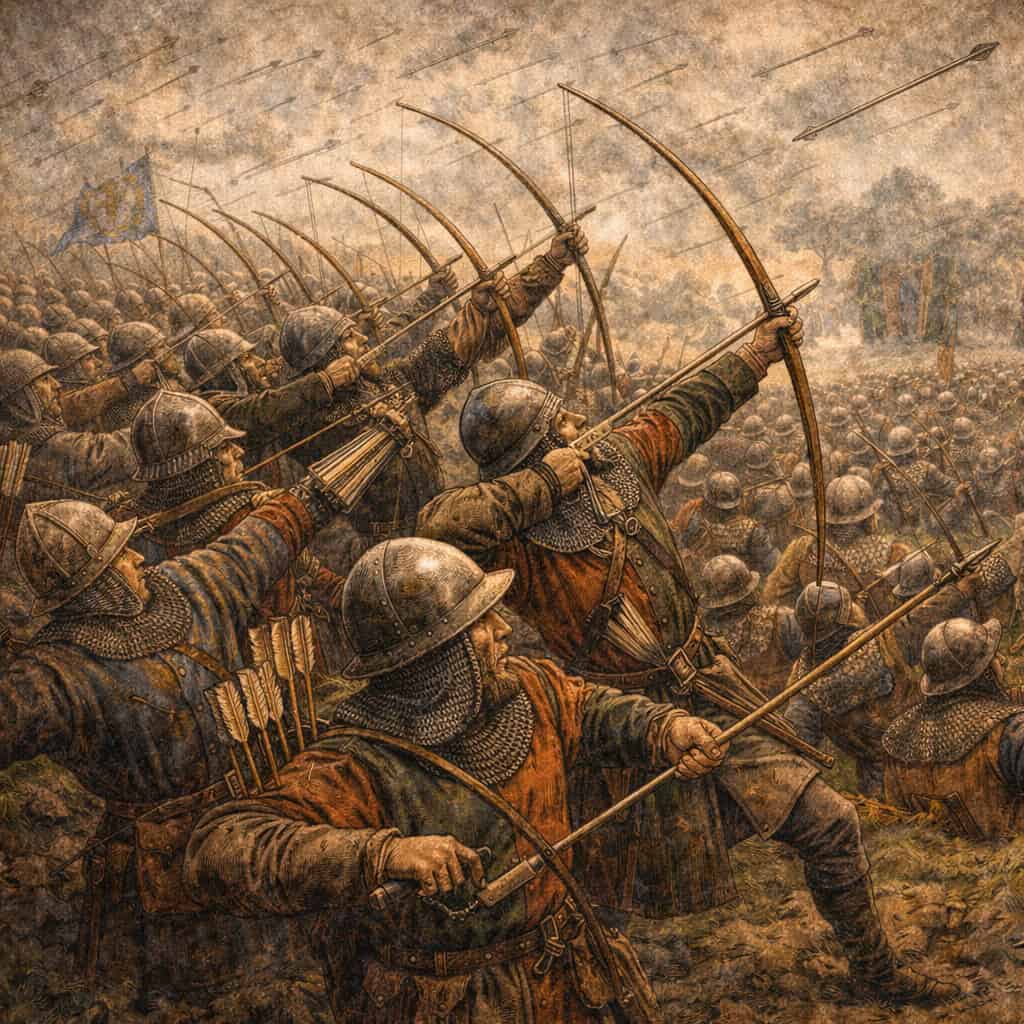
The longbow and crossbow transformed medieval combat by enabling armies to strike from a distance with lethal force. Massed archery could disrupt formations before melee combat even began.

Medieval Warfare Era Comparison
Warfare during the Middle Ages evolved alongside advances in armor, battlefield tactics, and military organization. Each era introduced new weapons that reshaped how wars were fought.
| Era | Primary Forces | Key Weapons | Battlefield Style | Strategic Advantage |
|---|---|---|---|---|
| Early Middle Ages 500–1000 |
Warbands, tribal levies, emerging cavalry | Swords, spears, axes, round shields | Close combat and shield-wall formations | Mobility and disciplined formations |
| High Middle Ages 1000–1300 |
Feudal knights supported by infantry | Lances, arming swords, crossbows, early siege engines | Cavalry charges supported by castle warfare | Shock power of armored knights |
| Late Middle Ages 1300–1500 |
Professional armies and mass infantry | Longbows, polearms, halberds, early firearms, cannons | Combined arms and ranged dominance | Firepower and tactical coordination |
The gradual shift from knight-led armies to infantry and gunpowder weapons marked one of the most important military transformations in European history.
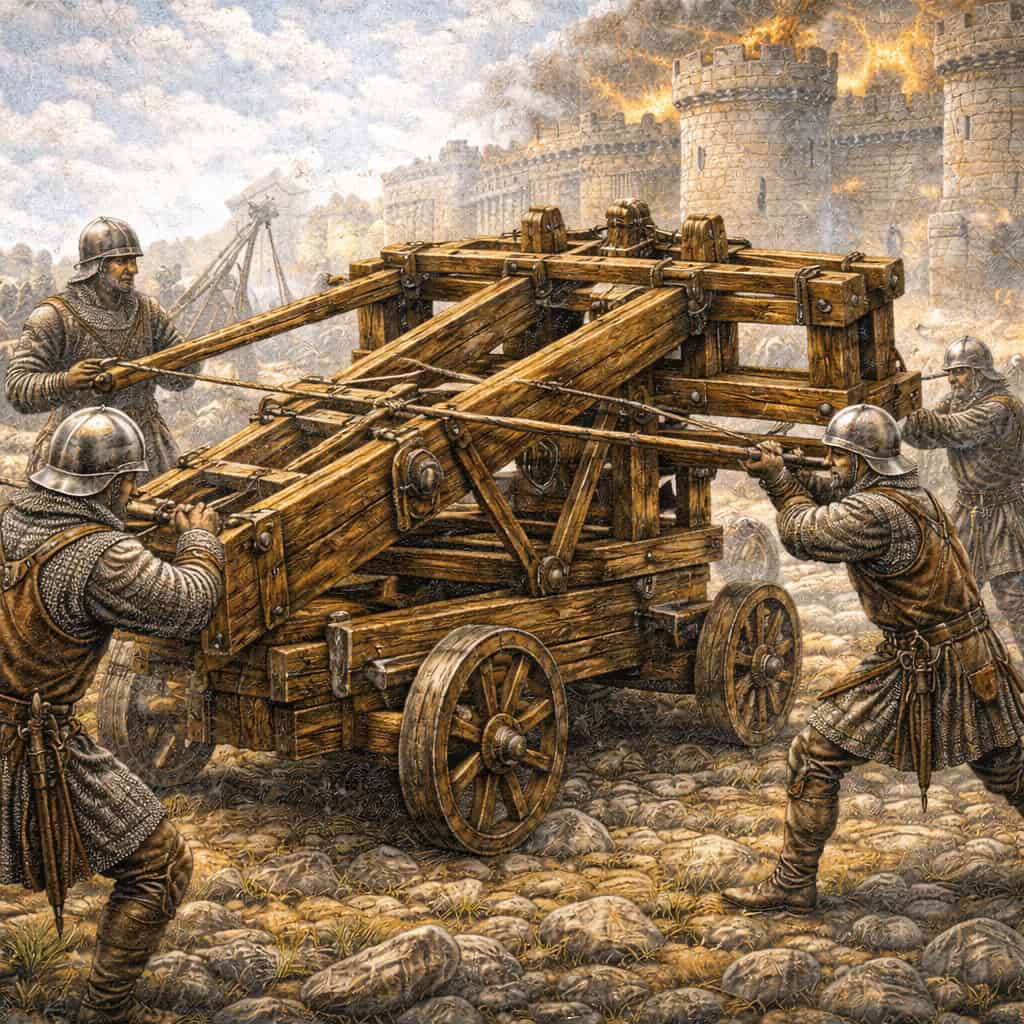
Siege Weapons
When battles shifted to fortified cities, specialized machines became essential. Trebuchets, battering rams, siege towers, and early cannons allowed attackers to breach walls that once seemed impenetrable.
Siege Warfare
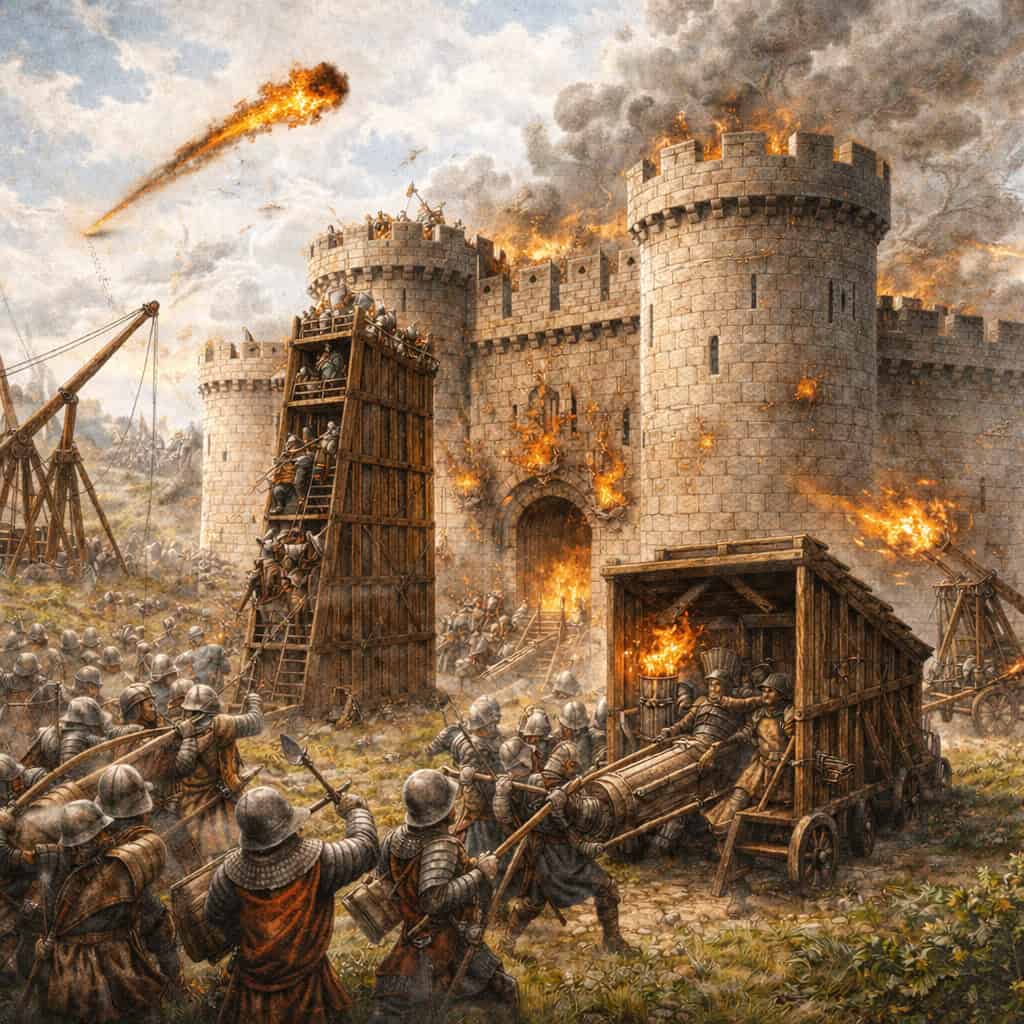
Rather than risking open battle, many commanders preferred to starve or exhaust their enemies through siege warfare.
Common tactics included:
- Mining beneath walls to trigger collapse
- Bombardment using stone-throwing machines
- Blockading supply routes
- Constructing siege towers for direct assaults
In response, defenders strengthened fortifications and engineered increasingly complex castle defenses. This cycle of innovation drove some of the most impressive military architecture of the medieval world.
Recruitment and Feudal Armies
Early medieval rulers depended heavily on the feudal system to raise armies. Powerful nobles were required to provide troops — including knights and foot soldiers — in exchange for land known as a fief.
Ceremonies of homage and fealty formalized these relationships, binding vassals to their monarch through military obligation.
Over time, however, warfare demanded greater flexibility. Permanent forces and paid soldiers began to replace purely feudal levies, while mercenaries offered experienced fighters for those who could afford them.
This transition marked an important step toward the professional armies of the early modern period.
Famous Medieval Battles
Some battles proved especially influential, reshaping political borders and demonstrating new military strategies.
Notable examples include:
- Battle of Tours (732) — halted Islamic expansion into Western Europe.
- Battle of Hastings (1066) — brought Norman rule to England.
- Battle of Bannockburn (1314) — showcased the power of disciplined infantry.
- Battle of Crécy (1346) — highlighted the effectiveness of the English longbow.
- Battle of Agincourt (1415) — demonstrated how terrain and missile troops could defeat heavily armored knights.
- Battle of Bosworth Field (1485) — effectively ended the Wars of the Roses.
Each reflected the changing nature of medieval combat.
Decisive Battles That Shaped Medieval Warfare
Several landmark battles transformed military strategy during the Middle Ages. From cavalry dominance to the rise of disciplined infantry and powerful longbows, these conflicts reshaped the balance of power across Europe.
Battle of Hastings (1066)
Fought between the Norman forces of William the Conqueror and the Anglo-Saxon army of King Harold II, Hastings demonstrated the effectiveness of combined arms — archers, infantry, and cavalry working together.
- Secured Norman control of England
- Highlighted tactical flexibility
- Changed English political and military structure
Battle of Crécy (1346)
One of the defining battles of the Hundred Years’ War, Crécy proved that well-positioned infantry could defeat heavily armored knights.
- English longbowmen devastated French cavalry
- Marked decline of traditional knightly charges
- Elevated the importance of ranged warfare
Battle of Agincourt (1415)
Despite being vastly outnumbered, English forces achieved a stunning victory over France, largely due to terrain, discipline, and coordinated longbow attacks.
- Showed the power of tactical positioning
- Confirmed infantry superiority in many scenarios
- Reinforced the decline of heavily armored cavalry
Together, these battles illustrate the gradual transition from knight-centered warfare to professionally organized armies built around infantry, planning, and battlefield strategy.
Naval Warfare
Although land battles dominate popular imagination, naval power also played an important role.
Ships initially served mainly as transports, but later vessels were built for combat, featuring raised fighting platforms and improved missile capabilities. Boarding enemy ships often led to brutal hand-to-hand encounters at sea.
Technologies such as incendiary weapons further increased the destructive potential of medieval fleets.

Medieval Warfare Summary
Medieval warfare was defined by constant adaptation. Advances in weaponry encouraged stronger armor; improved fortifications demanded more powerful siege engines; evolving tactics reshaped army composition.
The era began with cavalry dominance but gradually shifted toward infantry-based warfare supported by ranged weapons and emerging gunpowder technology.
Ultimately, medieval military innovation laid the foundation for the professional armies and strategic doctrines that would define warfare in the centuries to follow.
Frequently Asked Questions
Clear answers to the most common questions about medieval warfare, from the dominance of knights to the rise of infantry and the impact of new military technologies.
What was medieval warfare?
Medieval warfare describes the methods of fighting used between the 5th and 15th centuries, featuring armored knights, fortified castles, siege weapons, and increasingly organized armies.
Why were castles important?
Castles acted as defensive strongholds and power centers. Their thick walls, towers, and moats made them difficult to capture without lengthy and costly sieges.
When did knights lose battlefield dominance?
From the 14th century onward, disciplined infantry and powerful ranged weapons such as the longbow reduced the effectiveness of heavy cavalry.
What weapons were most common?
Medieval armies relied on swords, lances, axes, maces, polearms, longbows, and crossbows, while trebuchets and battering rams were used to attack fortified positions.
How were medieval armies recruited?
Early armies were raised through feudal obligations, requiring nobles to provide troops. Later periods saw the growth of paid soldiers and mercenary forces.
Did gunpowder change medieval warfare?
Yes. Early cannons weakened castle defenses and helped shift Europe toward early modern military strategy.
Medieval Warfare Glossary
Medieval warfare introduced specialized weapons, military structures, and battlefield strategies that shaped conflicts across Europe for centuries. This glossary explains key terms to help you better understand how medieval armies fought, defended territory, and evolved over time.
Cavalry
Mounted soldiers who fought on horseback. Cavalry dominated early medieval battlefields due to their mobility, shock power, and elevated fighting position.
Infantry
Foot soldiers who became increasingly important in later medieval warfare as armies expanded and new weapons made massed formations more effective.
Feudal Levy
Troops raised by nobles under the feudal system. Lords were required to supply soldiers to their king in exchange for land and protection.
Mercenary
A professional soldier hired to fight for payment rather than loyalty to a ruler. Mercenaries became more common as warfare grew larger and more expensive.
Polearm
A broad category of long-shafted weapons such as halberds, pikes, and glaives, designed to give infantry greater reach against mounted knights.
Longbow
A powerful tall bow capable of firing arrows over long distances with high penetration. English longbowmen famously helped defeat heavily armored knights.
Crossbow
A mechanical bow that fired short bolts with tremendous force. Easier to master than traditional bows, it allowed armies to train effective soldiers quickly.
Trebuchet
A large siege engine that used counterweight mechanics to hurl massive stones at castle walls, making it one of the most destructive weapons of the Middle Ages.
Siege Warfare
A military strategy focused on surrounding and attacking fortified locations such as castles or cities to force surrender through assault, starvation, or psychological pressure.
Portcullis
A heavy iron or wooden gate that dropped vertically to seal a castle entrance, providing an additional defensive barrier during attacks.
Barbican
An outer defensive structure protecting a castle gate, often designed to funnel attackers into narrow, heavily defended approaches.
Chivalry
A moral and martial code associated with knights that emphasized bravery, loyalty, honor, and the defense of the weak.