Naval warfare played a decisive role in shaping the political and military landscape of the Middle Ages. While medieval conflicts are often associated with castles and cavalry, control of the seas frequently determined the outcome of wars, protected trade routes, and secured imperial borders.
From the struggle between the Byzantine Empire and rising Islamic powers to the maritime clashes of the Hundred Years’ War, medieval naval battles demonstrated evolving ship technology, tactical innovation, and the growing importance of naval supremacy.
This page explores some of the most significant naval engagements of the medieval period and explains how they influenced the balance of power across Europe and the Mediterranean.
⚓ Famous Medieval Naval Battles — At a Glance
Medieval naval warfare shaped the balance of power across Europe and the Mediterranean. From the incendiary terror of Greek fire to the longbow dominance at Sluys, control of the seas often determined the outcome of wars, protected trade routes, and secured empires.
- Earliest Turning Point: Battle of the Masts (655) signaled the rise of Arab naval power.
- Legendary Weapon: Byzantine fleets used Greek fire to destroy enemy ships.
- Strategic Innovation: Ships were hauled across the Isthmus of Corinth in a surprise maneuver.
- Technological Shift: Naval artillery appeared during the Battle of Arnemuiden.
- Decisive Victory: England secured Channel supremacy after the Battle of Sluys (1340).
These battles demonstrate how medieval commanders increasingly recognized that naval supremacy meant political and military dominance.

🕰️ Timeline of Famous Medieval Naval Battles
Medieval sea battles evolved from boarding-based combat to increasingly sophisticated naval strategy. This timeline highlights key engagements that reshaped maritime power between the 7th and 14th centuries.
Battle of the Masts
Arab forces defeat the Byzantine fleet, marking the emergence of a powerful Islamic navy in the Mediterranean.
Naval Fighting During the Siege of Constantinople
Byzantine ships deploy Greek fire to destroy enemy fleets and help preserve the empire’s capital.
Battle of the Gulf of Corinth
Byzantine commanders haul ships across the Isthmus of Corinth and launch a surprise attack against raiding fleets.
Battle of Stelai
Byzantium secures a major victory near southern Italy, briefly restoring control over key coastal waters.
Battle of the Straits
Fatimid forces devastate Byzantine ships, strengthening their control in Sicily and the central Mediterranean.
Battle of Arnemuiden
Early Hundred Years’ War naval clash; notable for one of the earliest uses of ship-mounted artillery.
Battle of Sluys
England destroys the French fleet and establishes dominance in the English Channel.
Battle of the Masts (655)
The Battle of the Masts was one of the earliest major naval confrontations between the Byzantine Empire and the expanding Arab forces. Fought near the Phoenician coast in 655, the battle marked a turning point in Mediterranean naval dominance.
Emperor Constans II personally oversaw the Byzantine fleet, reportedly consisting of around 500 ships. Opposing him was the Muslim navy led by Abu’l-Awar, commanding approximately 200 vessels.
Despite their numerical disadvantage, the Arab fleet achieved a decisive victory after fierce close-quarters fighting. Much of the Byzantine fleet was destroyed, and the emperor narrowly escaped capture.
The outcome signaled the rise of Arab naval power — an influence that would challenge Byzantine control of the Mediterranean for centuries.

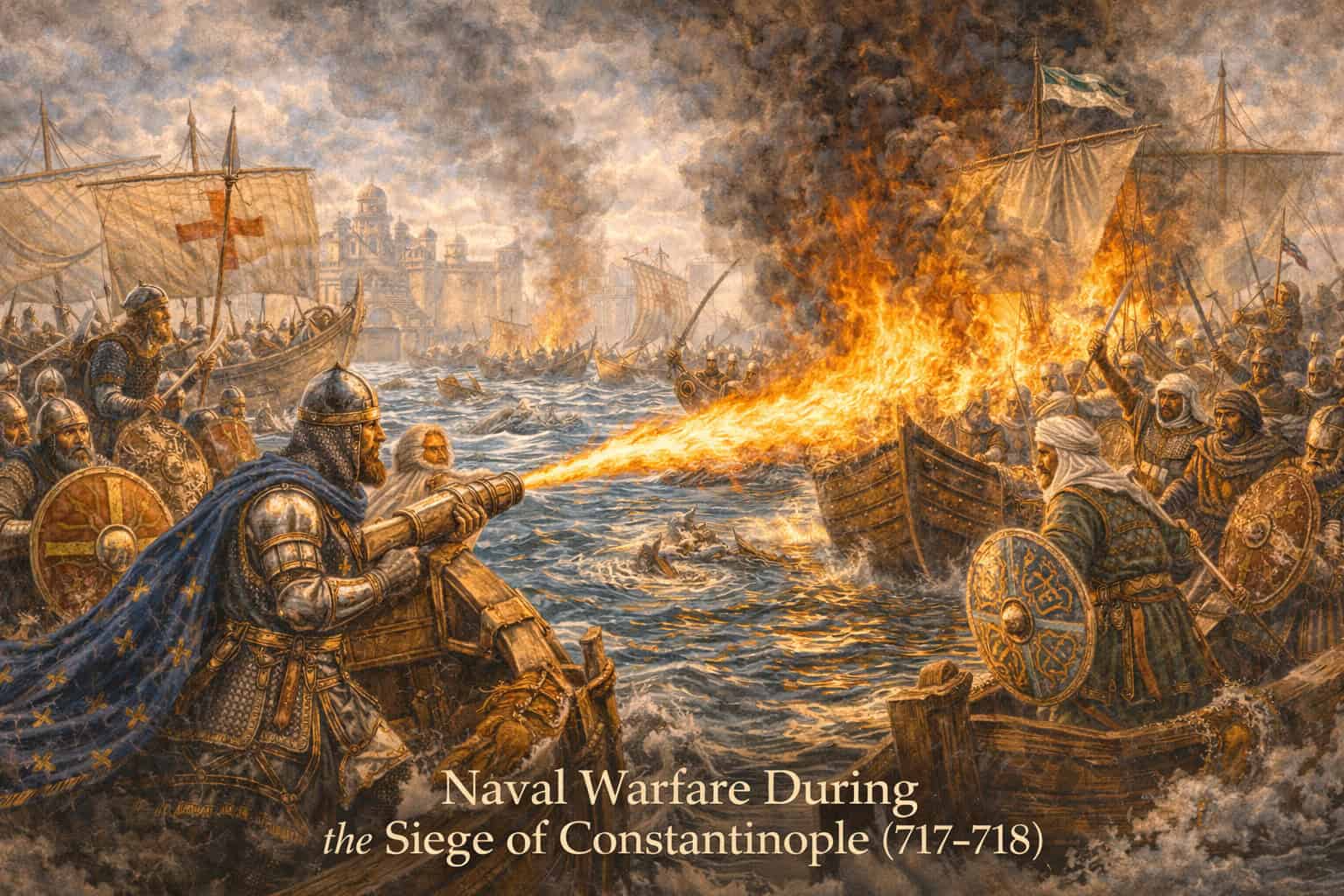
Naval Warfare During the Siege of Constantinople (717–718)
Repeated Arab attempts to capture Constantinople relied heavily on naval support, as fleets transported soldiers, weapons, and provisions to sustain the siege.
The Byzantine navy responded with one of the most feared weapons of medieval warfare: Greek fire — a highly combustible liquid capable of burning even on water.
When Arab fleets approached the city, Byzantine ships deployed Greek fire with devastating effectiveness, destroying large numbers of enemy vessels. Additional fleets sent to reinforce the siege met the same fate.
This naval victory proved crucial in preserving the Byzantine capital and preventing further Islamic expansion into southeastern Europe. Historians often regard the failed siege as one of the defining defensive successes of medieval Christendom.
Battle of the Gulf of Corinth (873)
By the late ninth century, Muslim forces had established strongholds in Sicily and Crete, enabling frequent raids across Byzantine territories.
The Battle of the Gulf of Corinth demonstrated remarkable strategic ingenuity. Byzantine commanders ordered ships hauled across the Isthmus of Corinth — a maneuver widely considered impossible.
Appearing unexpectedly in waters the Saracen fleet believed secure, the Byzantine navy launched a surprise attack that destroyed much of the opposing force.
The victory effectively ended large-scale raiding along the Peloponnesian coast and restored Byzantine confidence at sea.

Battle of Stelai (879)
Following the loss of Sicily, the Byzantine Empire struggled to maintain maritime control around southern Italy. The Battle of Stelai became a critical effort to reassert dominance.
Facing the navy of the Aghlabid Emirate, the Byzantines deployed roughly sixty ships. Superior coordination and tactical discipline allowed them to defeat the opposing fleet and capture numerous vessels.
The triumph granted Byzantium temporary control over nearby waters and slowed further Muslim expansion in the region.

Battle of the Straits (965)
The rise of the Fatimid Caliphate introduced a new maritime rival in the western Mediterranean. After losing key positions near Messina, Byzantine forces attempted to retreat toward mainland Italy.
Fatimid ships intercepted them in what became known as the Battle of the Straits.
Employing an unusual tactic, Fatimid divers reportedly swam toward Byzantine vessels to sabotage them using incendiary weapons — possibly variants of Greek fire delivered through siphons.
The strategy proved devastating. Much of the Byzantine fleet was destroyed, securing Fatimid dominance around Sicily and the lower Italian Peninsula.

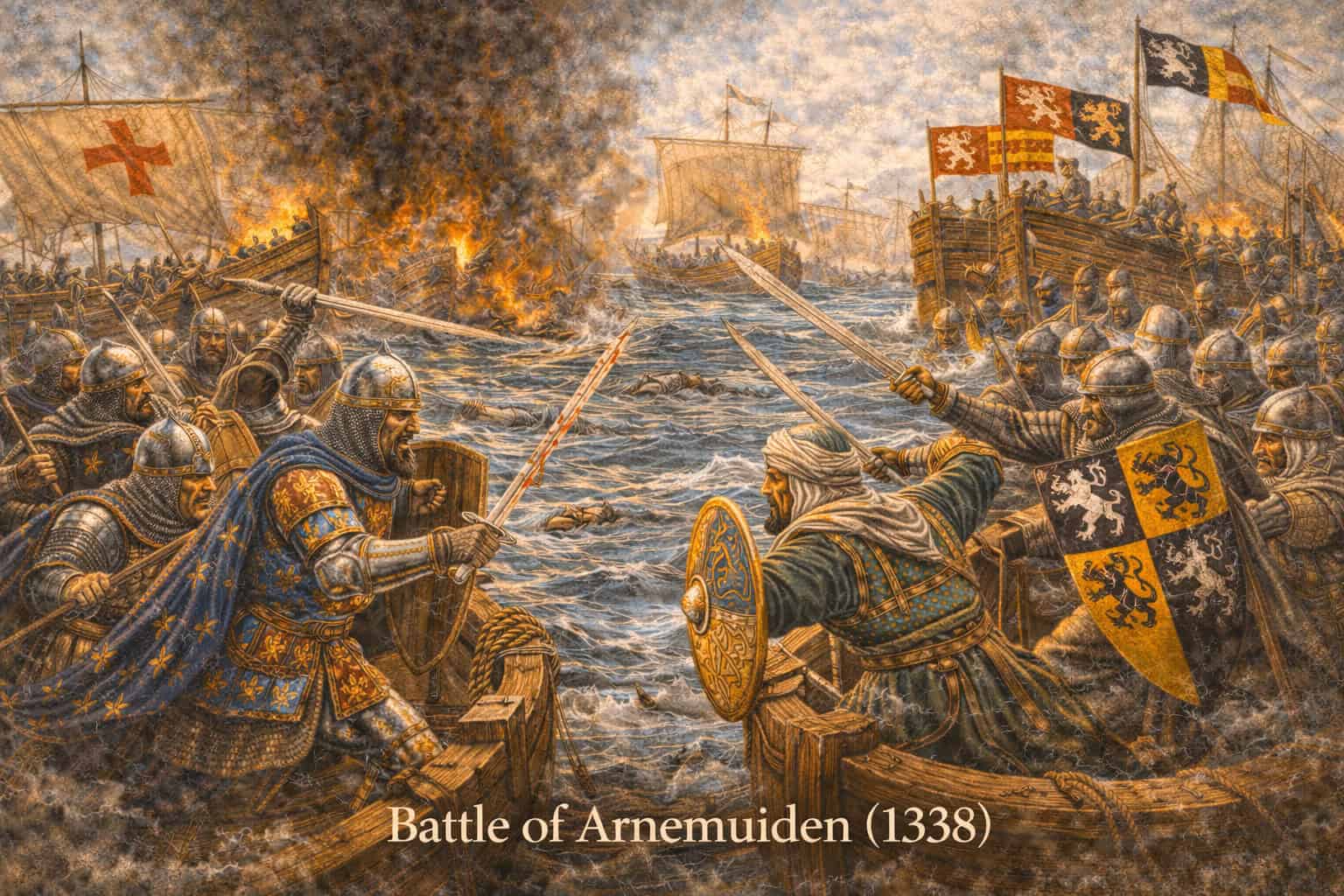
Battle of Arnemuiden (1338)
The Battle of Arnemuiden marked one of the earliest naval engagements connected to the Hundred Years’ War between England and France.
Unlike purpose-built warships, many English vessels were converted merchant ships known as cogs, transporting valuable wool cargo.
French forces captured several English ships, seized their goods, and executed many prisoners — an act that reflected the brutal realities of medieval warfare.
Notably, the battle featured one of the first recorded uses of naval artillery, signaling the beginning of a technological transformation in maritime combat.
Battle of Sluys (1340)
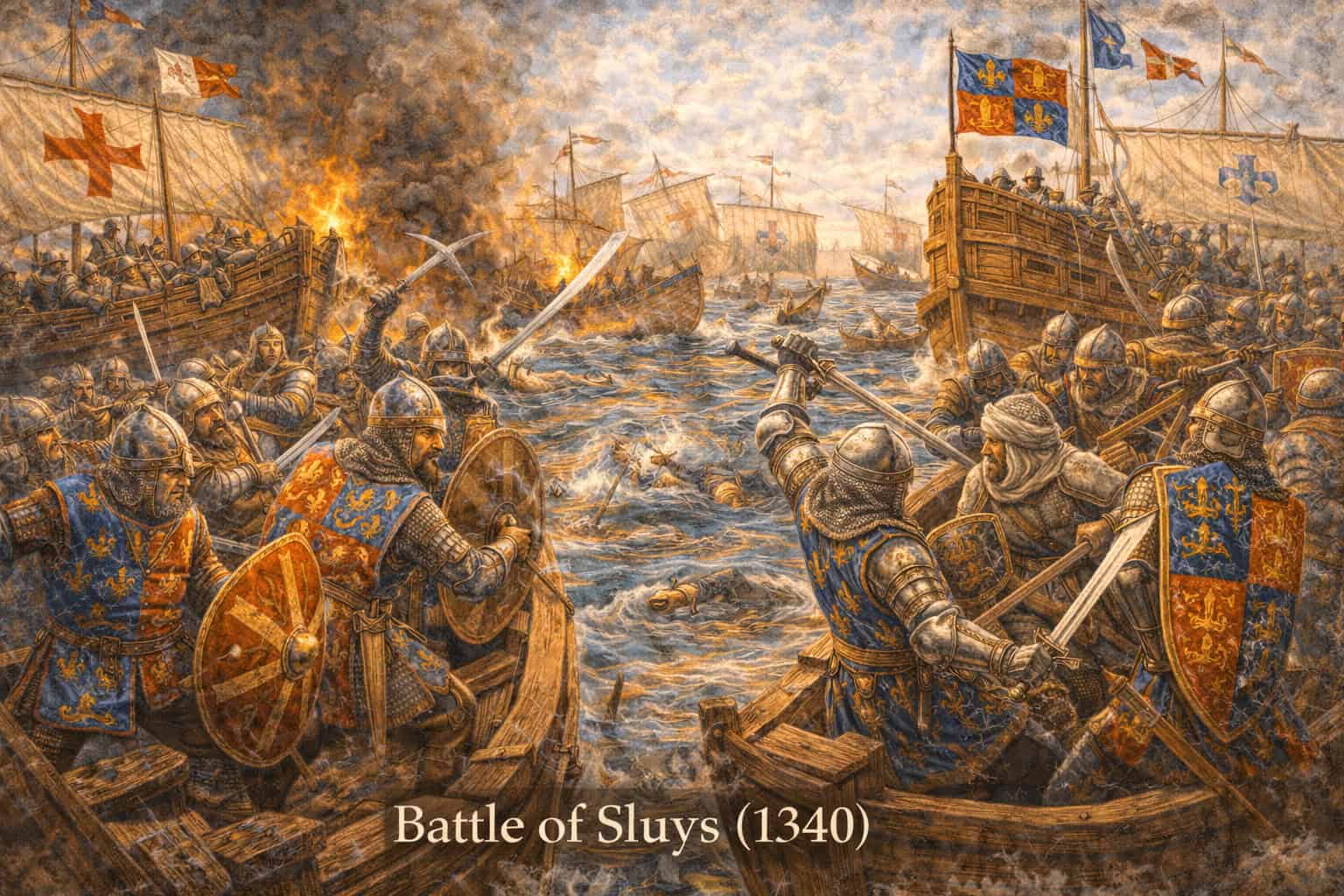
The Battle of Sluys stands among the most decisive naval victories of the Middle Ages.
Commanded personally by Edward III, the English fleet confronted a large French force positioned defensively with ships chained together to block access to the harbor.
English ships, built higher than their opponents, allowed longbowmen to rain arrows onto French decks before soldiers boarded enemy vessels in brutal hand-to-hand combat.
The destruction of the French fleet granted England control of the English Channel, enabling future invasions of France and reshaping the strategic direction of the Hundred Years’ War.
Many historians consider Sluys one of the battles that established England as a formidable naval power.
Why Medieval Naval Battles Mattered
Although overshadowed by famous land battles, naval warfare influenced medieval history in several crucial ways:
- Protected trade networks and economic stability
- Enabled long-distance military campaigns
- Determined control of strategic waterways
- Supported sieges and territorial expansion
- Encouraged technological innovation in shipbuilding and weaponry
As maritime strategy evolved, naval strength increasingly became a marker of political power.
The Evolution of Medieval Naval Warfare
Early medieval fleets relied heavily on boarding tactics, turning sea battles into extensions of land combat. Over time, commanders adopted more sophisticated strategies that incorporated maneuverability, ranged weapons, and eventually artillery.
The introduction of incendiary weapons like Greek fire — followed later by ship-mounted cannons — signaled a transition toward early modern naval warfare.
By the late Middle Ages, control of the seas had become essential for any kingdom seeking regional dominance.
Summary
Famous medieval naval battles reveal a dynamic and often overlooked dimension of the Middle Ages. From Byzantine defensive triumphs to Anglo-French maritime rivalry, these conflicts reshaped empires and influenced the course of European history.
Control of the sea was never merely about ships — it was about trade, survival, expansion, and power.
Together, these engagements demonstrate that the struggle for maritime supremacy was just as critical as the battles fought on land.
❓ Medieval Naval Battles — Frequently Asked Questions
Naval warfare played a decisive role in shaping medieval power struggles. These commonly asked questions explain how fleets fought, why sea control mattered, and what made certain battles historically significant.
-
Why were naval battles important in the Middle Ages?
Control of the seas protected trade routes, enabled invasions, supplied armies, and often determined the success or failure of major military campaigns. -
What was Greek fire and why was it feared?
Greek fire was a Byzantine incendiary weapon that could burn on water, making it devastating against wooden ships and extremely difficult to extinguish. -
Which medieval naval battle was a major turning point?
The Battle of the Masts (655) marked the rise of Arab naval power and challenged Byzantine dominance in the Mediterranean. -
How were most medieval naval battles fought?
Combat usually involved ramming, missile fire, and boarding actions, where soldiers fought hand-to-hand on the decks of enemy vessels. -
When did gunpowder weapons appear in naval warfare?
Early naval artillery began appearing in the 14th century, signaling a technological shift that gradually transformed maritime combat. -
What made the Battle of Sluys significant?
England’s victory in 1340 destroyed much of the French fleet and secured English control of the Channel during the Hundred Years’ War. -
Were medieval warships designed specifically for battle?
Some were, but many fleets adapted merchant vessels for combat, especially in northern Europe where ships like cogs were converted into warships.
As ship design and weaponry improved, naval warfare became an increasingly strategic element of medieval conflict rather than merely a support function.
📘 Medieval Naval Warfare — Glossary
Understanding key maritime terms helps clarify how fleets fought, maneuvered, and secured dominance at sea during the Middle Ages. This glossary highlights important concepts frequently associated with medieval naval battles.
- Greek Fire: A highly destructive Byzantine weapon that burned even on water, capable of setting enemy ships ablaze.
- Dromon: The primary warship of the Byzantine navy — fast, maneuverable, and often equipped with siphons for projecting Greek fire.
- Galley: A long, narrow vessel powered mainly by oarsmen, widely used in Mediterranean warfare.
- Boarding: A combat tactic in which sailors crossed onto enemy ships to fight at close quarters.
- Naval Artillery: Early ship-mounted weapons, including primitive cannons, that began appearing in late medieval sea battles.
- Cog: A sturdy northern European sailing ship frequently adapted for warfare during conflicts such as the Hundred Years’ War.
- Fleet: A coordinated group of warships operating together under unified command.
- Maritime Supremacy: Control of strategic sea routes, allowing a power to protect trade, launch invasions, and limit enemy movement.
Mastery of these technologies and tactics often determined which kingdoms controlled trade networks, projected military strength, and expanded their influence.