Medieval Helmets: Types, Evolution, and Knight Armor Guide
Medieval helmets were one of the most important elements of medieval armor, protecting warriors from swords, arrows, axes, and blunt-force weapons. On the battlefield, a strong helmet often meant the difference between survival and death, which is why helmet construction improved steadily throughout the Middle Ages.
As weapons became more powerful and warfare more organized, armorers responded with increasingly sophisticated designs. Early helmets focused on basic skull protection, while later versions fully enclosed the head with steel plates engineered to deflect blows. From the early Spangenhelm to the heavily armored Great Helm, and later the versatile Bascinet and aerodynamic Sallet, helmet evolution mirrors the technological arms race of medieval warfare.
What Were Medieval Helmets?
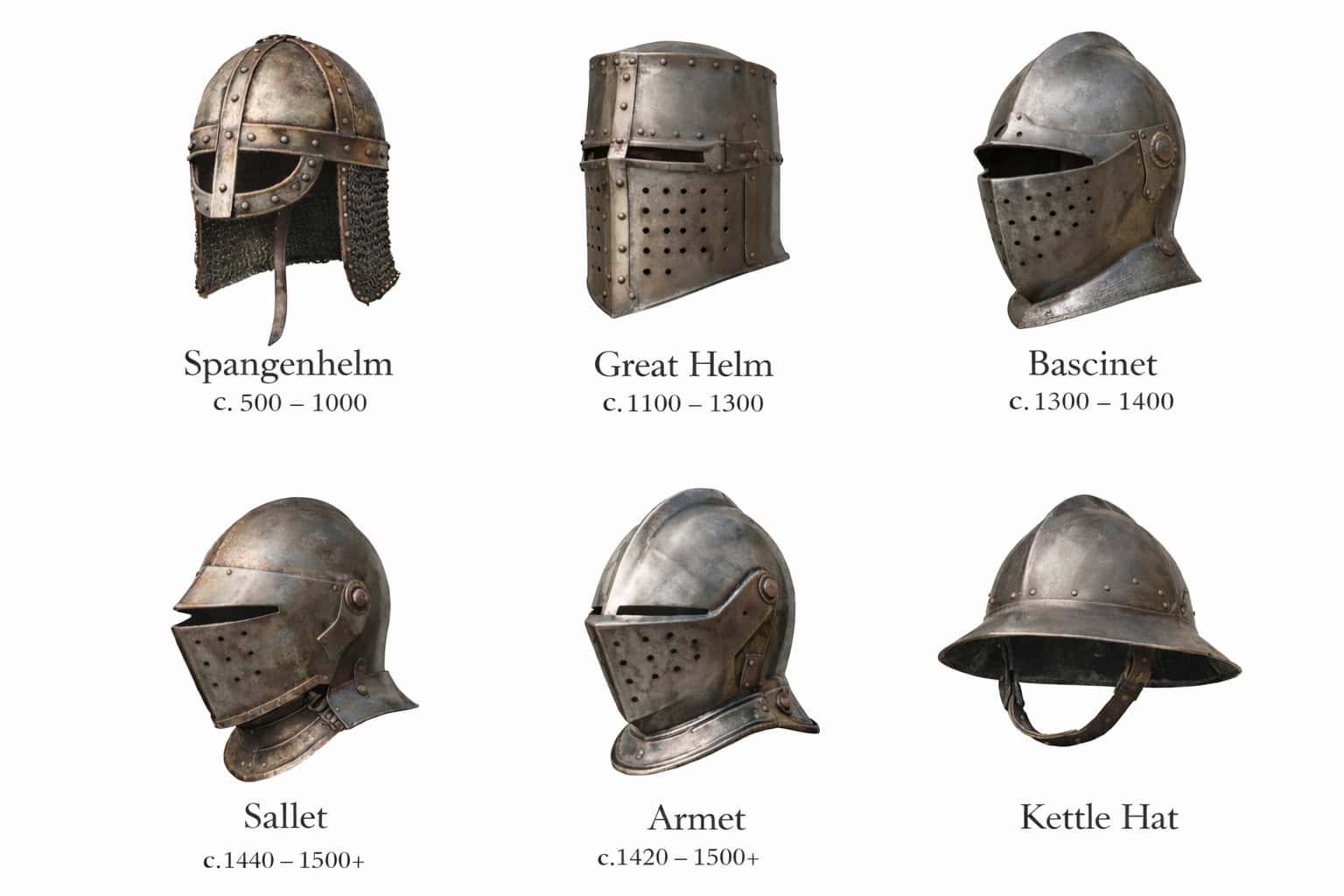
Medieval helmets were protective headpieces worn by knights and soldiers throughout the Middle Ages to defend against swords, arrows, and blunt-force weapons. Evolving from simple iron caps to fully enclosed steel designs, these helmets balanced protection, visibility, and breathability while becoming defining symbols of medieval armor and battlefield survival.
In short, medieval helmets were essential defensive armor that evolved alongside weapons technology to improve a warrior’s chances of survival in combat.
This parent guide provides a structured overview of the major types of medieval helmets, how they developed, and what made each design effective. Use it as a central hub to explore individual helmet guides in greater depth.
Why Medieval Helmets Were So Important
In close combat, the head was one of the most vulnerable parts of the body. Even a glancing strike could be fatal, making the helmet a foundational piece of a warrior’s defensive equipment.
Key reasons helmets became essential:
- Protected against cutting and crushing blows
- Helped deflect arrows and crossbow bolts
- Reduced the impact of falling debris during sieges
- Provided psychological confidence in battle
Over time, helmets also became symbols of status and rank. Wealthier knights could afford custom-forged helmets with superior steel and craftsmanship, while infantry typically wore simpler but practical designs.
Evolution of Medieval Helmets
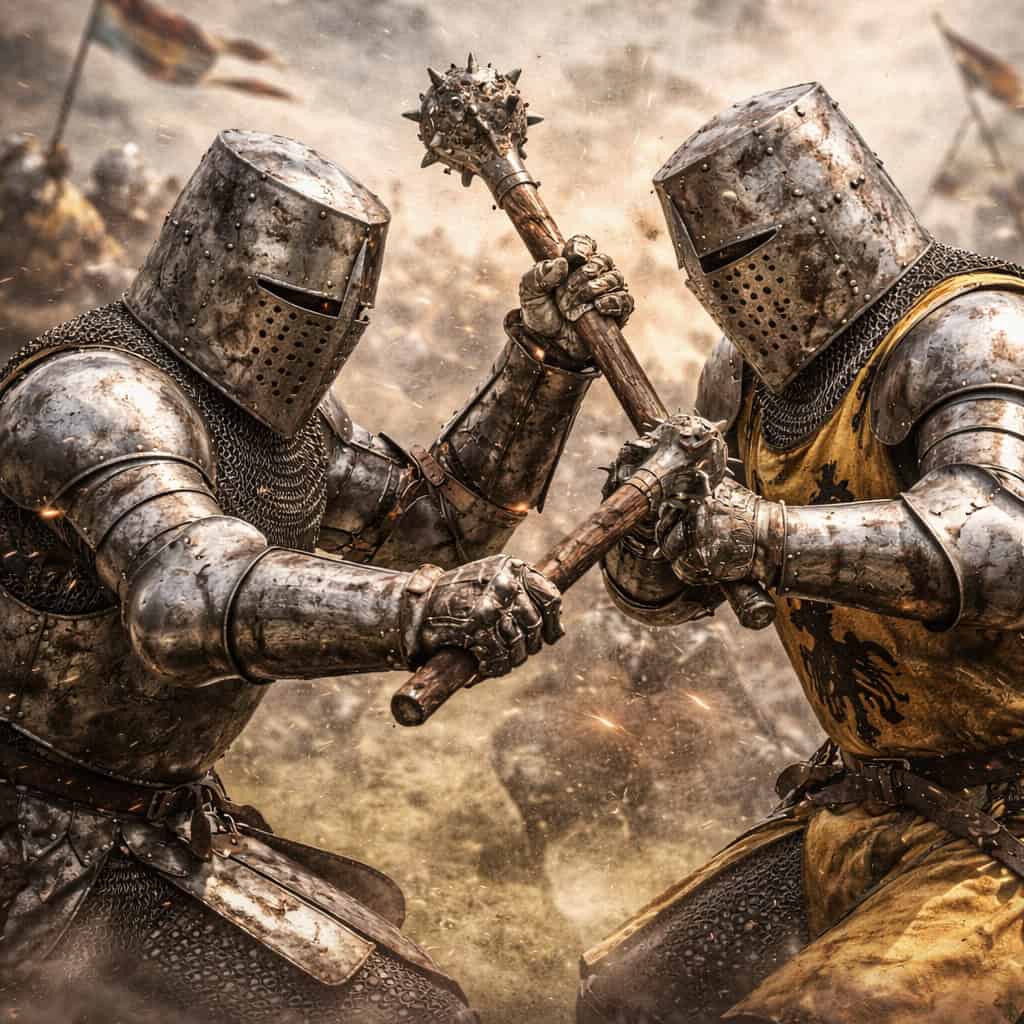
The story of medieval helmet development is one of constant adaptation. As offensive weapons improved, defensive armor evolved to keep warriors protected on increasingly dangerous battlefields.
Early Medieval Period (5th–10th Century)
Helmets from this era prioritized mobility over full protection, making them practical for fast-moving combat.
- Lightweight and functional construction
- Designed for visibility and movement
- Favored by early medieval warriors
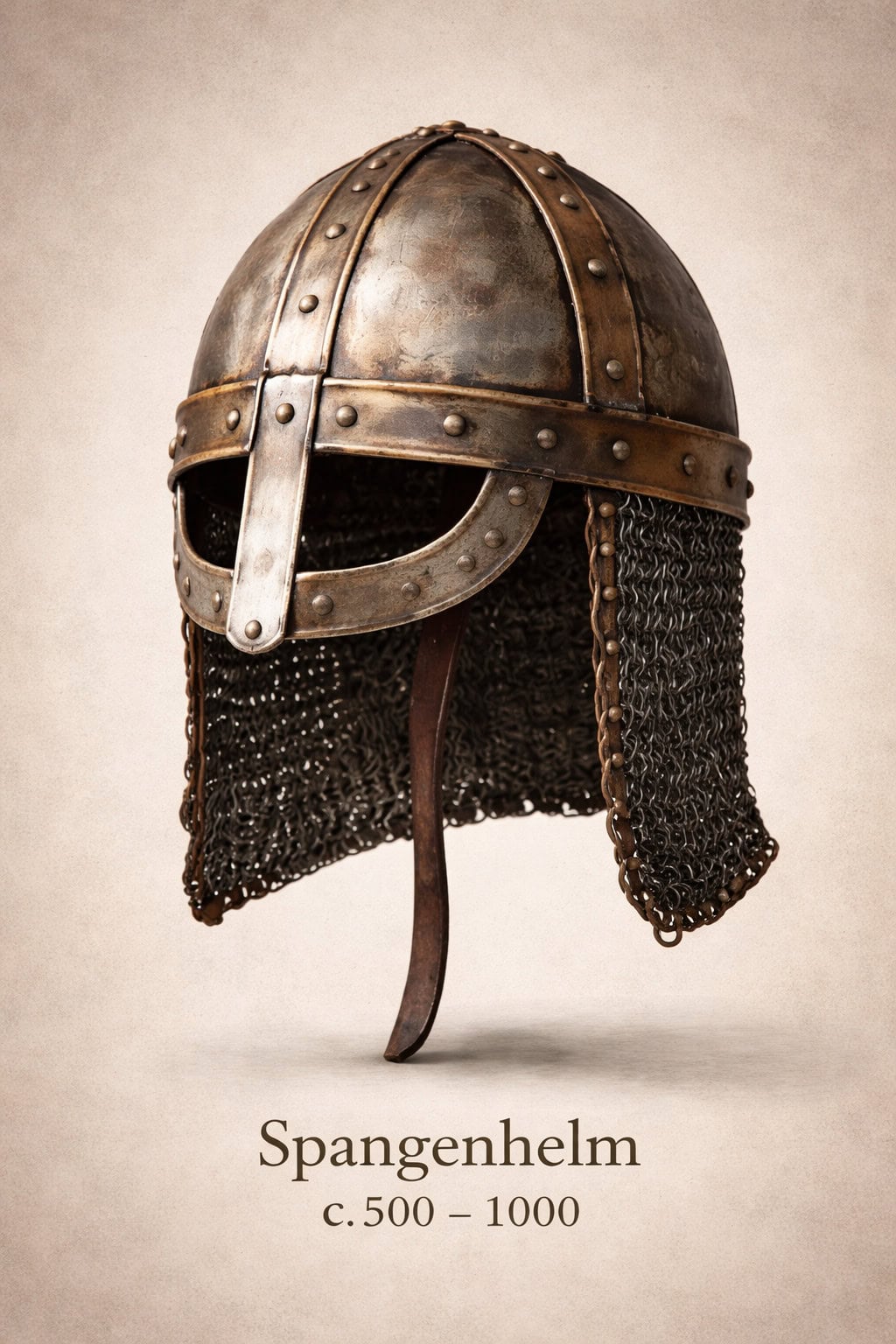
The most recognizable design was the Spangenhelm, built from metal plates joined by riveted bands. Its conical shape helped deflect downward strikes.
High Medieval Period (11th–13th Century)
As heavy cavalry warfare expanded, knights demanded stronger facial protection.
- Rise of fully enclosed helmets
- Improved defense against direct blows
- Essential for mounted combat
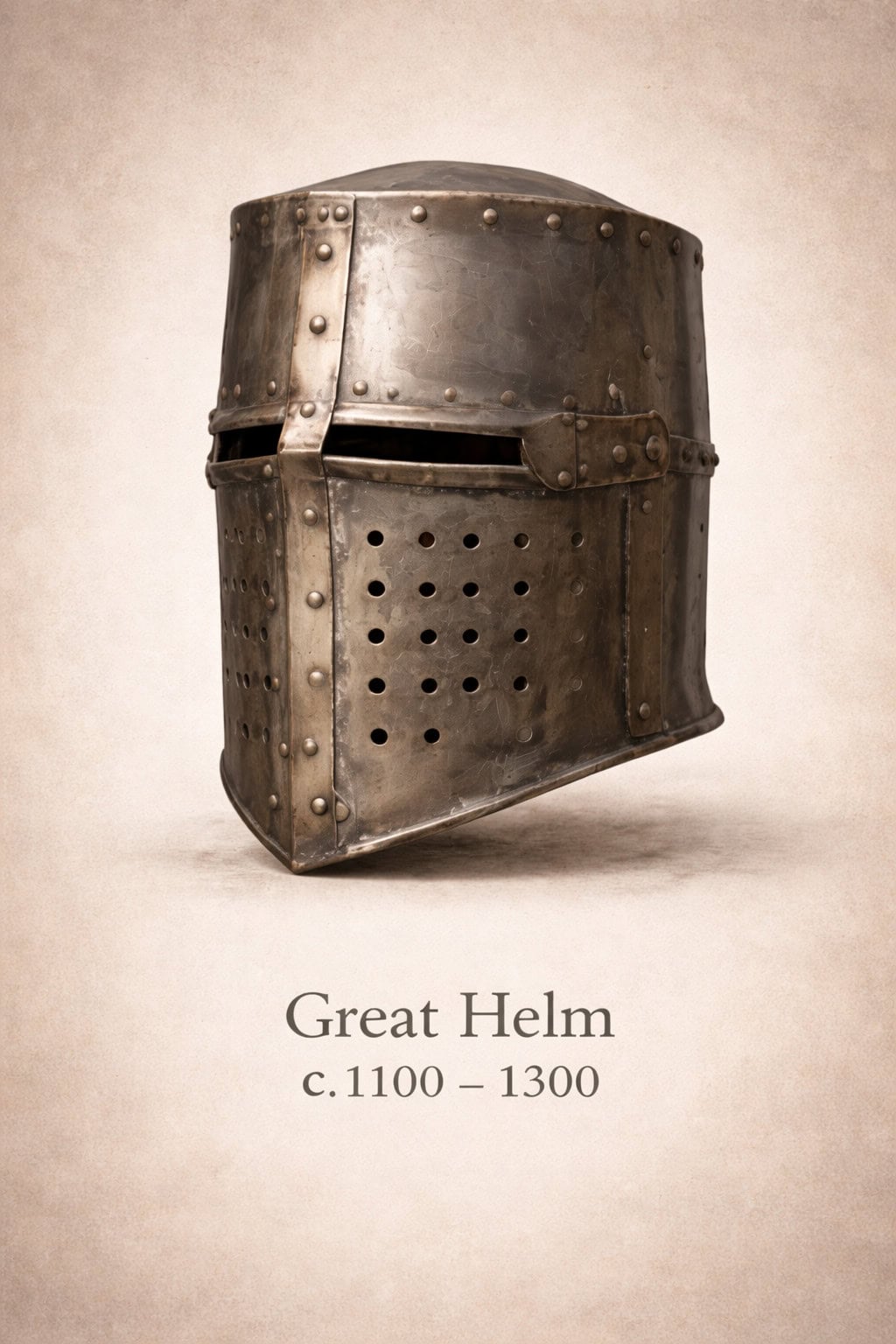
The answer was the Great Helm — a helmet strongly associated with crusading knights. While highly protective, it restricted airflow and visibility, forcing warriors to balance defense with endurance.
Late Medieval Period (14th–15th Century)
Helmet engineering reached new levels of sophistication as armorers refined both safety and usability.
- Introduction of visors and ventilation
- Steel surfaces shaped to glance away blows
- Increasing specialization by battlefield role
During this period, the Bascinet became one of the most widely used combat helmets before eventually giving way to the highly refined Sallet throughout much of Europe.
Overall, medieval helmet design progressed from practical early protection to fully enclosed knightly armor, culminating in advanced late medieval helmets that combined survivability with improved battlefield awareness.
Major Types of Medieval Helmets
Below is a quick-reference guide to the most influential medieval helmet types. Each played a major role in battlefield protection and the evolution of armor design.
Spangenhelm – Early Medieval Protection
One of the most enduring early designs, the Spangenhelm helmet was worn by Germanic, Viking, and Norman warriors.
- Segmented construction for easier manufacturing
- Reliable defense for early medieval combat
- Widely used across Northern Europe
👉 Read more: Spangenhelm Helmet: Early Nasal Helm of Medieval Warriors
Great Helm – The Iconic Crusader Helmet
The Great Helm became synonymous with heavily armored knights, dominating battlefields during the Crusades.
- Near-total head protection
- Strong association with crusader warfare
- Heavy with limited visibility
👉 Read more: Great Helm: The Crusader’s Iconic Medieval Helmet
Bascinet – The Knight’s Versatile Helmet
Favored for adaptability, the Bascinet helmet could be worn open-faced or fitted with a visor for enhanced protection.
- Dominant knightly helmet of the 14th century
- Balanced protection with usability
- Popular across European battlefields
👉 Read more: Bascinet Helmet: The Knight’s Versatile Head Armor
Sallet – Advanced Late Medieval Design
The Sallet helmet reflected the peak of medieval armor innovation, combining protection with improved battlefield awareness.
- Enhanced neck and rear skull protection
- Streamlined shape to deflect blows
- Widely adopted throughout Europe
👉 Read more: English Sallet Helmets: The British Gothic Headpiece
Medieval Helmet Comparison
Comparing major medieval helmets reveals how armorers balanced protection, visibility, and battlefield mobility. Each design reflects the changing demands of medieval warfare.
Spangenhelm (Early Medieval)
The Spangenhelm was a segmented helmet constructed from metal plates riveted together, offering dependable protection while remaining relatively lightweight.
- Popular with early medieval warriors
- Conical shape helped deflect blows
- Easier and faster to manufacture
Great Helm (High Medieval)
The Great Helm became one of the most recognizable knightly helmets, enclosing the entire head to provide exceptional defense during heavy combat.
- Maximum facial protection
- Strong association with crusader knights
- Reduced airflow and visibility
Bascinet (14th Century)
The Bascinet helmet offered flexibility, functioning as an open helmet or paired with a visor for full coverage.
- Extremely popular among knights
- Often worn with an aventail for neck defense
- Balanced protection with improved comfort
Sallet (Late Medieval)
The Sallet represented a major step forward in helmet engineering, improving skull and neck protection while allowing better battlefield awareness.
- Dominant 15th-century helmet
- Streamlined design deflected strikes
- Widely used across Europe
Overall, medieval helmet design evolved from the practical Spangenhelm to the heavily armored Great Helm, before shifting toward the adaptable Bascinet and the refined Sallet — each improving survivability on the battlefield.
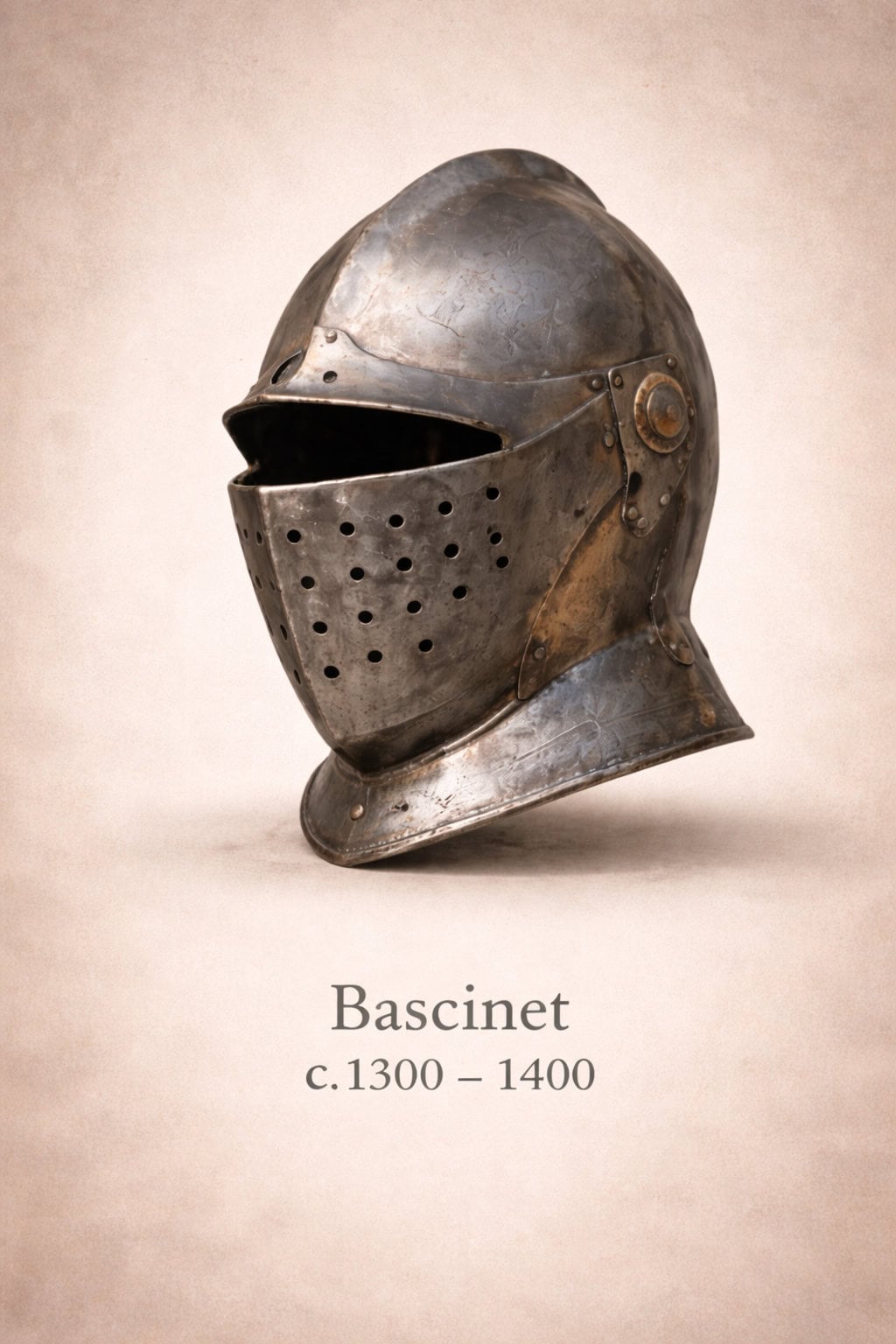
Medieval Helmet Table Comparison
This side-by-side medieval helmet comparison highlights how protection, design, and battlefield roles evolved throughout the Middle Ages. Understanding these differences helps explain why certain helmets dominated specific eras.
| Helmet | Primary Dates | Protection | Typical Wearers | Key Strength | Main Weakness |
|---|---|---|---|---|---|
| Spangenhelm | c. 500 – 1000 | Moderate | Early medieval warriors, Vikings, Norman soldiers | Lightweight and mobile | Limited facial protection |
| Great Helm | c. 1100 – 1300 | Very High | Knights and heavy cavalry | Maximum head and face defense | Restricted vision and airflow |
| Bascinet | c. 1300 – 1400 | High | Knights, men-at-arms, professional soldiers | Versatile with optional visor | Less rigid than great helms |
| Sallet | c. 1440 – 1500+ | Advanced | Knights and infantry across Europe | Excellent protection-to-visibility balance | Neck sometimes required extra armor |
| Armet | c. 1420 – 1500+ | Very High | Elite knights and heavy cavalry | Fully enclosed with strong articulation | Complex and expensive to produce |
| Kettle Hat | c. 1200 – 1500 | Moderate | Infantry, archers, crossbowmen | Excellent protection from overhead blows | Open face vulnerable in close combat |
The progression of medieval helmet design reflects a constant effort to improve survivability while maintaining mobility — a defining characteristic of medieval armor innovation.
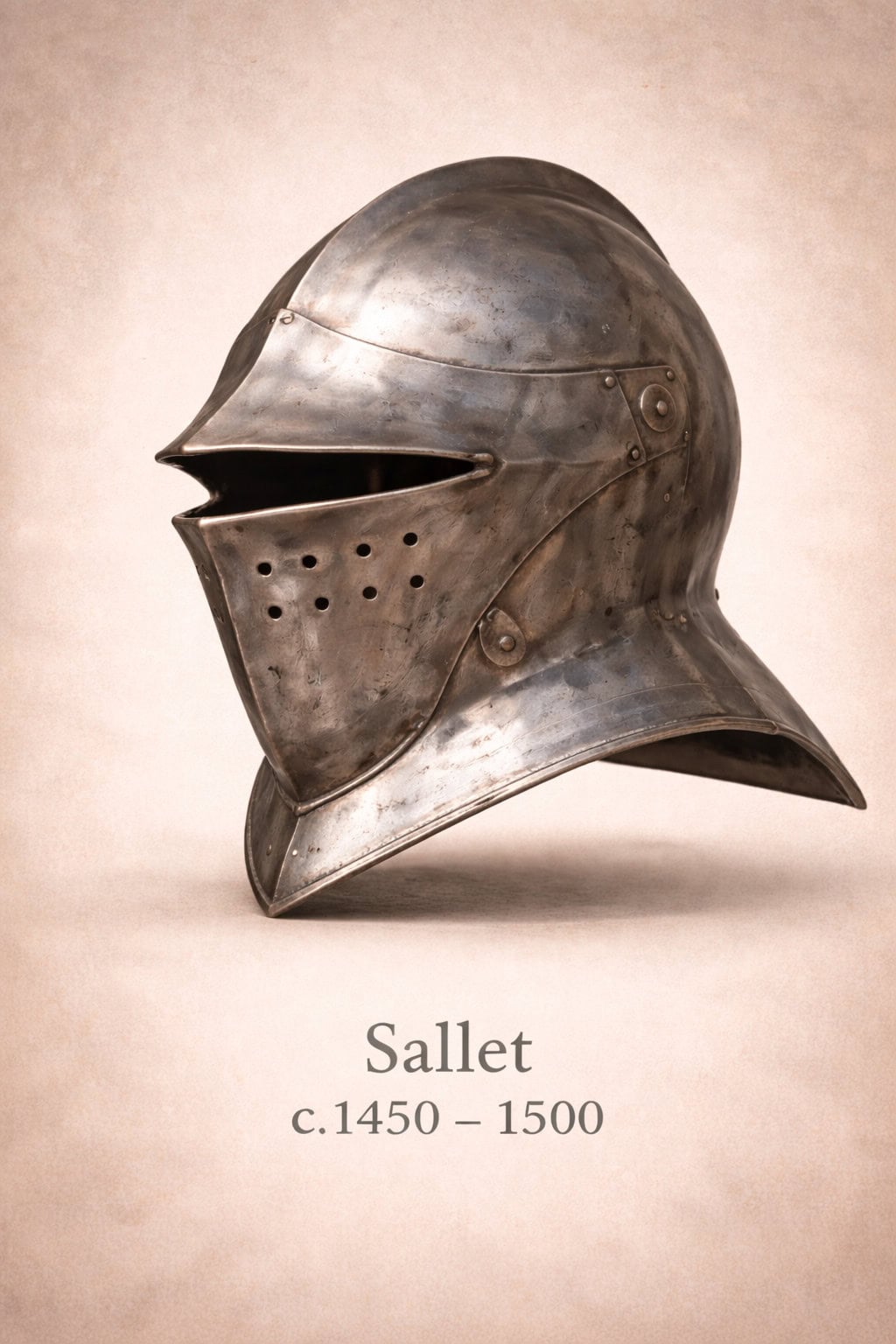
How Helmets Balanced Protection and Visibility
Designing effective medieval helmets required compromise. Total protection could reduce awareness, restrict breathing, and exhaust the wearer.
Armorers addressed this challenge through:
- Narrow eye slits for vision
- Ventilation holes for airflow
- Curved steel to deflect blows
- Visors that could be raised when not in direct combat
The most successful helmets were those that achieved a workable balance between safety and battlefield function.
Who Made Medieval Helmets?
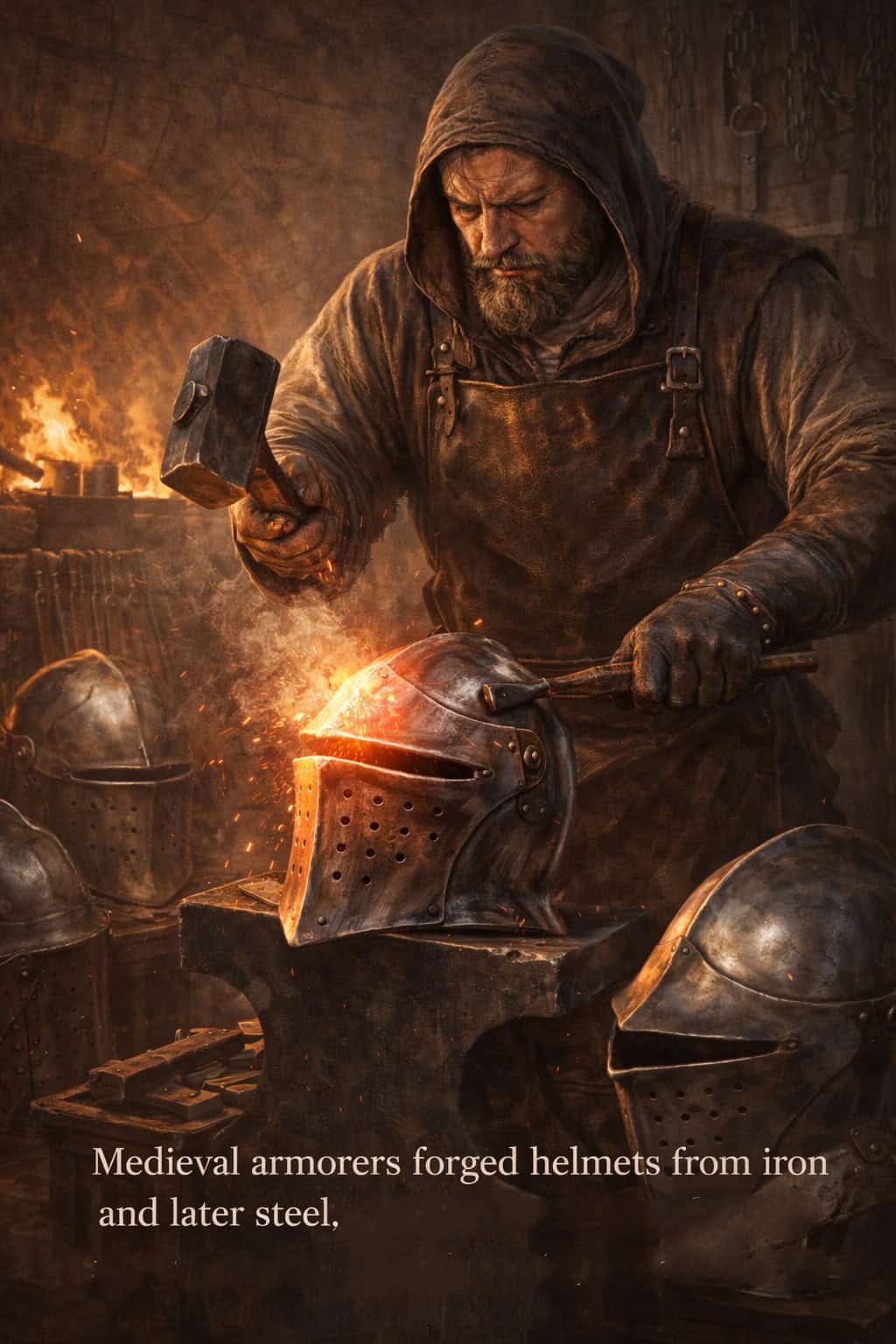
Creating a high-quality helmet required specialized skill. Dedicated medieval armorers forged helmets from iron and later steel, shaping heated metal with precision hammers before hardening it for combat durability.
Helmet production was both a craft and an industry. Wealthy nobles often commissioned custom pieces, while large armor workshops supplied equipment to professional armies.
These craftsmen played a quiet but vital role in medieval warfare — their work protected the warriors who shaped European history.
What Made a Helmet “Good” in the Middle Ages?
The best medieval helmets typically shared several qualities:
- Strong but not excessively heavy
- Shaped to deflect strikes
- Comfortable enough for long battles
- Compatible with mail coifs or padding
- Appropriate for the warrior’s role
No single helmet was perfect — effectiveness depended on context, combat style, and technological era.
Medieval Helmets in Historical Perspective
Few pieces of equipment illustrate the evolution of medieval armor as clearly as the helmet. Over centuries of conflict, these protective headpieces transformed from simple metal caps into highly engineered defenses.
Today, medieval helmets remain enduring symbols of knighthood, craftsmanship, and military innovation — representing both the dangers of medieval warfare and the ingenuity used to survive it.
Frequently Asked Questions About Medieval Helmets
These answers explain how medieval helmets developed, what they were made from, and why they were essential pieces of medieval armor on the battlefield.
What were medieval helmets made from?
Most medieval helmets were forged from iron or steel. Earlier versions sometimes incorporated hardened leather or bronze, but advances in metallurgy made steel the preferred material for durability and impact resistance.
Why were helmets so important in medieval warfare?
The head was one of the most vulnerable targets in combat. A well-made medieval helmet protected against swords, axes, arrows, and blunt weapons while improving a warrior’s chances of surviving close combat.
Which helmet was most popular with medieval knights?
Popularity changed over time, but the Great Helm dominated during the Crusades, while the Bascinet became the preferred helmet of many 14th-century knights due to its versatility and visor options.
Did all medieval helmets fully cover the face?
No. Early helmets such as the Spangenhelm often left parts of the face exposed. Later designs increasingly enclosed the head to counter stronger weapons and improve battlefield protection.
How did helmet designs evolve during the Middle Ages?
Helmet design progressed from simple conical shapes to fully enclosed steel headpieces. Innovations such as visors, ventilation holes, and reinforced plates allowed armorers to balance protection with visibility and breathability.
Who made medieval helmets?
Skilled craftsmen known as armorers specialized in producing helmets and other protective gear. Wealthy knights often commissioned custom pieces, while infantry typically relied on simpler mass-produced designs.
Were helmets different for knights and infantry?
Yes. Knights often wore heavier helmets with greater facial protection, while infantry favored lighter designs such as the kettle hat that provided good visibility and protection from overhead strikes.
Are authentic medieval helmets still preserved today?
Many original medieval helmets survive in museums and private collections, offering valuable insight into the craftsmanship, technology, and regional styles of the era.
Glossary of Medieval Helmet Terms
Key definitions related to medieval helmets, armor construction, and battlefield protection during the Middle Ages.
Bascinet
A highly adaptable medieval helmet that could be worn open-faced or fitted with a visor, popular among knights in the 14th century.
Great Helm
A fully enclosed helmet associated with crusading knights, designed to provide maximum protection to the head and face.
Spangenhelm
An early medieval helmet constructed from multiple metal plates riveted together, known for its durability and practical design.
Sallet
A streamlined late medieval helmet that improved neck protection while allowing better battlefield awareness.
Visor
A movable face guard attached to a helmet, designed to protect the wearer while still permitting vision and airflow.
Aventail
A curtain of chainmail attached to a helmet that protected the neck, throat, and shoulders from cutting blows.
Armorer
A skilled craftsman who forged medieval armor and helmets, combining metalworking expertise with battlefield practicality.
Kettle Hat
A wide-brimmed helmet commonly worn by infantry, offering strong protection from downward strikes and missiles.