
Falconry was one of the most prestigious and highly respected pursuits of the medieval world. More than a method of hunting, it symbolized authority, discipline, and aristocratic identity across much of Europe and the Middle East.
Practiced primarily by kings, nobles, and high-ranking clergy, falconry required patience, wealth, and specialized knowledge. A well-trained bird of prey was not merely a hunting companion — it was a visible marker of social rank.
Throughout the Middle Ages, falcons were exchanged as royal gifts, used in diplomatic negotiations, and even accepted as ransom payments, demonstrating their extraordinary value.
Falconry was the medieval practice of hunting wild animals using trained birds of prey such as falcons, hawks, and eagles. Popular among kings, nobles, and clergy, it served not only as a method of securing food but also as a powerful symbol of wealth, status, and social rank. Falcons were highly prized and were often exchanged as diplomatic gifts, ransoms, and royal treasures.

Origins of Medieval Falconry
Falconry predates the Middle Ages by centuries, likely emerging in parts of Central Asia or the Middle East before spreading westward into Europe.
By the High Middle Ages, the sport had reached remarkable popularity. Monarchs maintained extensive mews (falcon housing), and specialized staff were employed solely to breed, train, and care for the birds.
Falconry became so embedded in elite culture that knowledge of the practice was often considered part of a noble education.
Even prominent church figures embraced the sport — a reminder that medieval clergy often belonged to the same social class as the aristocracy.
Why Falconry Mattered in Medieval Society
Falconry was far more than entertainment. It reflected the structure and values of medieval life.
The sport represented:
- Social hierarchy — certain birds were reserved for specific ranks
- Wealth — acquiring and maintaining falcons was expensive
- Discipline — training required exceptional control and patience
- Prestige — carrying a falcon signaled elite status
- Political influence — birds were exchanged between rulers
To see a noble riding with a falcon perched calmly on a gloved hand was to witness a powerful symbol of authority.
🦅 Birds Used in Medieval Falconry
Different birds were prized for their speed, temperament, and hunting ability. Ownership often reflected a person’s social rank, making certain falcons powerful symbols of medieval hierarchy.
Gyrfalcon
The largest and rarest falcon, typically associated with royalty. Its scarcity made it one of the most valuable birds in medieval Europe.
Peregrine Falcon
Celebrated for its astonishing diving speed, the peregrine was favored by knights and skilled falconers who required precision hunters.
Lanner Falcon
An adaptable and resilient bird, particularly effective in open landscapes where endurance and maneuverability were essential.
Merlin
Smaller yet highly agile, the merlin was frequently associated with noblewomen and prized for its swift pursuit.
Sparrowhawk
Widely used by clergy and lower-ranking nobles, valued for its practicality and effectiveness in everyday hunting.
Falconry and Social Rank
Medieval society was deeply hierarchical, and falconry reflected this structure with remarkable precision.
Although regional variations existed, a commonly cited hierarchy included:
- King — Gyrfalcon
- Prince / Noble — Peregrine Falcon
- Knight — Saker or Lanner
- Lady — Merlin
- Priest — Sparrowhawk
Owning a bird above one’s station could even be considered a breach of social order.
How Falcons Were Trained
Training a falcon was a demanding process that could take months or even years.
Falconers relied on techniques such as:
Imprinting — building trust between bird and handler
Hooding — calming the bird by limiting visual distractions
Lure training — teaching the falcon to return after flight
Glove conditioning — reinforcing the bird’s landing behavior
The success of a hunt depended as much on the falconer’s skill as on the bird itself.
Because of this expertise, professional falconers were highly respected members of noble households.
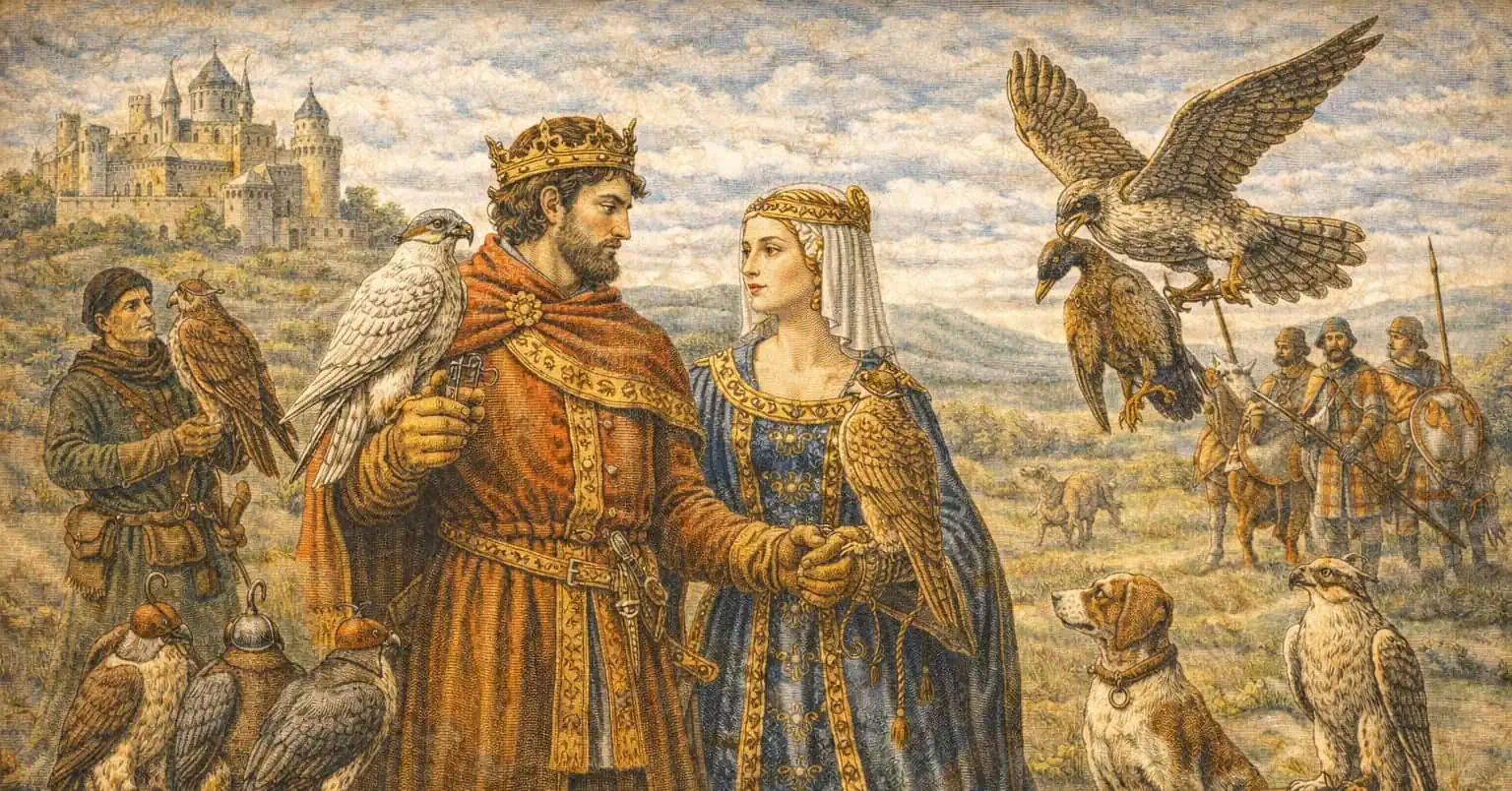
Falcons as Diplomatic Gifts and Ransom
Few animals carried the political significance of a prized falcon.
Rulers frequently exchanged birds to strengthen alliances or negotiate peace. In some cases, falcons were considered more desirable than gold.
One notable episode involved the ransom of a captured nobleman when a ruler reportedly rejected a vast monetary payment in favor of receiving rare white gyrfalcons instead.
Similarly, Scandinavian rulers sent prized birds to English courts as gestures of goodwill during treaty negotiations.
Such exchanges highlight the extraordinary prestige attached to these animals.
🛡️ Falconry in England
Falconry flourished in medieval England, where the sport had been practiced since the early Anglo-Saxon period. Over time, it became deeply woven into aristocratic culture and was widely viewed as a symbol of refinement, discipline, and social prestige.
Royal Oversight
Royal households commonly employed a Master of the Mews, an official responsible for managing the king’s birds, supervising training, and maintaining the facilities where falcons were housed.
A Noble Companion
English nobles sometimes traveled with their falcons during military campaigns, highlighting how integral the sport had become to aristocratic identity both in war and in peace.
Beyond the Battlefield
The practice was not limited to men. Noblewomen frequently participated, and contemporary accounts even describe members of the clergy carrying birds within cathedral grounds — a testament to falconry’s broad social reach.
The Decline of Falconry
Falconry began to lose prominence between the 16th and 17th centuries.
Several developments contributed to its decline:
- The spread of firearms, which simplified bird hunting
- Changing aristocratic tastes
- Agricultural shifts that altered hunting landscapes
- The gradual modernization of European society
Although the sport never vanished entirely, it transitioned from a dominant aristocratic pursuit into a specialized tradition.
The Legacy of Medieval Falconry
Today, falconry survives as both a heritage practice and a regulated sport in many countries.
Its endurance speaks to the profound relationship medieval people developed with trained birds of prey — one rooted in cooperation rather than simple domestication.
More importantly, falconry offers modern historians insight into:
- medieval class structures
- diplomatic customs
- leisure culture
- hunting practices
- noble identity
Few activities capture the elegance and hierarchy of the Middle Ages as vividly as a falcon returning to its master’s glove.
📜 Falconry FAQ
What was falconry in the Middle Ages?
Falconry was the practice of hunting wild animals using trained birds of prey. It was especially popular among the medieval nobility and served both as a practical hunting method and a symbol of social status.
Why was falconry associated with nobility?
Training and maintaining falcons required significant wealth, time, and land. Because of these costs, falconry became closely tied to aristocratic life and was often regulated by social rank.
Which birds were most commonly used in medieval falconry?
Popular birds included the gyrfalcon, peregrine falcon, lanner falcon, merlin, and sparrowhawk. The type of bird often reflected the owner’s social position.
Did women participate in falconry?
Yes. Noblewomen frequently practiced falconry, particularly with smaller birds such as merlins. The sport was considered refined and suitable for elite members of society regardless of gender.
Was falconry only used for sport?
Originally, falconry helped secure food, but it gradually evolved into a prestigious recreational activity. Falcons were also exchanged as diplomatic gifts and valuable ransoms.
Why did falconry decline?
The widespread adoption of firearms in the 16th and 17th centuries made hunting more efficient. As a result, falconry slowly declined, though it never disappeared entirely.
Is falconry still practiced today?
Yes. Falconry survives as a regulated sport in many countries and is recognized by UNESCO as an important element of intangible cultural heritage.

