The Norman period in England (1066–1154) stands as one of the most transformative eras in medieval history. Sparked by the Norman Conquest under William the Conqueror, this period reshaped England’s political institutions, aristocracy, culture, language, military organization, church relations, and architectural landscape. Norman rulers replaced the Anglo-Saxon elite, introduced monumental stone castles, and established a centralized administrative system that influenced English governance for centuries.
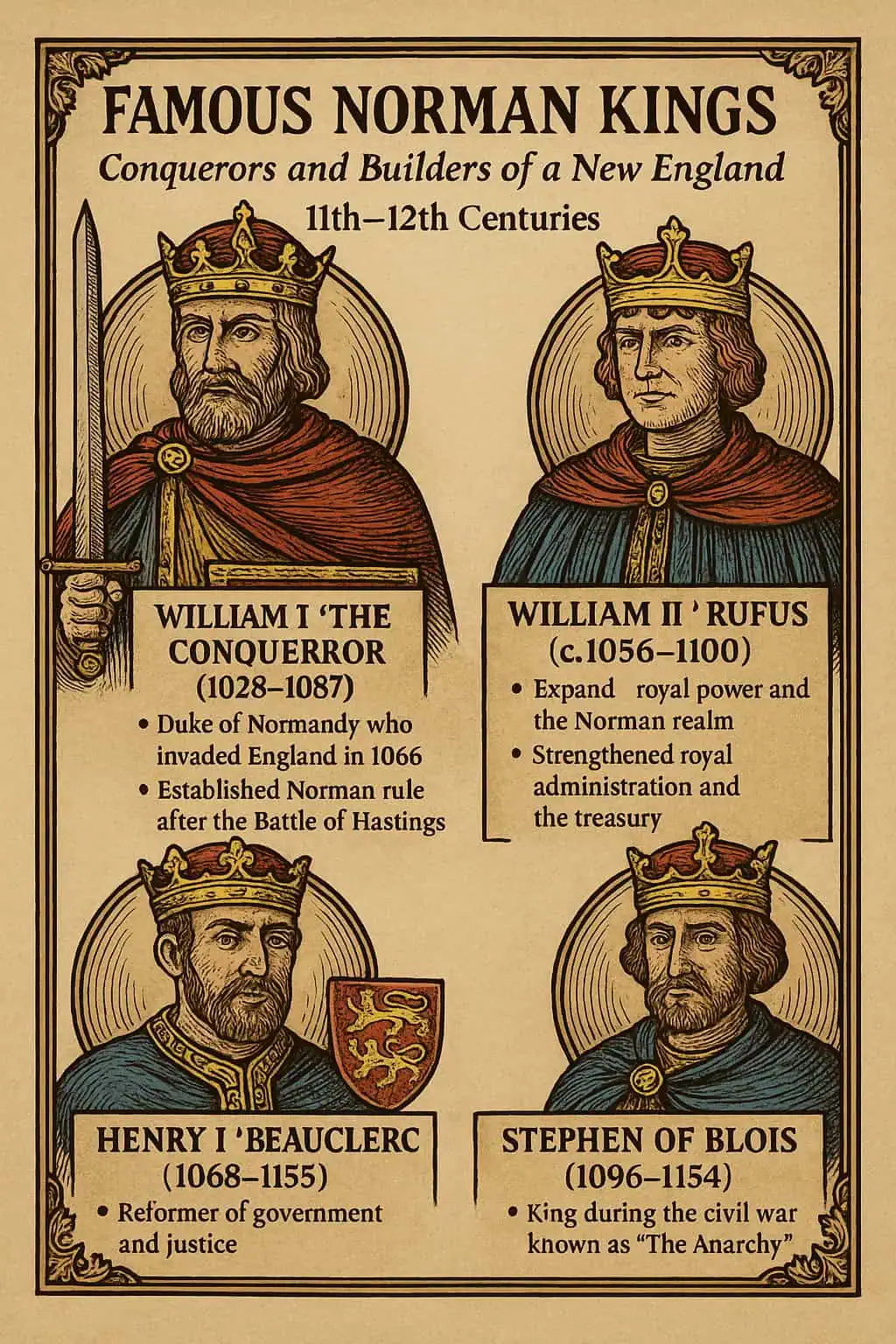
This expanded guide explores the major Norman rulers, their achievements, and the turbulent events that defined this age—from the Battle of Hastings to the rise of the Angevin dynasty.
Origins of Norman Rule in England
The origins of Norman rule lie in the contested succession of 1066. William, Duke of Normandy, claimed that Edward the Confessor had promised him the English throne. However, when Edward died, the English nobility chose Harold Godwinson as king. William viewed Harold’s coronation as a betrayal, arguing that Harold had previously sworn an oath to support William’s claim.

Determined to enforce his right, William launched an invasion with one of the most formidable armies of the medieval world. His decisive victory at the Battle of Hastings, fought on 14 October 1066, shattered the Anglo-Saxon army and opened the door for Norman conquest. William was crowned on Christmas Day 1066, marking the beginning of a new political and social order.
📜 Fast Facts: The Norman Dynasty
- The Normans originated from Viking settlers in Normandy.
- Their rule in England began after the Battle of Hastings (1066).
- They introduced the feudal system and reshaped English aristocracy.
- The Domesday Book (1086) remains one of medieval Europe’s greatest administrative achievements.
William the Conqueror (1066–1087)
William I, also known as William the Conqueror, became the architect of a fundamentally transformed England. Through military dominance and administrative innovation, he reshaped every major institution in the kingdom.

Key Achievements of William the Conqueror:
- Replaced the Anglo-Saxon aristocracy with a loyal Norman nobility
- Introduced the Feudal System, binding land ownership to military and political service
- Constructed hundreds of Norman castles, including the Tower of London, Rochester Castle, and Durham Castle
- Crushed rebellions, especially during the Harrying of the North (1069–1070)
- Commissioned the Domesday Book (1086), the most comprehensive medieval survey ever made in Europe
William’s reign imposed tight royal control over the land and people of England. The landscape was forever altered by the Norman castle network, built to secure dominance and suppress uprisings. By his death in 1087, William had laid the foundations for a new English identity under Norman rule.
William II “Rufus” (1087–1100)
William’s third son, William Rufus, inherited the English throne while his older brother Robert Curthose received Normandy. Rufus was known for his red hair or ruddy complexion, earning him the nickname “Rufus.”
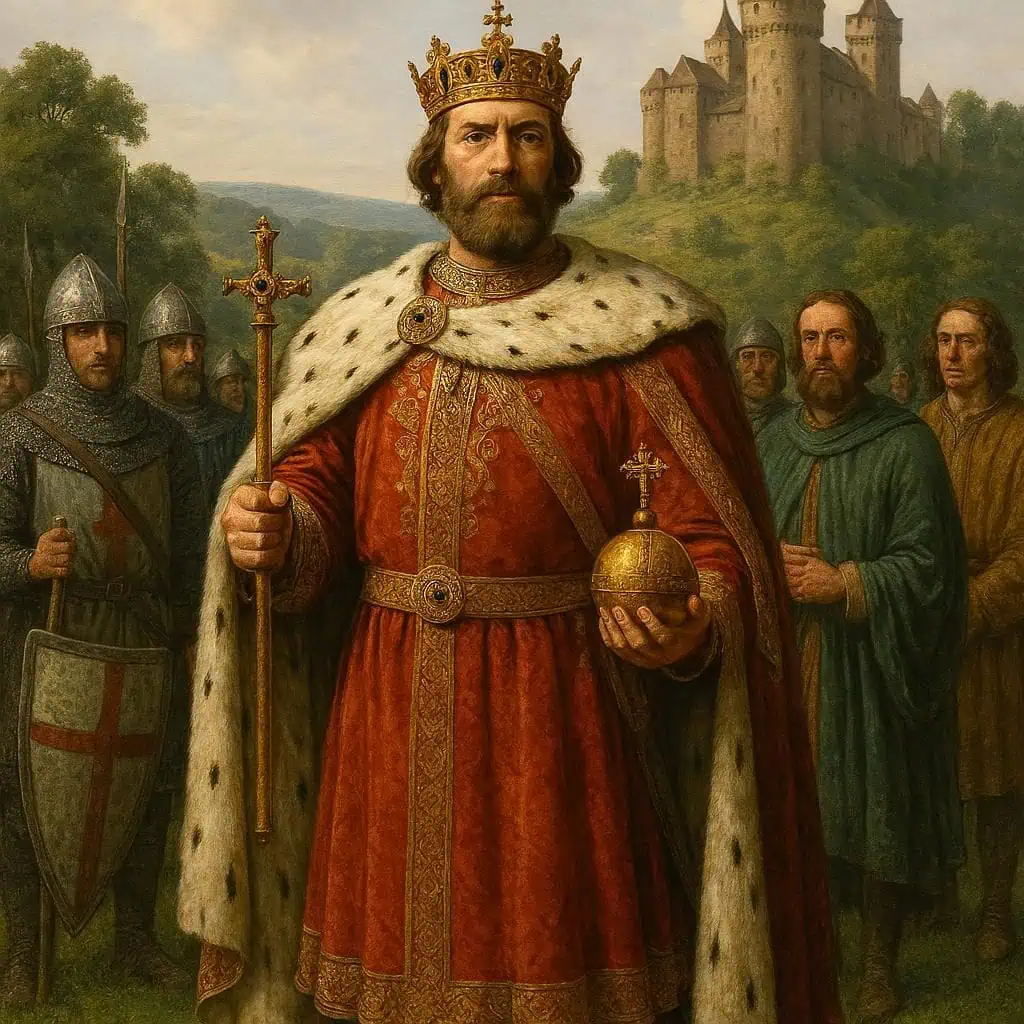
His reign was marked by conflict both at home and abroad.
Highlights of William II’s Rule:
- Asserted strong royal authority and expanded influence into Wales
- Fought repeated rebellions supporting Robert Curthose
- Clashed with the Church, especially with Archbishop Anselm of Canterbury
- Raised heavy taxes to finance campaigns in Normandy
In 1100, William Rufus died suddenly while hunting in the New Forest. The circumstances of his death were mysterious and fuelled speculation of assassination. His death allowed his younger brother Henry to seize the crown before Robert could return from abroad.
⚔️ Key Innovations Introduced by the Normans
- Construction of stone keep castles, including the Tower of London.
- Reorganisation of the English church under Norman bishops and abbots.
- Development of new taxation and record-keeping systems.
- Replacement of Anglo-Saxon nobility with loyal Norman barons.
Henry I ‘Beauclerc’ (1100–1135)
Known for his intelligence and administrative skill, Henry I, called Henry Beauclerc, restored stability after the turbulence of William Rufus’s reign. Henry moved swiftly to secure power, issuing the Charter of Liberties to gain the support of the barons by limiting royal abuses.
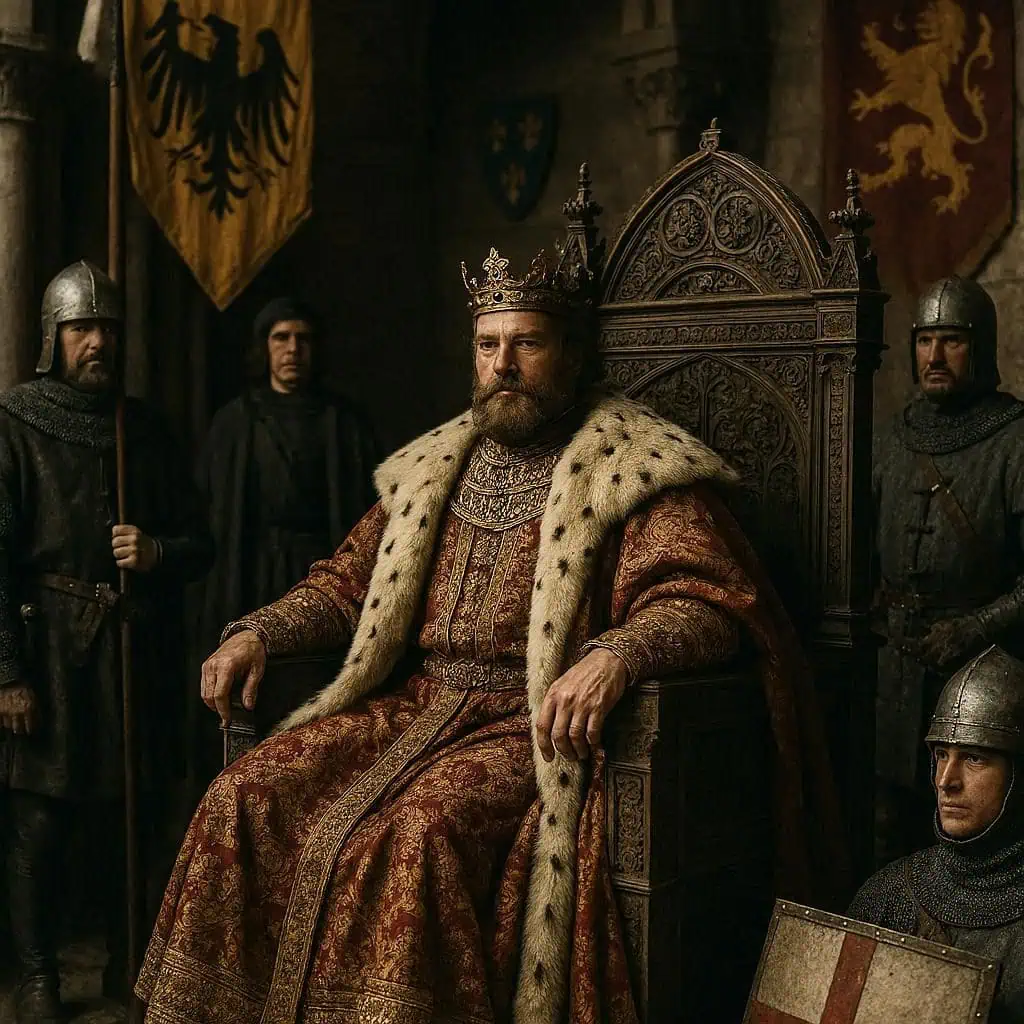
Major Achievements of Henry I:
- Strengthened the English monarchy and centralized authority
- Developed the Exchequer, an early financial system that improved revenue management
- Expanded royal justice and strengthened the king’s power over the Church
- Defeated Robert Curthose at the Battle of Tinchebray (1106) and brought Normandy under English control
However, tragedy struck in 1120 with the sinking of the White Ship, which killed Henry’s only legitimate son, William Adelin. With no male heir, Henry named his daughter Empress Matilda as successor, but many nobles were reluctant to accept a female monarch.
🛡️ Norman Kings – Click to Reveal Facts
- William I (1066–1087) – The Conqueror
- William II (1087–1100) – William Rufus
- Henry I (1100–1135) – Henry Beauclerc
- Stephen of Blois (1135–1154) – Civil war and the Anarchy
The Anarchy: Civil War Between Matilda and Stephen (1135–1154)
When Henry I died in 1135, his nephew Stephen of Blois seized the throne, breaking his oath to Matilda. This act plunged England into nearly two decades of chaos known as The Anarchy.
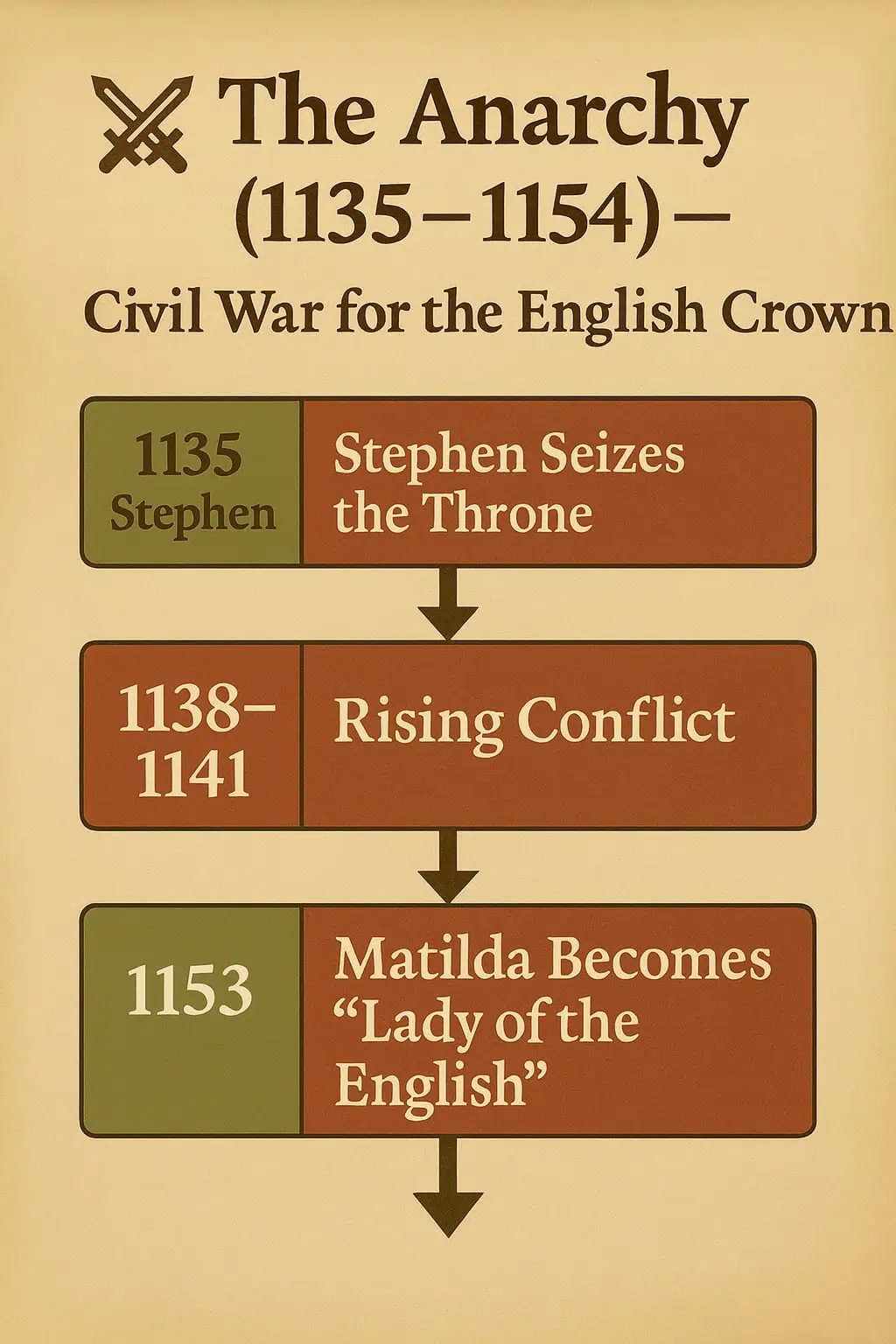
Key Features of The Anarchy:
- A bitter civil war between King Stephen and Empress Matilda
- A breakdown of central authority and widespread lawlessness
- Chroniclers claimed that during this period “Christ and his saints slept”
- Rapid castle-building by ambitious barons, often without royal permission
- The Battle of Lincoln (1141), where Stephen was captured and Matilda briefly controlled the government
- Matilda’s failure to be crowned due to violent opposition in London
The conflict dragged on until both sides agreed to the Treaty of Wallingford (1153). Stephen would remain king for life, but Matilda’s son, Henry Plantagenet, would succeed him. When Stephen died in 1154, Henry ascended the throne as Henry II, founding the powerful Angevin (Plantagenet) dynasty.
🏰 Why the Norman Era Was So Important
- It marked the beginning of centralised royal authority in England.
- Norman culture blended with Anglo-Saxon traditions, influencing law, language, and architecture.
- The period laid foundations for the future Plantagenet dynasty.
- Norman reforms shaped medieval Europe for centuries.
Legacy of the Norman Kings
The Norman dynasty transformed England in ways that endured for centuries:
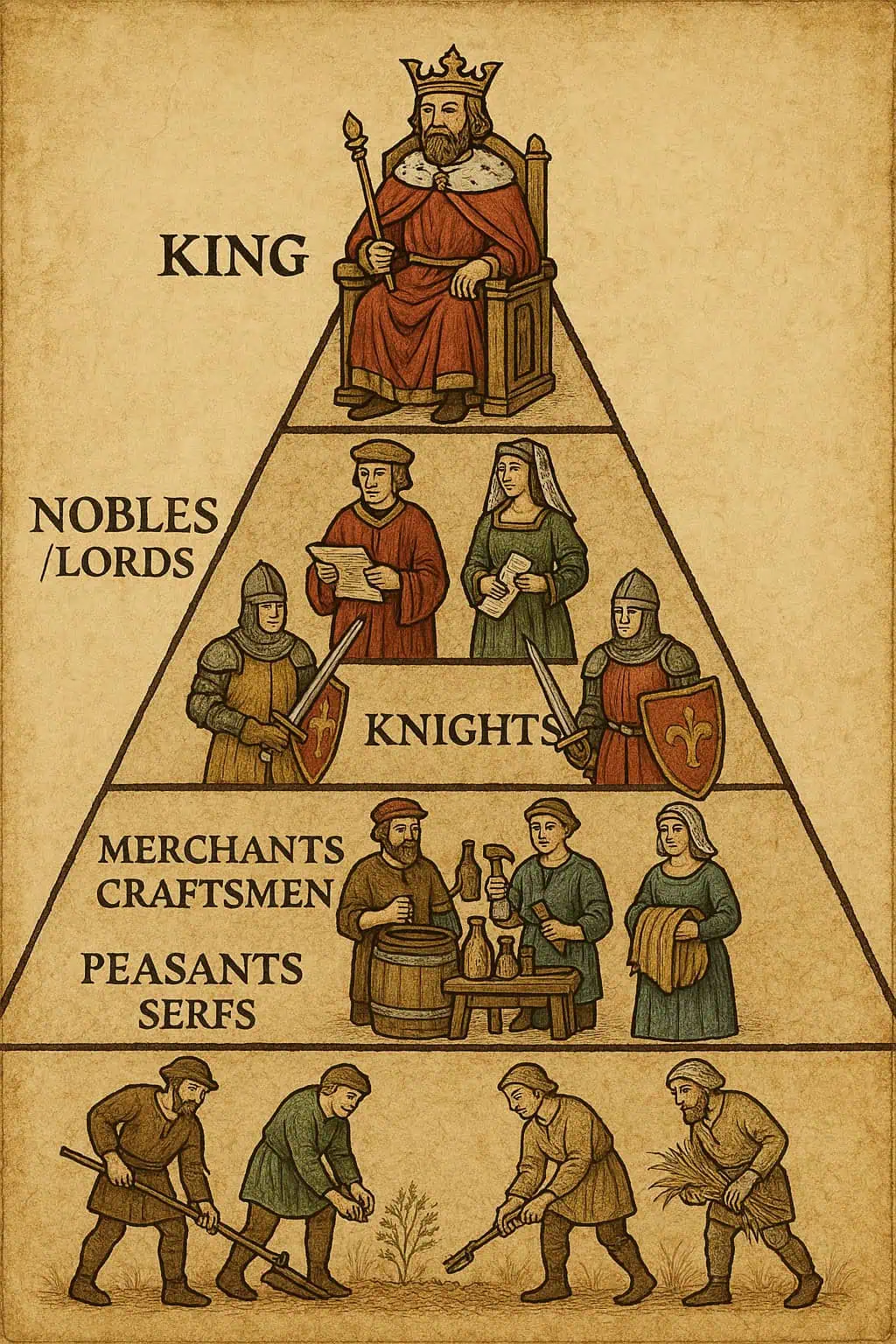
- Feudalism replaced Anglo-Saxon landholding
- Norman French influenced the English language
- A new castle-based military system strengthened royal authority
- The Domesday Book set a precedent for state record-keeping
- The monarchy became more centralized and bureaucratic
- England became deeply connected to continental Europe, especially Normandy
The Normans created the framework for medieval England’s government, legal structures, and aristocracy. Their influence persisted long after their dynasty ended, shaping the identity of the kingdom for generations.
❓ Norman Kings – Frequently Asked Questions
Who were the Normans?
The Normans were descendants of Viking settlers who occupied the region of Normandy in northern France. Over time, they became a powerful, culturally distinct people known for their military skill, castle-building expertise, and strong feudal governance.
How did the Normans come to rule England?
Norman rule began after William, Duke of Normandy, invaded England in 1066, claiming that Edward the Confessor had promised him the throne. His victory at the Battle of Hastings over King Harold II established Norman control.
Who were the main Norman kings of England?
The major Norman kings were William I (the Conqueror), William II (Rufus), Henry I (Beauclerc), and Stephen of Blois. Their reigns shaped medieval England through reforms, conquests, and administrative innovation.
What major changes did the Normans bring to England?
They transformed the English aristocracy, introduced the feudal system, built stone castles such as the Tower of London, reformed law and administration, and reshaped the Church by installing Norman bishops and abbots.
What was the Domesday Book and why was it important?
Completed in 1086 under William the Conqueror, the Domesday Book recorded land ownership, taxation potential, and population details across England. It is one of the most comprehensive medieval surveys ever created.
When and why did Norman rule end?
Norman rule ended in 1154 with the death of King Stephen. The throne then passed to Henry II, founder of the Angevin (Plantagenet) dynasty, marking the beginning of a new era in English royal history.
🧠 Norman Kings Knowledge Quiz
📜 Glossary of Norman & Early Medieval Terms
Feudal System
A hierarchical land-holding structure introduced by the Normans in which land was exchanged for loyalty and military service.
Domesday Book
A comprehensive 1086 survey ordered by William the Conqueror to assess land ownership, wealth, and taxation across England.
Keep
The strong central tower of a Norman castle, designed for defence and as a symbol of authority.
Baron
A noble who held land directly from the king and provided knights and military support in return.
Manor
A local estate owned by a lord, containing farmland, a village, and peasants who provided labour and rents.
Anglo-Saxons
The dominant population and culture in England before the Norman Conquest of 1066.
Normandy
A region in northern France founded by Viking settlers, home of the Normans who conquered England.
Angevin Dynasty
The royal house that succeeded the Normans in 1154, beginning with Henry II, son of Empress Matilda.
Battle of Hastings
The decisive 1066 battle where William the Conqueror defeated Harold Godwinson and seized the English throne.
⚔️ Norman Kings & Medieval England Image Gallery