
Medieval Times
Medieval Times
The Judas Cradle is one of the most infamous torture devices traditionally associated with late medieval and early modern Europe. Often depicted in museums and illustrations as a pyramid-shaped seat designed to inflict extreme pain, the device has become a powerful symbol of judicial cruelty, inquisitorial fear, and punishment through humiliation.
Unlike many medieval torture methods that are well documented in court records, the Judas Cradle occupies a controversial place in historical scholarship. While physical examples and later descriptions exist, historians continue to debate how widely it was used, when it emerged, and whether some accounts were exaggerated in later centuries.
Understanding the Judas Cradle requires separating documented legal practices, later reconstructions, and modern interpretations of medieval justice.
The Judas Cradle was a pyramid-shaped torture device associated with late medieval and early modern Europe, allegedly used during judicial interrogations. It inflicted pain by suspending a victim above a pointed structure, allowing their own body weight to increase suffering. While often linked to the Inquisition, historians debate its actual medieval use due to scarce contemporary court records and the late dating of most surviving examples.
The Judas Cradle occupies a controversial place in the study of medieval and inquisitorial torture. While often cited as a notorious punishment device, modern historians approach its history with caution, separating documented evidence from later interpretation.
Myth: The Judas Cradle was a common torture device used throughout the Middle Ages.
Fact: Surviving historical evidence suggests it was rare, regionally limited, or possibly symbolic, with many examples appearing in later centuries.
Myth: It was officially used in all Inquisition trials.
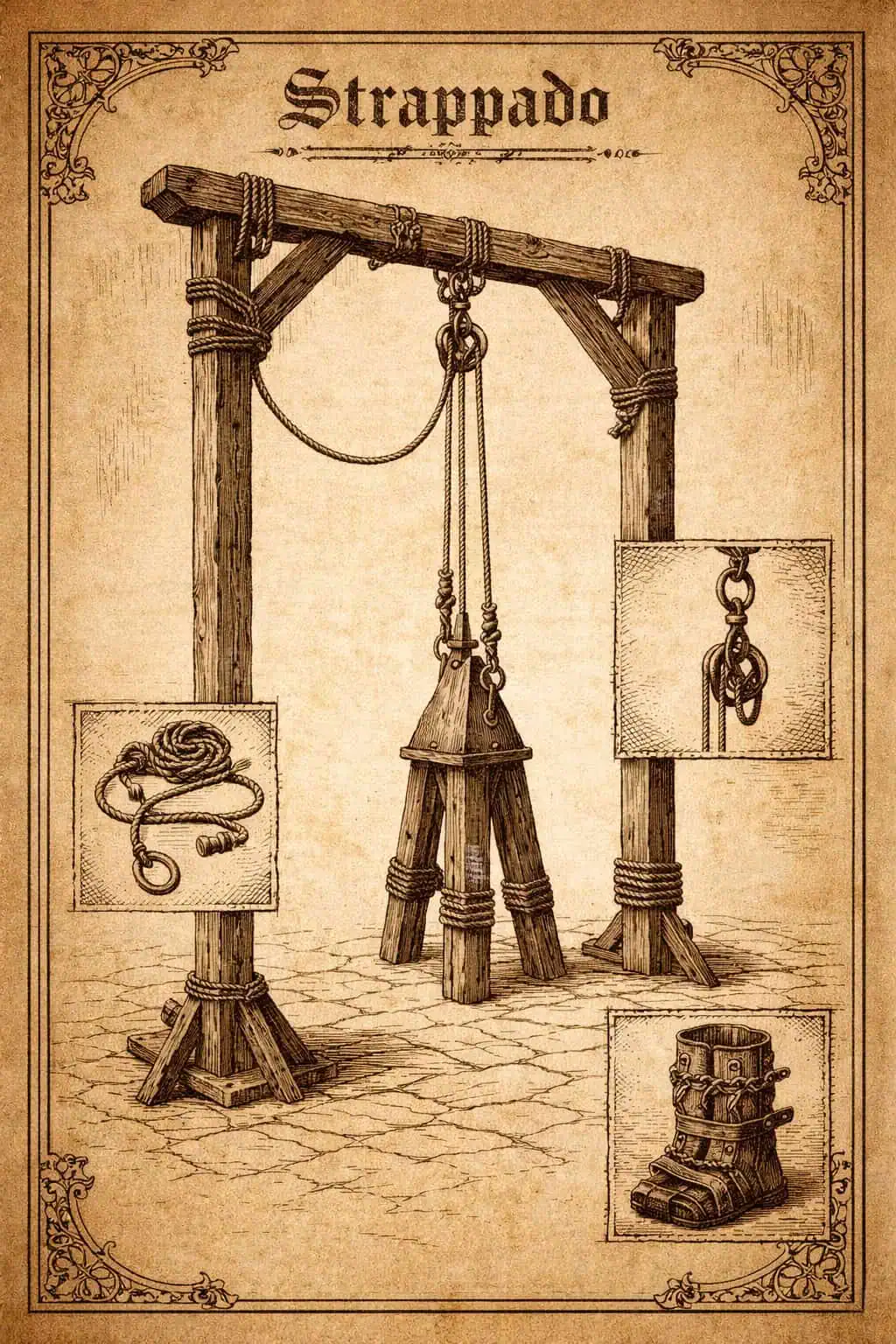
Fact: Most documented Inquisition torture relied on strappado, confinement, and psychological pressure, not this device.
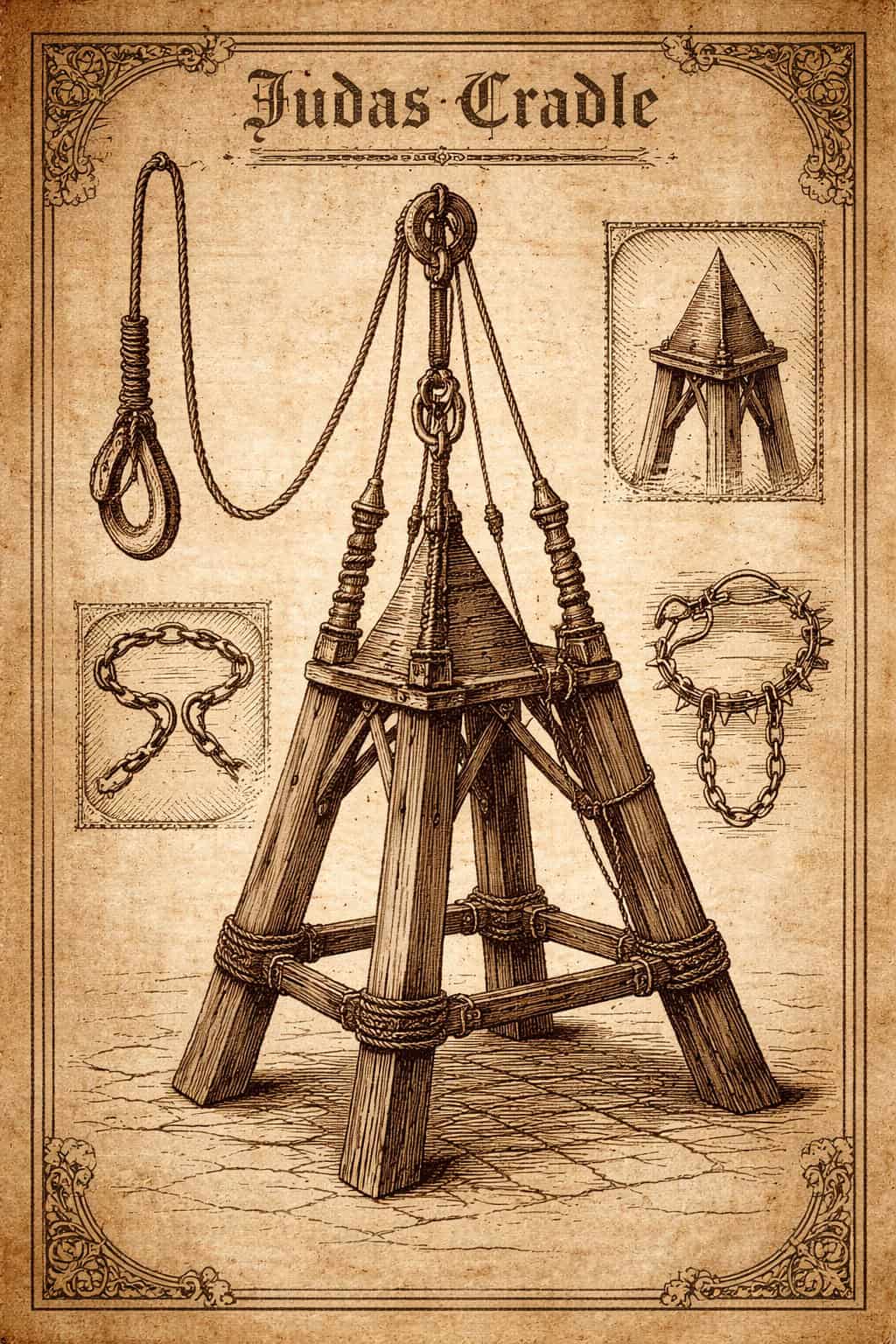
The Judas Cradle was a pyramid-shaped torture device associated with late medieval and early modern punishment. Victims were suspended above a pointed structure and slowly lowered onto it using their own body weight.
Although often described as medieval, most surviving evidence places the Judas Cradle primarily in the late Middle Ages and early modern period, especially within inquisitorial contexts.
Victims were typically individuals accused of heresy, apostasy, or religious nonconformity. Torture was used to extract confessions or enforce religious conformity.
The device caused extreme pain, soft-tissue injury, and high risk of infection. Death was not always immediate, but long-term physical damage was common.
Yes. Some historians argue that later illustrations and museum reconstructions may exaggerate its frequency of use. Torture existed, but the Judas Cradle’s prevalence remains debated.
Studying the Judas Cradle helps historians understand how law, religion, and authority intersected in past societies — and why modern legal protections developed.
The Judas Cradle (sometimes called the Cradle of Judas) is described as a pyramid-shaped structure, usually made of wood or metal. Victims were allegedly suspended above the pointed apex and slowly lowered onto it, with their own body weight increasing the pressure.
Unlike execution devices, the Judas Cradle was intended to:
Death was not the primary goal, though severe injury, infection, and long-term trauma were common risks.
Torture was legally regulated in many medieval courts, especially inquisitorial systems.
Important facts:
The Spanish Inquisition, established in 1478, is frequently associated with extreme torture, but modern scholarship shows:
Historical Context Note: Many torture devices traditionally attributed to the Middle Ages are known primarily from later reconstructions, illustrations, or museum displays. Modern historians continue to reassess their authenticity, frequency of use, and original context based on surviving legal and archival evidence.
The Judas Cradle stands as one of the most controversial and disturbing symbols associated with medieval torture. While its brutal design has made it infamous in popular history, modern scholarship shows that its actual historical use remains debated, with many surviving examples dating to the early modern period rather than the Middle Ages. Examining the Judas Cradle through verified sources allows us to separate historical evidence from later myth, offering a clearer understanding of how justice, punishment, and fear operated in pre-modern societies. Studying this device today is essential not for sensationalism, but for gaining insight into the evolution of legal systems, human rights, and historical memory.
The Judas Cradle was a pyramid-shaped torture device associated with late medieval and early modern Europe, allegedly used to inflict extreme pain during interrogations.
Historians debate its medieval use. While illustrations and later accounts exist, direct medieval court records mentioning the device are rare.
The device is commonly linked to the Inquisition in popular history, though much of this association may come from later anti-Inquisition propaganda.
The device was designed to cause prolonged suffering rather than immediate death, though infections and injuries could prove fatal.
Most surviving examples date to the 18th or 19th centuries, raising questions about whether they reflect medieval practice or later reconstructions.
It represents the broader debate about medieval justice, torture, and how later generations interpreted and sometimes exaggerated the past.
A pyramid-shaped torture device historically associated with coercive interrogation practices.
Church-led tribunals established to identify and punish heresy in medieval and early modern Europe.
The legally sanctioned use of pain to extract confessions or testimony in pre-modern courts.
An admission of guilt, often sought through coercion in medieval legal systems.
Later writings and images that exaggerated cruelty to criticise religious tribunals.
The transitional era between the Middle Ages and modern history, roughly 1500–1800.
Scholarly disagreement over the interpretation, evidence, and use of past practices.