The Reconquista was not won through open-field battles alone. It was decided, above all, through sieges—long, brutal campaigns that determined control of cities, trade routes, and entire regions of medieval Iberia.
From the early Christian strongholds of northern Spain to the fall of Granada in 1492, siege warfare shaped the political, military, and cultural transformation of the Iberian Peninsula. Castles, walled cities, and fortified ports became the true prizes of the Reconquista, as Christian kingdoms gradually dismantled Muslim power through sustained pressure rather than sudden conquest.
This article explores the most important sieges of the Reconquista, explaining why they mattered, how they were fought, and how they reshaped medieval Spain.

🛡️ Click to Reveal: Key Themes of the Reconquista
The political, military, and cultural forces that shaped medieval Iberia
Siege Warfare Over Open Battle
The Reconquista was defined by sieges rather than pitched battles. Fortified cities, castles, and ports were the primary objectives, as controlling urban centers meant controlling territory, trade, and population.
Fragmented Christian Kingdoms
Christian Spain was never unified during most of the Reconquista. Castile, Aragon, Navarre, and Portugal pursued their own interests, often fighting each other as frequently as Muslim rulers.
Al-Andalus and Urban Power
Muslim rule in Iberia was heavily urbanized. Cities such as Córdoba, Seville, Valencia, and Granada were centers of administration, learning, and defense, making their capture strategically decisive.
Religion and Pragmatism
Although framed as a religious struggle, the Reconquista was often driven by political alliances, treaties, and negotiated surrenders. Cooperation across religious lines was common.
Crusading Influence
From the 12th century onward, the Reconquista increasingly intersected with wider European crusading movements, bringing foreign fighters, papal support, and ideological reinforcement.
The Rise of Centralized Power
Late Reconquista sieges reflected the growth of centralized monarchies. Gunpowder artillery, standing armies, and royal logistics transformed warfare and governance in Spain.
The Reconquista and the Central Role of Sieges
The Reconquista (c. 8th–15th centuries) was a centuries-long process during which Christian kingdoms expanded southward at the expense of Muslim-ruled al-Andalus. Unlike the Crusades in the eastern Mediterranean, Iberian warfare was deeply shaped by urban geography.
Key features of Reconquista warfare included:
- Strongly fortified cities inherited from Roman and Islamic rule
- Limited manpower, making pitched battles risky
- Long campaigns aimed at isolating, starving, and negotiating surrenders
As a result, sieges—not decisive battles—became the dominant form of warfare.
⏳ Timeline of the Reconquista (711–1492)
Key phases in the Christian reconquest of Iberia
⚔️ 711–756: Muslim Conquest of Iberia
Muslim forces rapidly conquered most of the Iberian Peninsula, establishing al-Andalus and reshaping political power in the region.
🛡️ 8th–10th Centuries: Christian Survival
Small Christian kingdoms in the north—Asturias, León, and Navarre—survived through defensive warfare and fortified strongholds.
🏰 11th–12th Centuries: Major Urban Sieges
The capture of Toledo (1085), Zaragoza (1118), and Lisbon (1147) marked decisive breakthroughs into central and eastern Iberia.
🔥 13th Century: Collapse of al-Andalus
Christian kingdoms seized Valencia, Seville, and Córdoba, reducing Muslim rule to the Nasrid Kingdom of Granada.
👑 1482–1492: Fall of Granada
A decade-long campaign culminated in the surrender of Granada, ending Muslim political rule in Spain.
🗺️ The Reconquista: Maps of Territorial Change


Siege of Toledo (1085): The Turning Point of Central Iberia
The capture of Toledo in 1085 by Alfonso VI of Castile marked one of the most significant moments of the early Reconquista.
Once the former Visigothic capital, Toledo occupied a strategic position in central Iberia. Its fall:
- Opened the heart of the peninsula to Christian expansion
- Gave Castile immense political prestige
- Signaled that major Muslim cities were no longer secure
Importantly, Toledo surrendered through negotiation rather than destruction, setting a precedent for pragmatic siege warfare that balanced force with diplomacy.

⚔️ Siege of Zaragoza (1118)
Aragonese expansion into the Ebro Valley
In 1118, Alfonso I of Aragon captured Zaragoza, a major urban, political, and economic center in northeastern Iberia. The city had long served as a strategic stronghold of Muslim power, controlling access to the fertile Ebro Valley.
The successful siege of Zaragoza:
- Secured Aragonese control of the Ebro Valley, providing access to rich agricultural land and trade routes
- Shifted the balance of power in eastern Spain in favor of the Christian kingdoms
- Demonstrated growing Christian expertise in prolonged siege warfare, including blockades and negotiated surrender
Zaragoza’s fall marked Aragon’s transformation from a regional kingdom into a major Iberian power, accelerating Christian expansion across northeastern Spain and reinforcing the central role of urban sieges in the Reconquista.
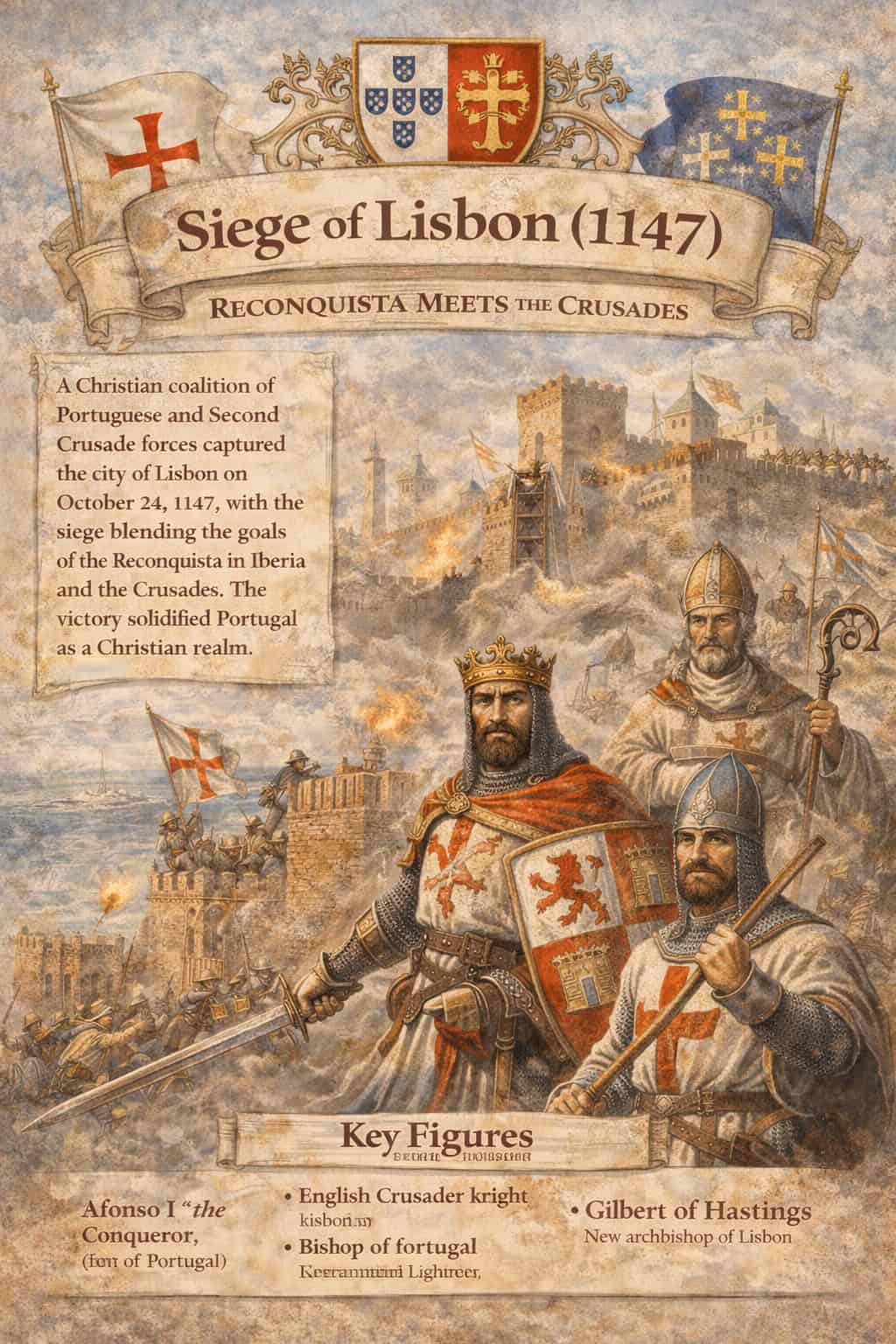
Siege of Lisbon (1147): Reconquista Meets the Crusades
The Siege of Lisbon in 1147 stands out for its international character. Portuguese forces under Afonso I were joined by crusaders traveling to the Holy Land during the Second Crusade.
Lisbon’s capture:
- Secured Portugal’s most important Atlantic port
- Integrated the Reconquista into wider European crusading movements
- Accelerated Portuguese maritime and commercial expansion
The siege was long, violent, and destructive—revealing how Reconquista warfare was becoming increasingly sophisticated and ruthless.
⚔️ Siege of Valencia (1238)
The fall of eastern al-Andalus
The Siege of Valencia, led by James I of Aragon, concluded in 1238 and ended Muslim political control over much of eastern Iberia. Valencia was one of the most important cities of al-Andalus, both economically and symbolically.
Valencia’s importance lay in:
- Its extensive agricultural wealth, supported by sophisticated irrigation systems inherited from Islamic rule
- Its coastal trade networks, linking Iberia to the western Mediterranean
- Its symbolic value as a major Islamic city in eastern Spain
Following its surrender, Valencia was rapidly repopulated and reorganized under Christian rule. Lands were redistributed, new settlers were introduced, and Islamic institutions were replaced or transformed, illustrating how Reconquista sieges were followed by deliberate social and demographic restructuring.
Siege of Málaga (1487): Artillery and Total War
By the late 15th century, Reconquista sieges had entered a new phase.
The Siege of Málaga in 1487 demonstrated the increasing use of gunpowder artillery and the rise of near-total warfare.
Málaga:
- Was a major port of the Nasrid Kingdom of Granada
- Resisted fiercely for months
- Fell after relentless bombardment and blockade
The aftermath was brutal, with mass enslavement and expulsion—signaling a harsher, more centralized form of conquest under the Catholic Monarchs.
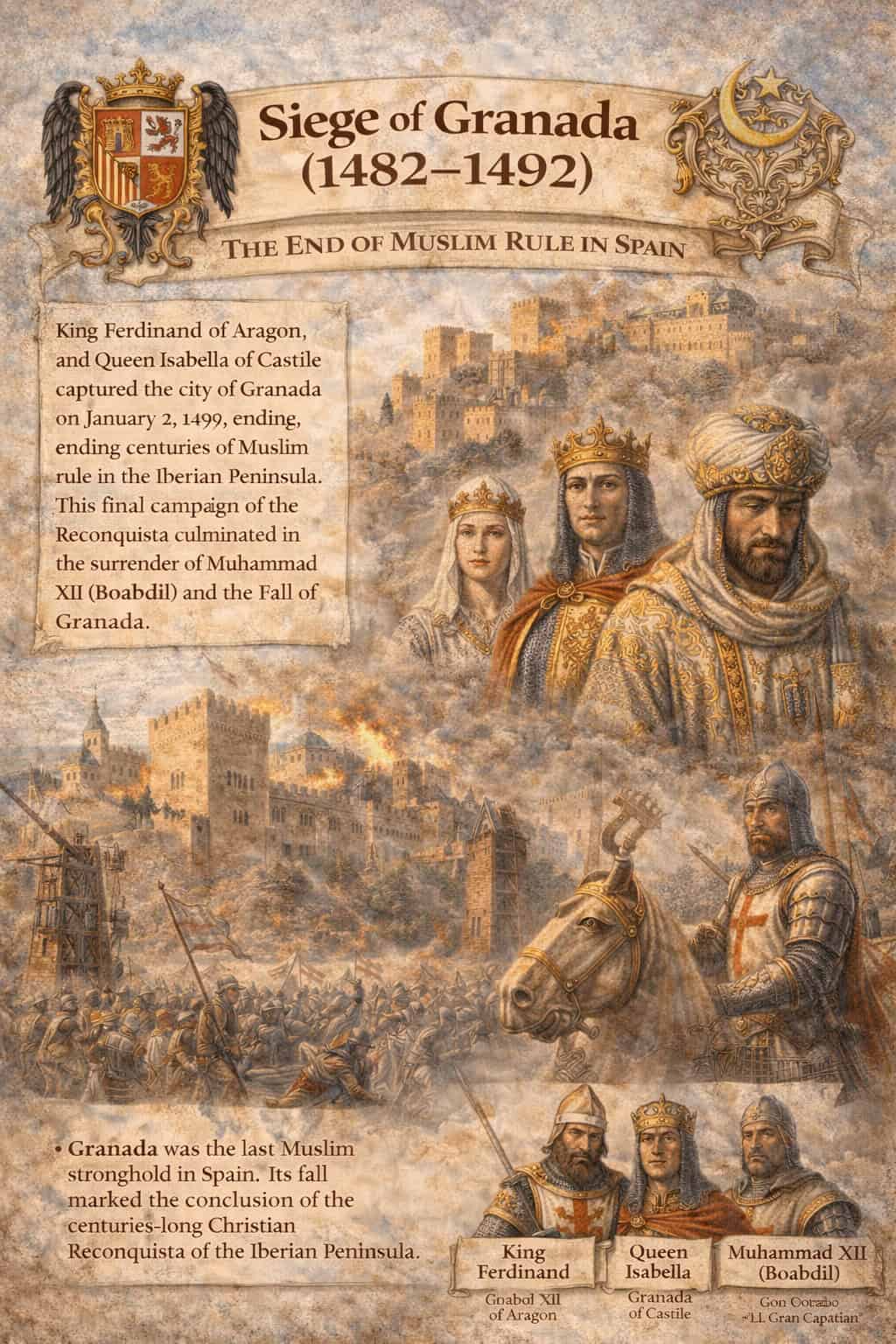
Siege of Granada (1482–1492): The End of Muslim Rule in Spain
The final and most famous siege of the Reconquista was the ten-year campaign against Granada, ending in 1492.
Rather than a single siege, Granada’s fall resulted from:
- Systematic isolation of surrounding cities
- Continuous pressure through fortresses and blockades
- Diplomatic negotiation alongside military force
On January 2, 1492, the Nasrid ruler Boabdil surrendered the city to Ferdinand and Isabella, ending nearly eight centuries of Muslim political rule in Iberia.
Granada’s fall coincided with:
- The unification of Spain
- The expulsion or forced conversion of religious minorities
- The beginning of Spanish overseas expansion
Why Sieges Defined the Reconquista
Across eight centuries, siege warfare shaped Iberian history more than any other military practice.
Sieges:
- Determined political boundaries
- Controlled trade and agriculture
- Reshaped population and religion
- Accelerated technological change in warfare
Unlike short campaigns elsewhere in medieval Europe, the Reconquista unfolded as a slow, methodical dismantling of fortified power.
Conclusion: The Legacy of Reconquista Sieges
The famous sieges of the Reconquista were not isolated military events—they were engines of historical transformation. Through Toledo, Lisbon, Valencia, Málaga, and Granada, medieval Spain was forged city by city.
These sieges explain:
- How Christian kingdoms expanded despite limited manpower
- Why urban centers became the focus of power
- How medieval warfare evolved toward early modern state control
The Reconquista ended in 1492, but its siege-driven legacy shaped Spain for centuries to come.
❓ Reconquista Sieges – Frequently Asked Questions
Why were sieges more important than battles in the Reconquista?
Medieval Iberia was dominated by fortified cities. Controlling these urban centers meant controlling land, trade, and population, making sieges more decisive than open-field battles.
Which siege marked a turning point in the Reconquista?
The capture of Toledo in 1085 is widely regarded as a turning point, as it opened central Iberia to Christian expansion and weakened Muslim political dominance.
Did Christian and Muslim forces ever negotiate during sieges?
Yes. Many cities surrendered through negotiated agreements that protected inhabitants, property, or religious practices, especially in earlier phases of the Reconquista.
Which siege ended Muslim rule in Spain?
The surrender of Granada in 1492 ended Muslim political rule in Iberia and completed the Reconquista.
🧠 Reconquista Sieges Quiz
📜 Glossary of Reconquista Terms
Reconquista
The centuries-long Christian reconquest of Muslim-ruled territories in Iberia (c. 711–1492).
Al-Andalus
The name given to Muslim-ruled territories in the Iberian Peninsula.
Taifa
Independent Muslim city-states that emerged after the collapse of centralized rule in al-Andalus.
Alcázar
A fortified palace or citadel, often serving as the military and administrative center of a city.
Mudéjar
Muslims who remained in Christian-controlled territories, often retaining their culture and crafts.
Capitulation
A negotiated surrender of a city, often including guarantees for inhabitants and property.